AI-first hospital software · India

Built for how Indian hospitals actually run

Close the gap between what your doctors prescribe and what your hospital delivers, keep every department ready for the NABH assessor, and run it on one patient record. Start with one product beside the HIS you already have.

  • Live at Mediversal Hospitals · DCDC Kidney Care · Apex Kidney Care
Mohammed Jamil Nasir

Founder – Product & Technology, Surgy Health · Last reviewed 25 November 2026

Short answer

Surgy Health is a Bengaluru company that builds AI-first software for Indian hospitals: SurgyOne (hospital information system and EHR), SurgyCRM (hospital CRM and care journeys), SurgyLearn (staff training and NABH evidence), SurgyScribe (AI medical scribe), SurgyInsights (analytics) and SurgySettle (claims). It is live at Mediversal Hospitals in Patna and across more than 520 locations of DCDC Kidney Care and Apex Kidney Care. Prices are published in INR, patient data is hosted in India on AWS Mumbai by default, and a hospital can start with one product beside its current HIS.

Key takeaways

  • Most revenue a hospital loses is care that was prescribed but never delivered there: the test not done, the admission not taken, the surgery estimate never followed up.
  • India's rules are moving fast: one-hour cashless decisions since 2024, NABH 6th Edition since January 2025, and most DPDP Act duties from 13 May 2027.
  • SurgyOne costs INR 6,250–8,750 per bed per year in graduated slabs; a 200-bed hospital pays INR 16,00,000 a year.
  • You do not have to replace your HIS to start.
4,000+
healthcare users across 500+ centres in India, Kuwait and Bahrain
520+
kidney-care locations training staff on SurgyLearn (DCDC Kidney Care and Apex Kidney Care)
15+
Indian states and union territories with live users
600+
patient calls a day handled on SurgyCRM at Mediversal Hospitals, Patna

Surgy Health data as of 24 November 2026.

Key facts
Company
Surgy Innovation Labs Private Limited, Bengaluru
Live in India
Mediversal Hospitals, Patna (SurgyCRM, SurgyLearn); DCDC Kidney Care (SurgyLearn, since July 2025); Apex Kidney Care (SurgyLearn, since August 2026)
Products
SurgyOne, SurgyCRM with SurgyField, SurgyLearn, SurgyScribe, SurgyInsights, SurgySettle, SurgyFrontdesk
Data hosting
AWS Mumbai (ap-south-1) by default; SurgyOne also on-premise
Data role
Your hospital is the data fiduciary under the DPDP Act; Surgy Health is your data processor
Standards
ABDM-integrated; HL7 v2 and FHIR R4; DICOM; ASTM; NHCX (SurgyOne, SurgySettle)
Languages
SurgyScribe: 89 languages including Hindi and English, notes in clinical English. SurgyInsights: questions in English or Hindi
Pricing
In INR, published on /pricing; GST extra
Surgy Health in India, as of 25 November 2026.

Where Indian hospitals lose revenue and time

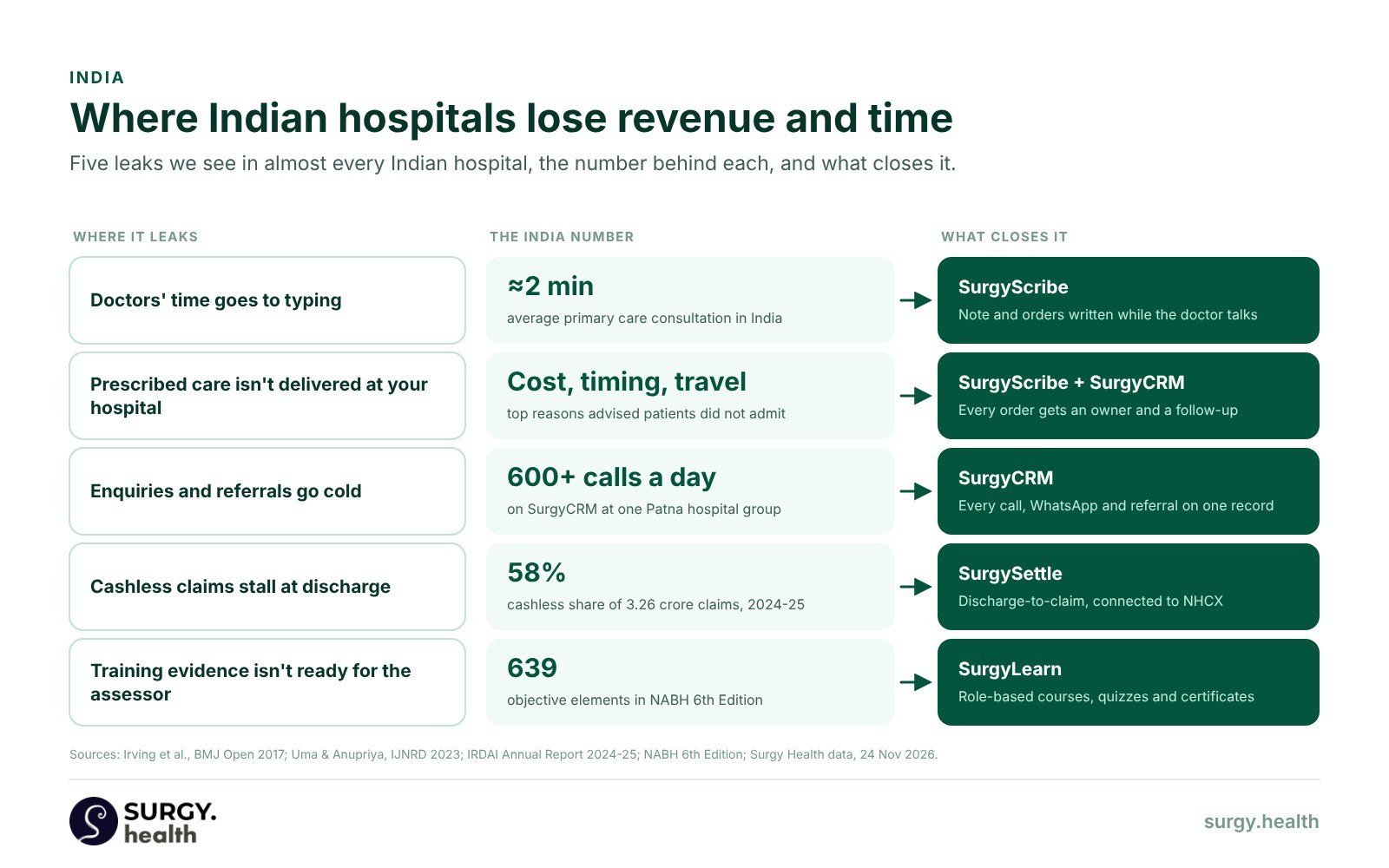
Five leaks show up in almost every Indian hospital we work with. Each has a number behind it, and each has a fix that does not need a new HIS.

Five places Indian hospitals lose revenue and time, the number behind each and the Surgy Health product that closes it: doctors' time goes to typing (about 2 minutes per primary care consultation; SurgyScribe), prescribed care not delivered at your hospital (cost, timing and travel; SurgyScribe and SurgyCRM), enquiries and referrals go cold (600+ calls a day at one Patna hospital group; SurgyCRM), cashless claims stall at discharge (58% of 3.26 crore claims cashless in 2024-25; SurgySettle) and training evidence not ready for the assessor (639 NABH objective elements; SurgyLearn).
Where it leaksWhat the data saysWhat closes it
Doctors' time goes to typingPrimary care consultations in India average about 2 minutes (Irving et al., BMJ Open 2017)SurgyScribe writes the note and captures every order while the doctor talks to the patient
Prescribed care is not delivered at your hospitalAdvised patients who did not admit most often cited cost, timing or travel (Uma & Anupriya, IJNRD 2023)SurgyScribe captures medicines, tests and admission or surgery advice; SurgyCRM gives each an owner and follows up until the bill shows it
Enquiries and referrals go coldMediversal Hospitals handles 600+ patient calls a day on SurgyCRM (Surgy Health data, 24 Nov 2026)SurgyCRM logs every call, WhatsApp and referral, and joins repeat enquiries to one lead
Cashless claims stall at discharge58% of 3.26 crore health claims settled in 2024-25 were cashless (IRDAI Annual Report 2024-25)SurgySettle runs discharge-to-claim for TPA, insurer and scheme claims, connected to NHCX
Training records are not ready for the assessorNABH 6th Edition has 639 objective elements and applies from 1 January 2025 (Surgy Health guide)SurgyLearn assigns courses by role, proctors quizzes and issues certificates, with records by person and department
Five common leaks in Indian hospitals and the Surgy Health product that closes each. Sources as linked; Surgy Health data as of 24 November 2026.

We never measure success by admitting more patients. 'Delivered' means the care the doctor prescribed was completed at your hospital.

Indian hospitals already running Surgy Health

SurgyCRM · SurgyLearn

Mediversal Hospitals, Patna

A three-hospital group in Bihar running enquiries, surgery counselling, maternity journeys, field referrals and staff training on Surgy Health.

600+
calls a day
200+
journey milestones a week
1,370
staff on SurgyLearn
322
certificates
Read the story →
SurgyLearn · since July 2025

DCDC Kidney Care

One training standard across a national dialysis network, assigned automatically from HR data.

2,819
staff
270+
locations in 15+ states
98.1%
of 51,181 assignments made by rules
1,082
certificates
Read the story →
SurgyLearn · since August 2026

Apex Kidney Care

Dialysis training in four languages across a fast-growing network.

250+
centres in 15 states and UTs
2,019
certificates in 30 days
87%
of staff active
Read the story →

Customer data as of 23–24 November 2026.

“They understand how Indian hospitals actually run. For a regional chain that wants one platform across the patient journey at a price that works, this has been a sensible choice. We would sign again.”
VivekAGM – CEO's OfficeCapterra

One patient record, seven products

Start with the product that closes your biggest leak. Each one works beside your current HIS, and every product you add shares the same patient record.

SurgyOne

AI-first HIS and EHR: OPD, IPD, emergency, lab, pharmacy and NHCX billing. First hospital go-live December 2026–January 2027.

Learn more

SurgyCRM

Every enquiry, call, WhatsApp, referral and care journey on one record, with SurgyField for your field team.

Learn more

SurgyLearn

Role-based training, AI-built courses, proctored quizzes and certificates your NABH assessor can check.

Learn more

SurgyScribe

Notes written while the doctor talks, in 89 languages including Hindi, with every order captured.

Learn more

SurgyInsights

Ask your hospital data a question in English or Hindi; 92 KPIs tagged to NABH and JCI.

Learn more

SurgySettle

Discharge-to-claim workflow for TPA, insurer and scheme claims, connected to NHCX.

Learn more

SurgyFrontdesk

A conversational AI agent for calls and bookings.

Learn more
Our view

Why AI-first, and why now

In most Indian hospitals the HIS runs registration and billing, while doctors keep writing on paper. The screens are slow and crowded, and a two-minute consultation leaves no time to type. That is why so much of what a doctor prescribes never reaches the system, and never reaches the bill.

AI-first software starts from the doctor's voice. SurgyScribe turns the consultation into a structured note and a list of orders, and SurgyCRM follows each order until it is done. The hospital gets complete records for NABH and ABDM without asking doctors to change how they consult.


What changes for Indian hospitals, and when

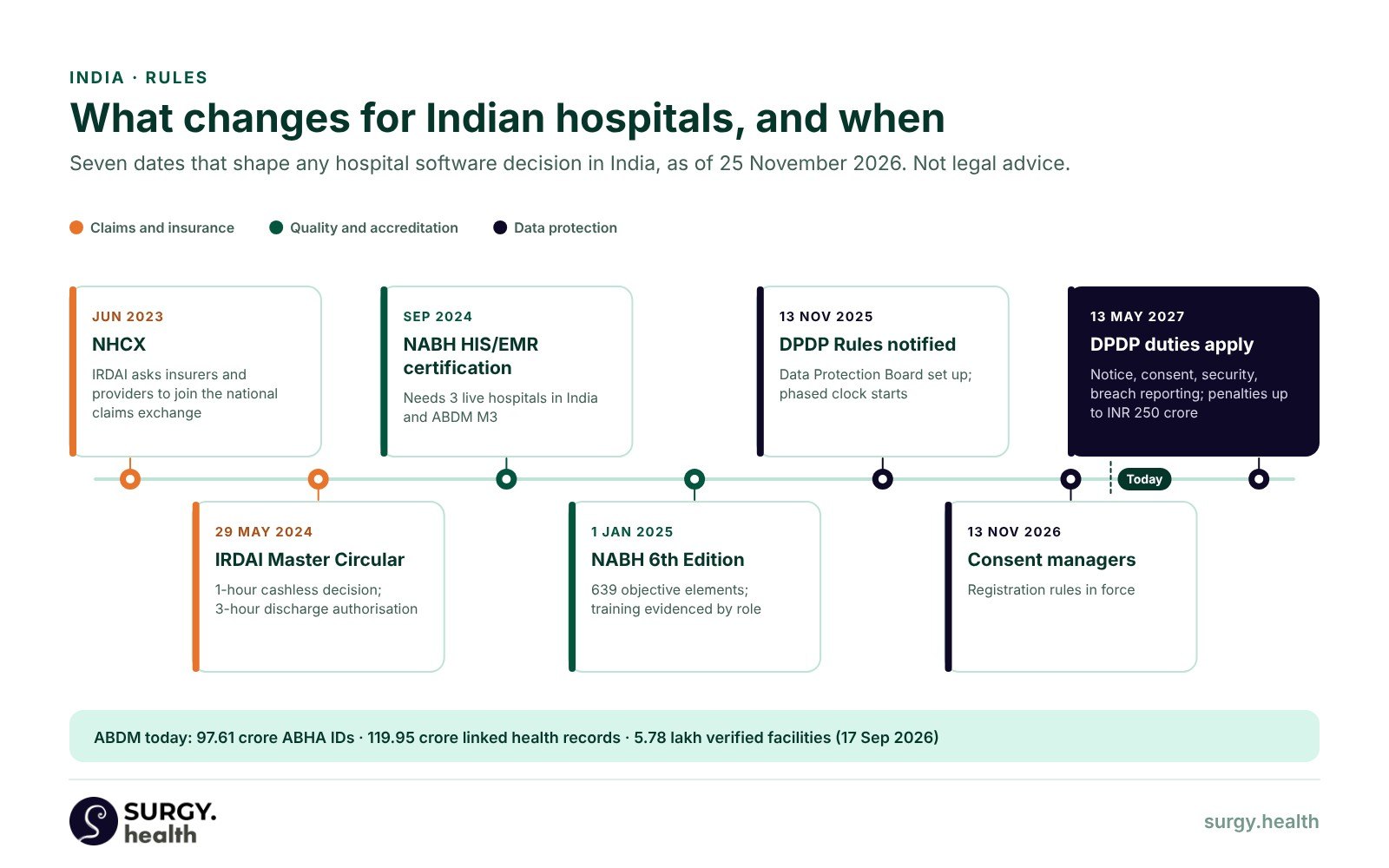
Five rule changes shape any hospital software decision in India in 2026–27. The dates below are the ones your vendor contract should already account for.

Timeline of rules that shape hospital software in India: NHCX advisory (June 2023), IRDAI Master Circular with one-hour cashless decisions (29 May 2024), NABH HIS/EMR certification (September 2024), NABH 6th Edition (1 January 2025), DPDP Rules notified (13 November 2025), consent manager rules (13 November 2026) and most DPDP duties applying (13 May 2027), with ABDM figures as of 17 September 2026.
DateRuleWhat it means for your software
Jun 2023IRDAI advises all insurers and providers to onboard the National Health Claims Exchange (NHCX)Claims, pre-authorisation and queries move to one FHIR-based exchange instead of one portal per insurer
29 May 2024IRDAI Master Circular on health insurance (IRDAI/HLT/CIR/PRO/84/5/2024)Insurers decide on cashless requests within one hour and authorise discharge within three; extra charges from a longer wait are paid by the insurer, and insurers collect documents from the hospital directly
Sep 2024NABH Digital Health Standards for HIS/EMR Systems, 1st EditionSoftware can be NABH-certified at Basic or Advanced level; a product needs three live hospital deployments in India and an ABDM M3 certificate to apply
1 Jan 2025NABH 6th Edition applies10 chapters, 100 standards, 639 objective elements; staff training must be evidenced by person and role
13 Nov 2025DPDP Rules, 2025 notifiedThe Data Protection Board is set up; the clock starts on the phased rules
13 Nov 2026DPDP consent manager rules in forceConsent managers register with the Board
13 May 2027Most DPDP duties applyNotice, consent, security safeguards, breach reporting, retention and patient rights; penalties up to INR 250 crore
Rules that shape hospital software in India, as of 25 November 2026. A summary, not legal advice.

Two things are not mandatory yet. Hospitals are not legally required to file claims through NHCX, although a Parliamentary Standing Committee recommended in August 2026 that insurers, TPAs and providers be required to join. And no rule requires your HIS to hold NABH software certification; it is a quality signal you can ask for.

India's digital health network, in numbers

97.61 crore ABHA health IDs, 119.95 crore linked health records and 5.78 lakh verified health facilities on ABDM (17 September 2026). PM-JAY has funded 13.25 crore hospital admissions worth INR 2.03 lakh crore across 38,000+ empanelled hospitals (31 August 2026). Source: PIB, 22 September 2026

The cashless clock your billing desk works to

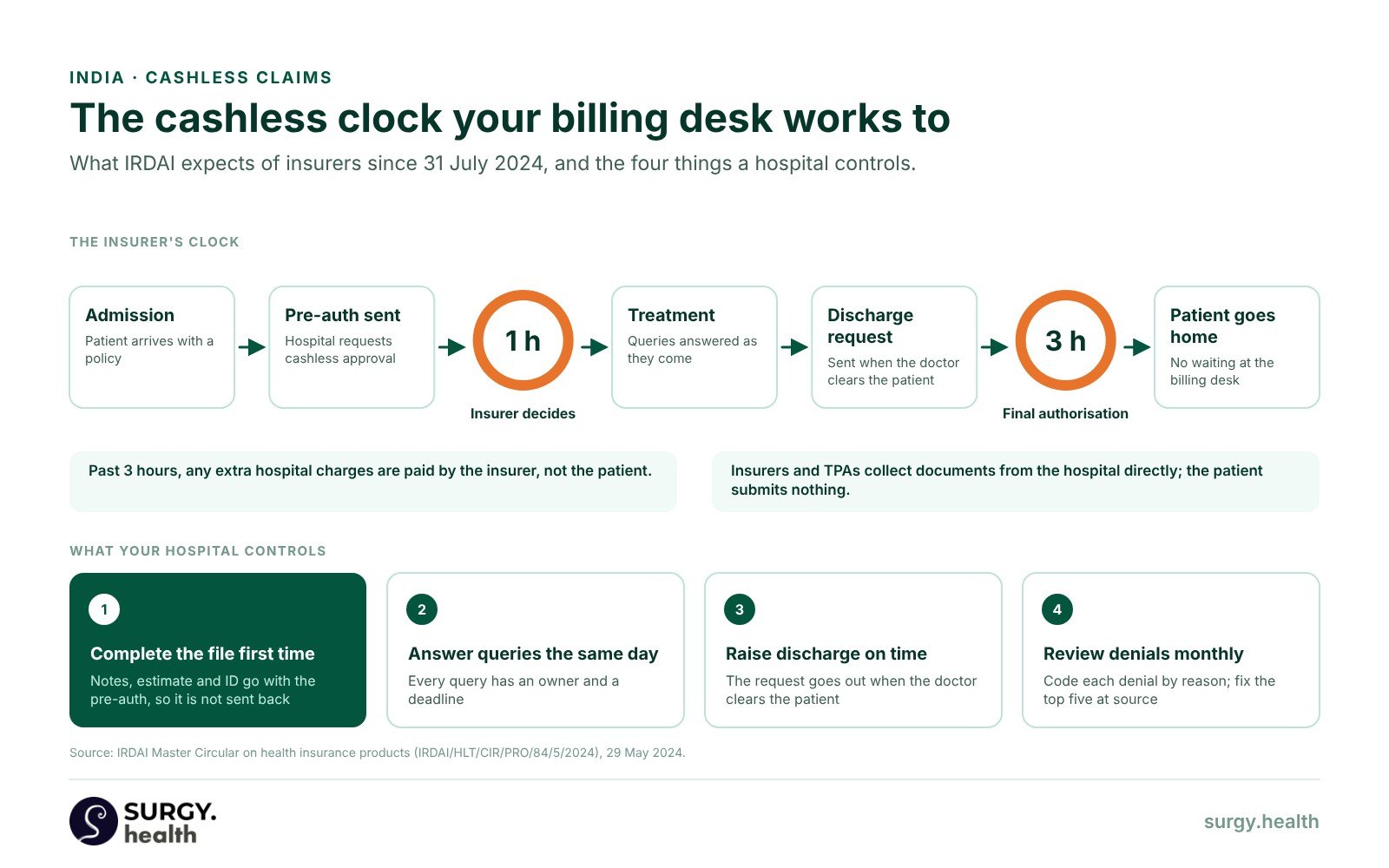
Since 31 July 2024, insurers have had one hour to decide on a cashless request and three hours to authorise discharge. Insurers report that many claims still arrive incomplete or inaccurate (NATHEALTH), so the delay a hospital controls is its own files and replies.

The cashless claim clock since 31 July 2024: admission, pre-authorisation sent, insurer decides within 1 hour, treatment, discharge request, final authorisation within 3 hours, patient goes home. The four things a hospital controls: complete the file first time, answer queries the same day, raise discharge on time, review denials monthly.
  1. Step 1

    Complete the file first time

    Pre-authorisation goes with the clinical notes, estimates and ID documents the payer needs, so it is not sent back.

  2. Step 2

    Answer every query the same day

    Each query has an owner and a deadline, tracked to closure.

  3. Step 3

    Raise discharge on time

    The discharge request goes out as soon as the doctor clears the patient, not at the end of the shift.

  4. Step 4

    Review denials every month

    Code each denial by reason and fix the top five at source.

Where your patients' data lives

Patient data is hosted on AWS in Mumbai (ap-south-1) by default, and SurgyOne can also run on-premise. Your hospital stays the data fiduciary under the DPDP Act; Surgy Health processes data only on your instructions, and every product has a Privacy Center for your admins. SurgyOne encrypts data in transit (TLS 1.2+) and at rest, keeps audit logs for 400 days and has a recovery point of five minutes or less.

Prices in INR

Prices are published so you can budget before the first call. GST is extra.

ProductPriceExample
SurgyOnePer bed per year, graduated: INR 8,750 (beds 1–100), 7,250 (101–300), 6,750 (301–500), 6,250 (501–1,000); minimum 50 beds. One-time implementation INR 1,500–2,500 per bed, minimum INR 1,50,000200 beds: INR 16,00,000 a year; INR 21,00,000 in year one with implementation
SurgyCRMINR 20,000 per user per year (20+ users), every module included; setup INR 1,00,000–3,50,00025 users: INR 5,00,000 a year plus setup
SurgyFieldINR 500 per field user per year10 field staff: INR 5,000 a year
SurgyScribeINR 25,000 per doctor per year below 10 doctors, falling to INR 15,000 at 100+Quote for 10–99 doctors
SurgyLearnINR 500–800 per employee per year, by number of employees—
SurgySettle, SurgyInsights, SurgyFrontdeskQuoted after scoping—
List prices in India as of 25 November 2026, before GST. SurgyOne rates are fixed for Years 1–2 and rise 5% a year from Year 3, on a 3-year minimum term.

Eight questions to ask any hospital software vendor in India

Ask every vendor the same eight questions, in writing. These are our answers.

QuestionWhy it mattersSurgy Health's answer
Is the HIS/EMR NABH-certified, at which level, and until when?Certification lasts two years and needs three live hospitals plus ABDM M3SurgyOne's first hospitals go live December 2026–January 2027; we apply once three are live
Which ABDM milestones (M1, M2, M3) is the product certified for?Decides whether you can create ABHA, share records and pull recordsABDM-integrated; certificates shared on request
Can it send pre-authorisations and claims through NHCX?One exchange instead of one portal per insurerYes, in SurgyOne billing and SurgySettle
Where is patient data hosted, and who can see it?DPDP duties sit with your hospital as data fiduciaryAWS Mumbai by default; role- and branch-scoped access; audit logs for 400 days
Will doctors actually use it?An HIS used only at the billing counter misses most clinical ordersDoctors speak; SurgyScribe writes the note and the orders
Do we have to replace our current HIS?Replacement is the costliest and riskiest stepNo. SurgyCRM, SurgyScribe and SurgyLearn run beside it
What is the price in writing, and what will it be in Year 3?Hidden escalations and per-module add-onsPublished in INR; SurgyOne fixed for Years 1–2, then +5% a year
How do we get our data back if we leave?Lock-in is the hidden costExport and deletion happen only on your instruction, on terms written into the contract
Vendor questions for Indian hospitals, with Surgy Health's answers as of 25 November 2026.

How Indian hospitals start with Surgy Health

  1. Step 1

    Pick the leak

    Choose the one problem that costs you most: unfollowed orders, cold enquiries, training evidence or claims.

  2. Step 2

    Run one product beside your HIS

    SurgyCRM connects to your HIS or takes a daily CSV until the integration is live. SurgyLearn syncs staff from your HR system.

  3. Step 3

    Measure it on your own numbers

    Agree the baseline before go-live: orders completed, enquiries converted, courses completed or claims queried.

  4. Step 4

    Add the next product on the same record

    Each product you add shares the patient record, so nothing is entered twice.

FAQ

Surgy Health in India: questions

Is Surgy Health an Indian company?

Yes. Surgy Health is the brand of Surgy Innovation Labs Private Limited, based at 91 Springboard, Bannerghatta Road, J. P. Nagar, Bengaluru 560078. We build AI-first software for hospitals in India and the GCC.

Which Indian hospitals use Surgy Health?

Mediversal Hospitals in Patna runs SurgyCRM and SurgyLearn. DCDC Kidney Care has trained staff across 270+ locations on SurgyLearn since July 2025, and Apex Kidney Care across 250+ centres since August 2026.

Is patient data stored in India?

Yes, by default. Surgy Health hosts data on AWS in Mumbai (ap-south-1), and SurgyOne can also run on-premise. Your hospital remains the data fiduciary under the DPDP Act, and Surgy Health is its data processor.

Is Surgy Health software ABDM-compliant?

Surgy Health products are ABDM-integrated and use HL7 v2 and FHIR R4. Ask us for the ABDM certificates that apply to the products you are buying.

Does Surgy Health work with NHCX and TPAs?

SurgyOne billing and SurgySettle connect to the National Health Claims Exchange (NHCX) for insurer and TPA claims. SurgySettle also covers government scheme claims.

How much does hospital software cost in India?

SurgyOne costs INR 6,250–8,750 per bed per year in graduated slabs, so a 200-bed hospital pays INR 16,00,000 a year plus a one-time implementation. SurgyCRM costs INR 20,000 per user per year, SurgyScribe INR 15,000–25,000 per doctor per year, and SurgyLearn INR 500–800 per employee per year. GST is extra.

Do we need to replace our current HIS?

No. SurgyCRM, SurgyScribe and SurgyLearn run beside your current HIS. SurgyCRM connects to it, or takes a daily CSV until the integration is live, and a typical SurgyCRM rollout takes 4–6 weeks.

Is SurgyOne NABH-certified?

Not yet. NABH certifies HIS and EMR products that have three live hospital deployments in India and an ABDM M3 certificate. SurgyOne's first hospitals go live in December 2026–January 2027, and we will apply once three are live.

When do hospitals have to comply with the DPDP Act?

The DPDP Rules were notified on 13 November 2025. Consent manager rules apply from 13 November 2026, and most duties for hospitals, including notice, consent, security safeguards and breach reporting, apply from 13 May 2027. This is not legal advice.

Which languages does Surgy Health support in India?

SurgyScribe understands 89 languages, including Hindi and English, and writes notes in clinical English. SurgyInsights answers questions in English or Hindi, and SurgyLearn courses can be published in several languages; Apex Kidney Care trains in four.

Sources

  1. Irving G et al. International variations in primary care physician consultation time: a systematic review of 67 countries. BMJ Open 2017
  2. Uma & Anupriya. OPD to IPD conversion study, IJNRD, April 2023
  3. IRDAI Annual Report 2024-25, section I.6.5
  4. Deloitte India: IRDAI Master Circular on health insurance products, 29 May 2024
  5. PIB: NHA and IRDAI accelerator workshops on NHCX, 14 November 2023
  6. Lok Sabha reply on NHCX, 26 July 2024
  7. PIB: Parliamentary Standing Committee reports 175–177, 7 August 2026
  8. NABH Digital Health Standards Certification Programme for HIS/EMR Systems
  9. Bar & Bench: MeitY notifies the DPDP Rules, 2025
  10. Hogan Lovells: India's DPDP Act brought into force
  11. PIB: Progressing towards universal health coverage (PM-JAY and ABDM figures), 22 September 2026
  12. NATHEALTH: National Health Claims Exchange paper, 2025
  13. Surgy Health: NABH 6th Edition standards guide
  14. Surgy Health: DPDP Act for hospitals