OPD revenue leakage: conversion benchmarks and how to fix them

Founder – Product & Technology, Surgy Health · Last reviewed 25 November 2026
Calculate your hospital's leakage →
Short answer
OPD revenue leakage is the revenue a hospital loses when patients it has already seen don't complete what the doctor advised: medicines bought outside, tests skipped or done elsewhere, admissions not taken and follow-ups missed. Indian hospitals typically convert 10–15% of OPD patients to admission. Most leakage happens because the advice is never captured as a structured order and nobody owns the follow-up.
Key takeaways
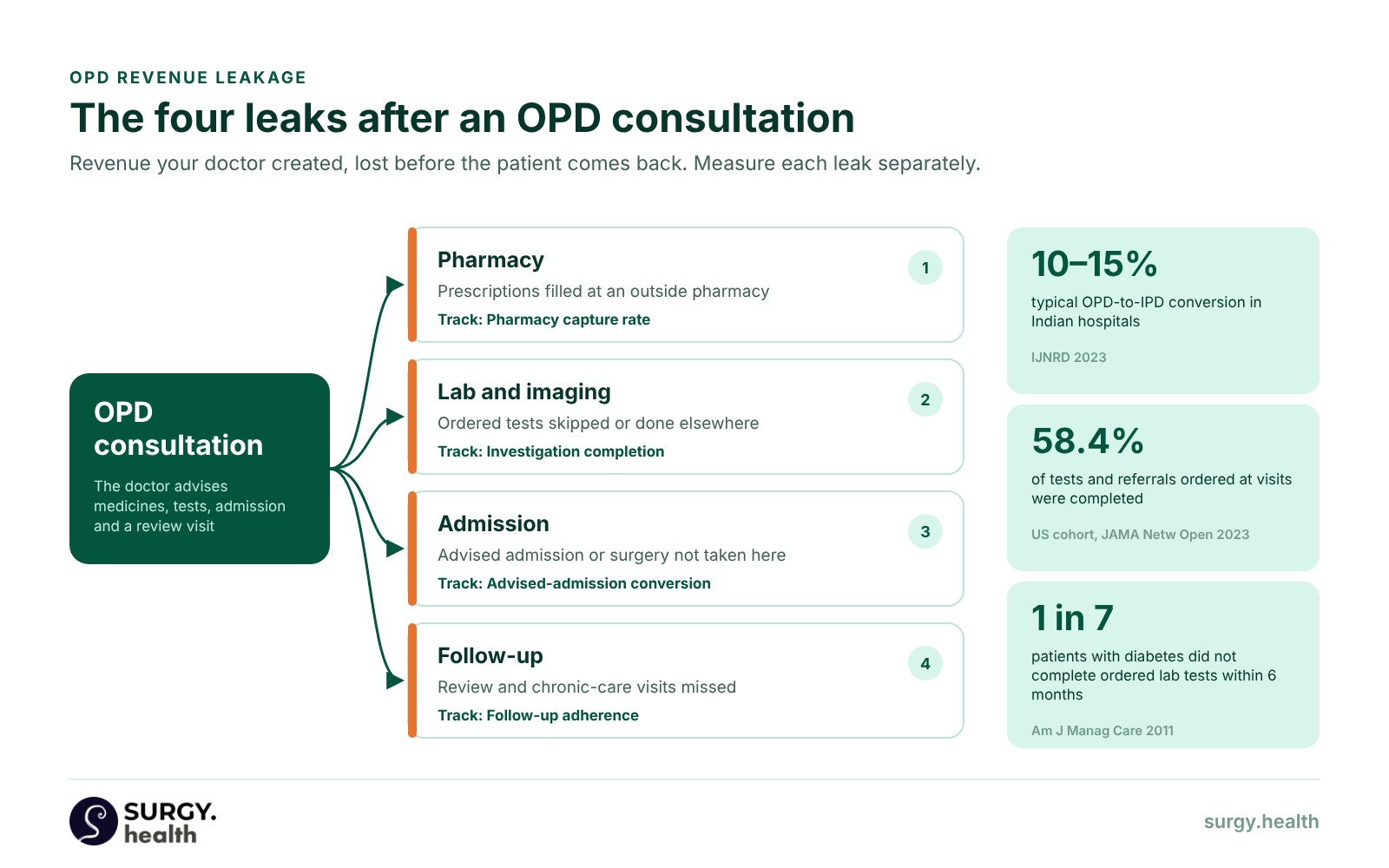
- There are four leaks after every consultation: pharmacy, lab and imaging, admission, and follow-up. Measure each one separately.
- The published benchmark for OPD-to-IPD conversion in Indian hospitals is 10–15%. Track 'advised admissions that converted' as well; it is the number you can act on.
- Patients rarely leave because of a better doctor elsewhere. Forgetting, cost and nobody calling back are the common reasons.
- The fix is a loop: capture each order at the consultation, give it an owner, nudge the patient, and verify completion against the bill.
- Start with one number. For most hospitals, advised-admission conversion moves revenue the most.
What is OPD revenue leakage?
Every OPD consultation creates follow-on work: a prescription, a test, sometimes an admission or a surgery, and usually a review visit. When the patient completes that work at your hospital, it shows up as pharmacy, lab and IPD revenue. When they don't, or complete it somewhere else, that revenue leaks, even though your doctor did the hard part.
Leakage is different from billing loss inside the hospital (missed charges, claim rejections). This page covers the revenue lost after the consultation, before the patient comes back.
The four leaks after the consultation
| Leak | What happens | Metric to track | Published signal | Source |
|---|---|---|---|---|
| Admission | Advised admission or surgery is not taken, or taken elsewhere | OPD-to-IPD conversion; advised-admission conversion | 10–15% OPD-to-IPD conversion is typical in Indian hospitals; "roughly 10–12 per cent for the industry" | IJNRD 2023; Business Standard 2020 |
| Lab and imaging | Ordered tests are not done, or done outside | Investigation completion (in-house) | 58.4% of tests and referrals ordered at in-person visits were completed in a US cohort of 4,133 orders; 1 in 7 patients with diabetes did not complete ordered lab tests within 6 months | JAMA Netw Open 2023; Am J Manag Care 2011 |
| Pharmacy | Prescriptions are filled at a pharmacy outside | Pharmacy capture rate | No reliable public benchmark; measure your own weekly | — |
| Follow-up | Review visits and chronic-care check-ups are missed | Follow-up adherence | Forgetting is the main reason patients give for not completing ordered tests | J Gen Intern Med 2013 |
How to calculate each metric
1. OPD-to-IPD conversion rate
OPD-to-IPD conversion (%) = admissions from OPD patients ÷ OPD consultations × 100
Count admissions that came from an OPD visit in the same period. Exclude direct emergency admissions.
2. Advised-admission conversion
Advised-admission conversion (%) = admissions taken ÷ admissions advised × 100
The actionable version: of the patients a doctor advised to admit, how many did. It needs the advice recorded at the consultation.
3. Pharmacy capture rate
Pharmacy capture (%) = prescriptions filled in-house ÷ prescriptions written × 100
Track by value as well as count; one expensive prescription filled outside costs more than several cheap ones.
4. Investigation completion (in-house)
Investigation completion (%) = tests done in-house ÷ tests ordered × 100
Split lab and imaging; their causes differ.
5. Follow-up adherence
Follow-up adherence (%) = review visits completed on time ÷ review visits advised × 100
'On time' means within the window the doctor set, for example 7 days.
6. Revenue at risk, per leak
Revenue at risk = volume advised × (1 − capture rate) × average value
Apply it to each of the four leaks and add them up.
A worked example
A hospital with 300 OPD consultations a day, 26 working days a month. All inputs are illustrative; replace them with your own in the calculator.
| Leak | Volume advised a month | Captured | Average value | Revenue at risk a month |
|---|---|---|---|---|
| Pharmacy | 5,460 prescriptions (70% of 7,800 consults) | 55% | ₹600 | ₹14,74,200 |
| Lab and imaging | 3,120 tests (40%) | 60% | ₹1,200 | ₹14,97,600 |
| Admission | 1,170 admissions advised (15%) | 70% (10.5% overall conversion) | ₹40,000 | ₹1,40,40,000 |
| Follow-up | 3,900 review visits (50%) | 55% | ₹500 | ₹8,77,500 |
| Total | ₹1,78,89,300 a month (about ₹21.5 crore a year) |
Admissions dominate the total, which is why advised-admission conversion is usually the first number to work on. Not every leaked admission is recoverable; some patients choose another hospital for good reasons. Recovering a fifth of the gap is a realistic first target.
Why patients leak
When researchers asked 245 patients at a Bangalore hospital why they did not take the admission their doctor advised, the main reasons were preferring medical management, choosing other treatment, postponing surgery or worrying about its cost, planning admission for the next month, and being out of station.
Advice not captured
Handwritten or free-text prescriptions mean nobody has a list of what was advised.
No owner
Follow-up belongs to everyone, so it belongs to no one.
Cost unclear
Patients advised surgery leave without an estimate they can plan around.
Stock-outs and waits
A missing drug or a long lab queue sends the patient across the road.
No reminder
Forgetting is the most common reason patients give for not completing tests.
No measurement
If conversion is not measured by doctor and department, nobody can fix it.
How to fix it: close the loop
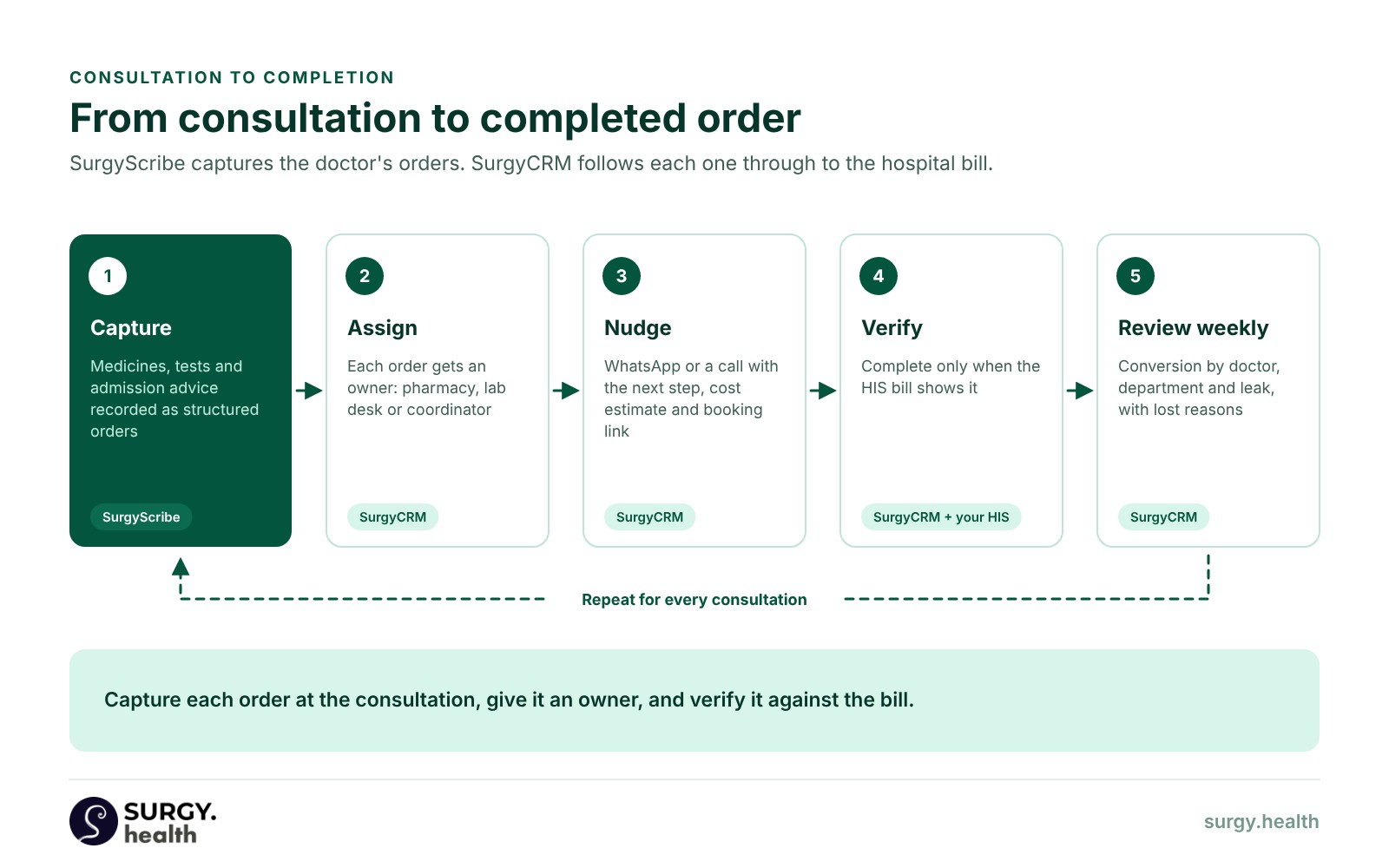
- Step 1
Capture each order at the consultation
Medicines, tests and admission or surgery advice recorded as structured items, not free text.
- Step 2
Give every order an owner
Pharmacy, lab desk or patient coordinator, with a response target.
- Step 3
Nudge the patient
WhatsApp or a call with the next step, the cost estimate and a booking link.
- Step 4
Verify against the bill
An order is complete only when the HIS bill shows it.
- Step 5
Review weekly
Conversion by doctor, department and leak, with the top lost reasons.
What to review every week
| Metric | Owner | Good direction | Review |
|---|---|---|---|
| Advised-admission conversion | Admissions coordinator, medical director | Up | Weekly, by doctor |
| OPD-to-IPD conversion | Medical director | Up | Weekly |
| Pharmacy capture (count and value) | Pharmacy head | Up | Weekly, by doctor |
| Investigation completion (in-house) | Lab and radiology heads | Up | Weekly |
| Follow-up adherence | Patient coordinator | Up | Weekly, by specialty |
| Top lost reasons | Coordinator team | Fewer "no contact" | Weekly |
Leakage after discharge: care journeys
Leakage does not stop at the OPD. Maternity patients, children due for vaccinations and people with diabetes need months of scheduled visits. Each missed visit is lost care and lost revenue.
Where Surgy Health fits (and where it doesn't)
SurgyScribe captures medicines, tests and admission or surgery advice at the consultation as structured items. SurgyCRM turns each one into a task or lead with an owner, nudges the patient on WhatsApp or by phone, and checks completion against the HIS bill. SurgyInsights tracks the weekly metrics among its 92 KPIs. You keep your current HIS. If your doctors already record structured orders in your HIS and your team has a working follow-up process, you may only need better reporting, not new software.
“They understand how Indian hospitals actually run. For a regional chain that wants one platform across the patient journey at a price that works, this has been a sensible choice. We would sign again.”