DPDP consent form template for hospitals

Founder – Product & Technology, Surgy Health · Last reviewed 25 November 2026
Short answer
Under India's DPDP Act, a hospital must give patients a clear notice and take consent that is specific to each purpose, with a way to withdraw it as easily as it was given. This free template separates the notice from the consent, asks for consent purpose by purpose, covers guardians of children and persons with disability, and includes a withdrawal form. Most DPDP obligations apply from 13 May 2027. Have your counsel review it before use.
Key takeaways
- Keep the notice separate from other terms, in plain language, and in English or another language listed in the Eighth Schedule.
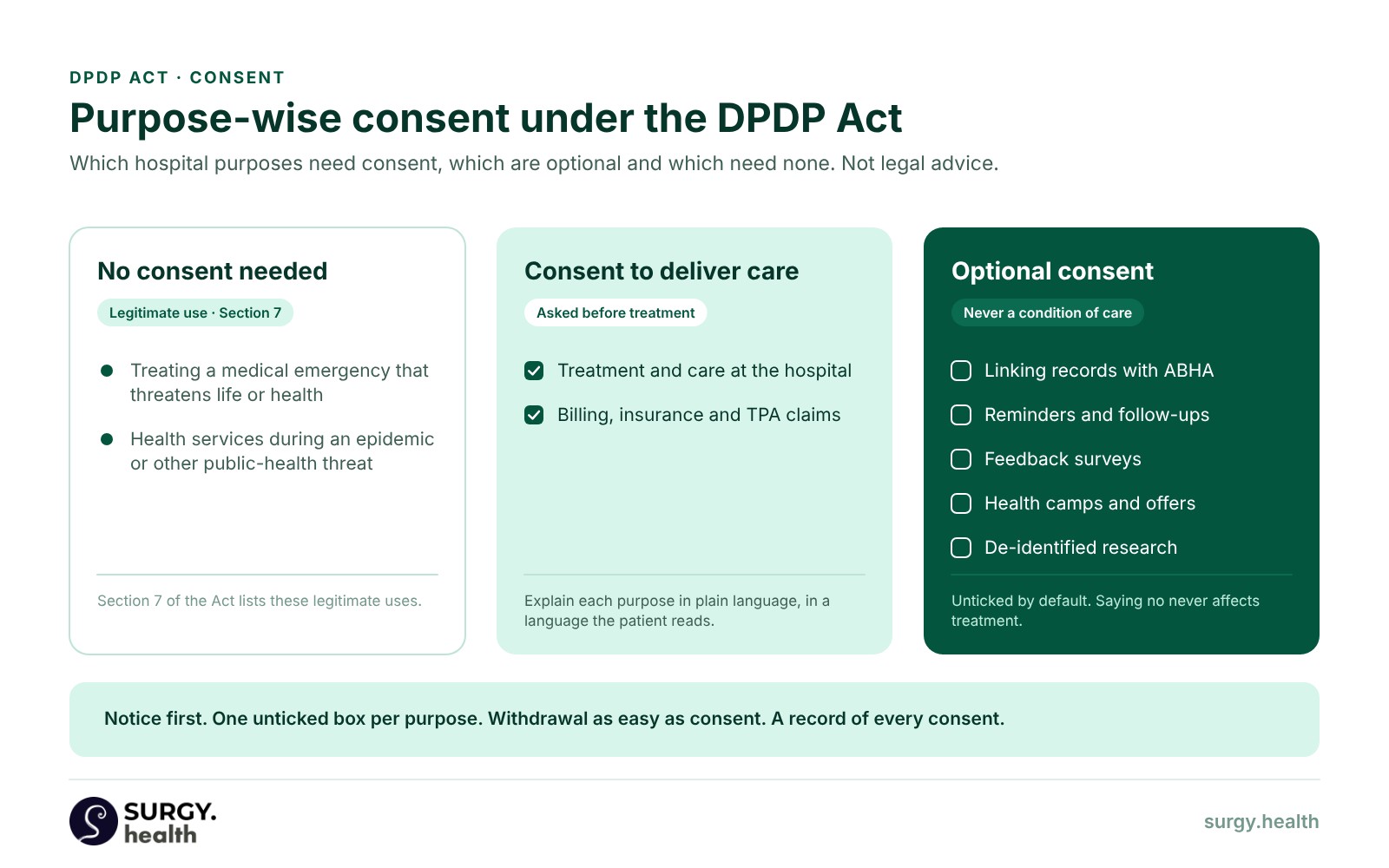
- Ask for consent purpose by purpose. Optional purposes (reminders, marketing, research) must never be a condition of treatment.
- Medical emergencies are a 'legitimate use' under Section 7; you do not need consent to treat a patient whose life is at risk.
- Withdrawal must be as easy as giving consent; tell patients how.
- Record every consent: who, which purposes, which notice version, when and how.
What the DPDP Act asks of a hospital consent
| Requirement | Where in the law | What it means on the form |
|---|---|---|
| Notice before or with the consent request | Section 5; DPDP Rules 2025 | A separate, itemised notice: what data, for which purposes, how to withdraw, how to complain |
| Consent that is free, specific, informed, unconditional and unambiguous | Section 6(1) | One checkbox per purpose, unticked by default |
| Withdrawal as easy as giving consent | Section 6(4) | A named channel: link, email or front desk |
| Legitimate uses without consent | Section 7 | Medical emergencies and public-health measures don't need consent |
| Guardian consent for children and persons with disability | Section 9 | A section for the parent or lawful guardian |
| Rights of the patient | Sections 11–14 | Access, correction, erasure, grievance and nomination explained |
The template
Patient privacy notice and consent (template)
Part A · Privacy notice
Who we are. [Hospital legal name], [address]. For any question about your personal data, contact [name or role], [email], [phone].
What personal data we collect. Your name, age, sex, address and phone number; your health information, including history, examinations, test results, images and prescriptions; insurance and payment details; your ABHA number if you choose to share it; and an emergency contact.
Why we use it.
Purpose Data used Basis Your treatment and care at this hospital Identity, contact, health Your consent Treating you in a medical emergency Identity, health Legitimate use under the DPDP Act (no consent needed) Billing, insurance and TPA claims Identity, health, insurance, payment Your consent Linking your records with your ABHA (ABDM) Identity, ABHA number, health Your consent optional Appointment reminders and follow-up messages by WhatsApp, SMS or call Contact, appointment details Your consent optional Feedback surveys about your care Contact Your consent optional Health camps, offers and newsletters Contact Your consent optional Research using data that does not identify you De-identified health data Your consent optional How long we keep it. We keep medical records for [retention period required by applicable law and our policy], and other data only as long as needed for the purposes above.
Your rights. You can ask for a summary of your personal data and who we shared it with, ask us to correct, complete or update it, ask us to erase data we no longer need to keep by law, raise a grievance with us, and nominate a person to exercise these rights if you cannot.
How to withdraw consent. You can withdraw any consent at any time, as easily as you gave it: [link], [email] or at the front desk. Withdrawal does not affect processing done before it. Withdrawing consent for an optional purpose will not affect your treatment.
Complaints. Contact us first at [email]. If you are not satisfied, you may complain to the Data Protection Board of India.
Language. This notice is available in English and [languages].
Part B · Consent by purpose
Each line is a separate checkbox, unticked.
- I consent to [Hospital name] using my personal data for my treatment and care. (Required to provide care, except in an emergency.)
- I consent to my data being used for billing and for insurance or TPA claims I choose to make.
- I consent to linking my records with my ABHA. (Optional)
- I consent to appointment reminders and follow-up messages by WhatsApp, SMS or call. (Optional)
- I consent to being contacted for feedback about my care. (Optional)
- I consent to receiving information about health camps, offers and newsletters. (Optional)
- I consent to my de-identified data being used for research. (Optional)
Saying no to any optional purpose will not affect your treatment.
Part C · Parent or lawful guardian
For a patient under 18, or a person with disability who has a lawful guardian.
Part D · Signature
Part E · Withdrawal of consent
Square-bracket fields are for your hospital to fill in. A practitioner starting point, not legal advice.
How to use the template
Adapt it with your counsel
Fill in the bracketed fields and check each purpose against what your hospital actually does.
Translate the notice
Offer it in the languages your patients read.
Present notice and consent together, but separately
The notice on its own page or screen; consent boxes after it.
Record every consent
Patient, purposes ticked, notice version, date, time, channel and staff member.
Make withdrawal easy
A link or desk process that works as fast as giving consent, and a way to stop each purpose.
Train the front desk
Staff should explain purposes in one sentence each and never pre-tick boxes.
This template is a practitioner starting point, not legal advice. The DPDP Rules 2025 and future guidance from the Data Protection Board may require changes. Most obligations apply from 13 May 2027.