

SurgyInsights: Ask Your Data
Upload a CSV. Ask in any language. Get dashboards, NABH/JCI KPIs, anomaly alerts and root-cause analysis — live in under an hour.

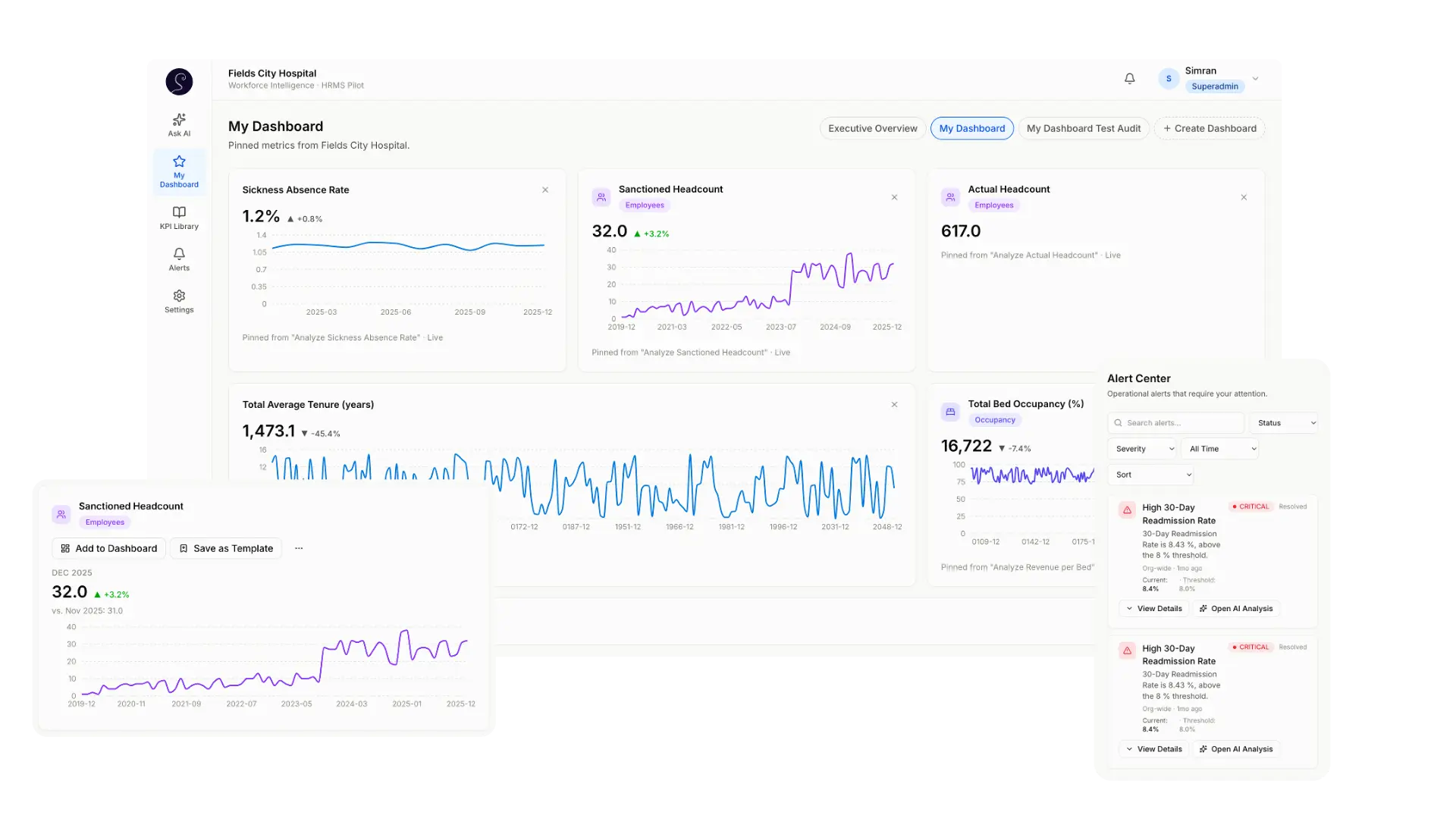
Monthly MIS is already 30 days stale
Leadership reviews last month's numbers in this month's meeting — long after the leak happened.
Data trapped in HIS, EHR & 12 Excel sheets
Every number lives somewhere different. The one number leadership trusts doesn't exist.
No early warning on bed / OT / claim risk
Bed crunches and revenue dips surface only after patients or finance teams complain.
NABH & JCI KPIs computed only at audit time
Quality is something teams scramble for once a year instead of running on every day.
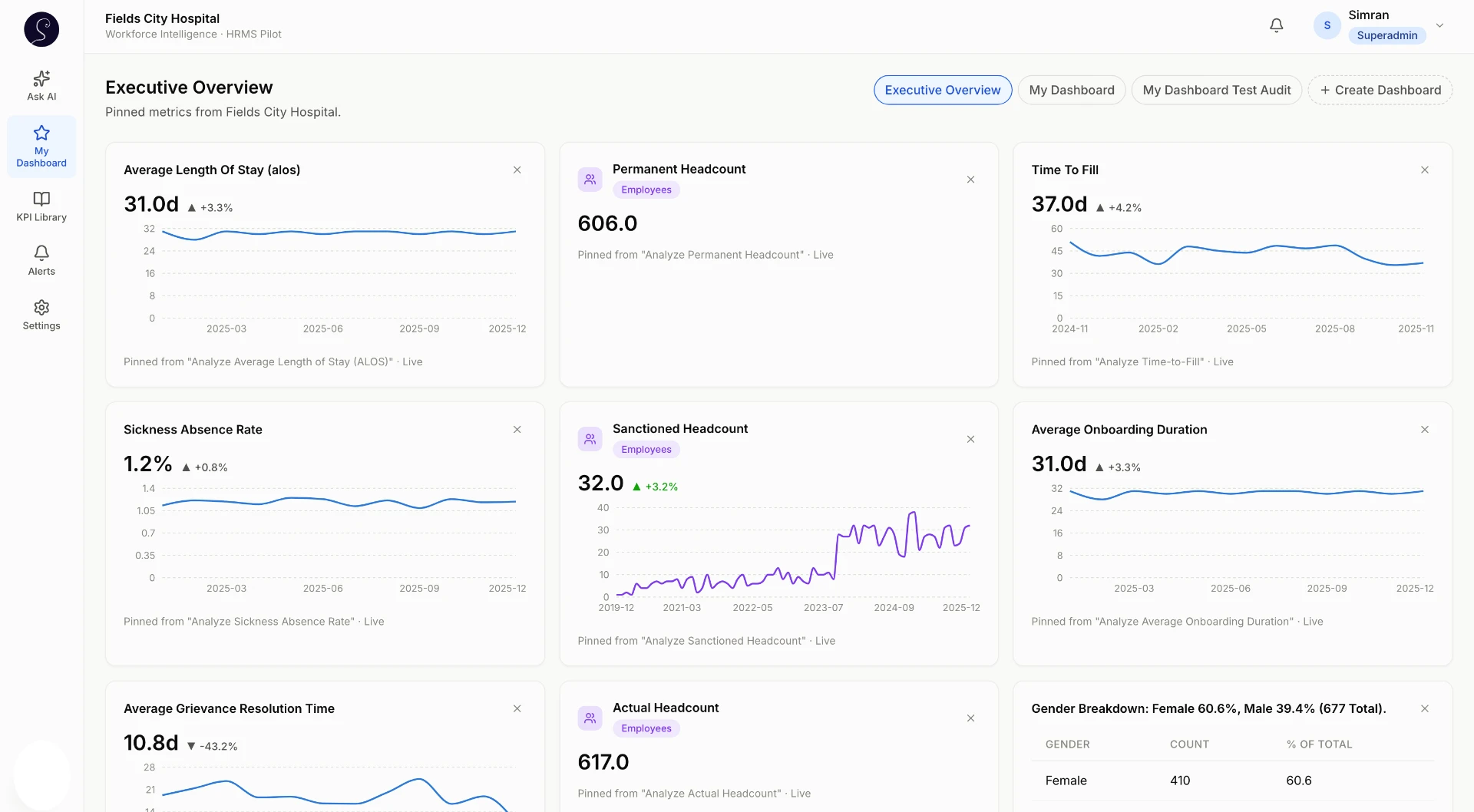
Live with your first dashboard the same afternoon
Drag in a CSV or Excel export from any department — payroll, theatre logs, quality registers, recruitment trackers. SurgyInsights classifies each file, maps it to a Universal Clinical Data Model, and works out how your files relate to one another before you ask a single question. No EHR project, no IT ticket, no schema sign-off.
Drag-Drop CSV / Excel
Multiple files at once, straight from your HIS, HRMS or ERP export.
Automatic Domain Classification
Every upload is scored and routed to Workforce, Operational, Clinical, Financial or Patient Experience.
Cross-File Relationship Discovery
Finds the real joins between your files and measures how well they actually match, so one question can safely span several datasets.
UCDM Mapping + Drift Watch
AI-suggested field mappings with a confidence score, and schema drift flagged when next month's export changes shape.
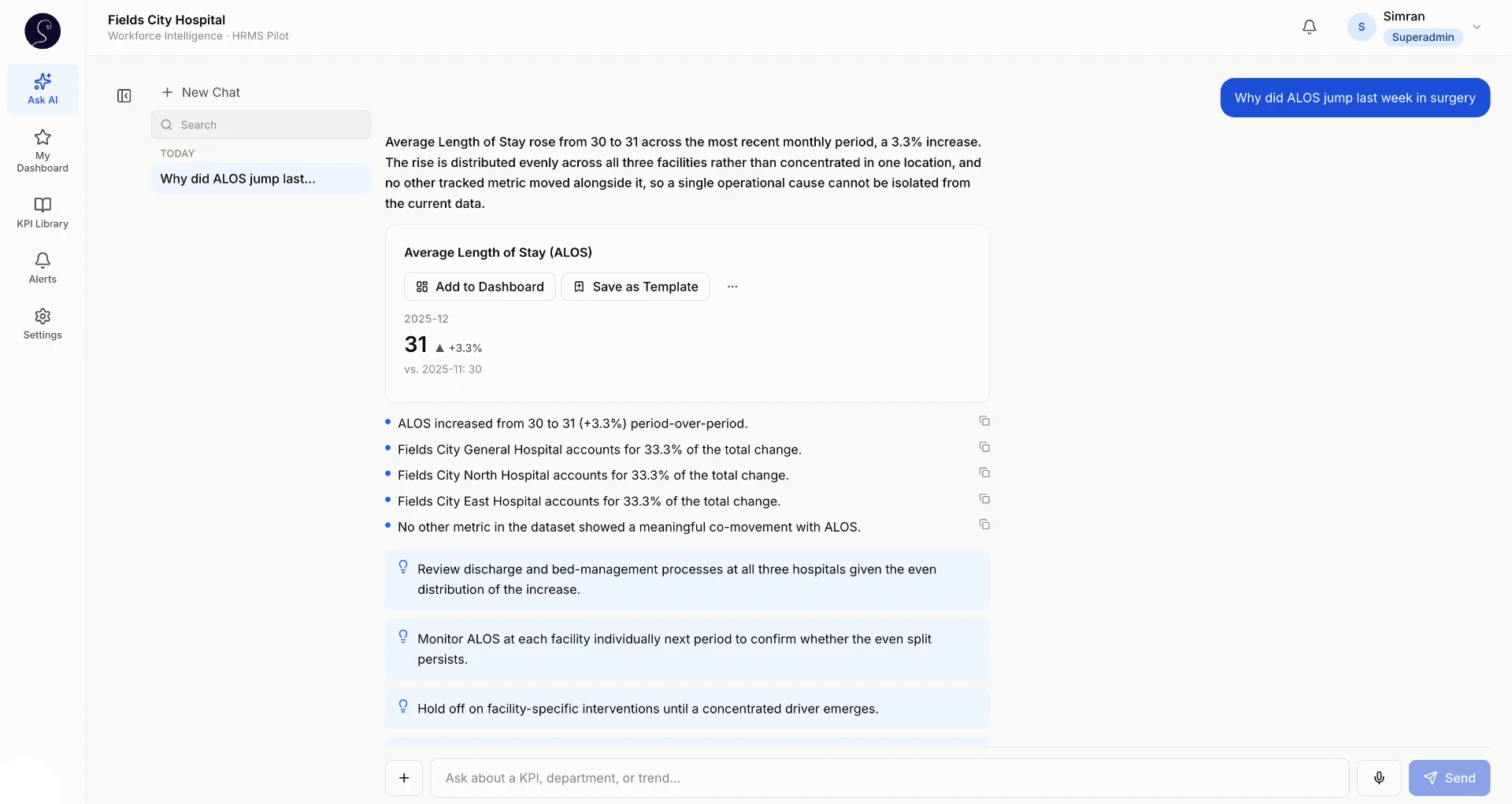
Your COO, CFO and HR Director all use the same box
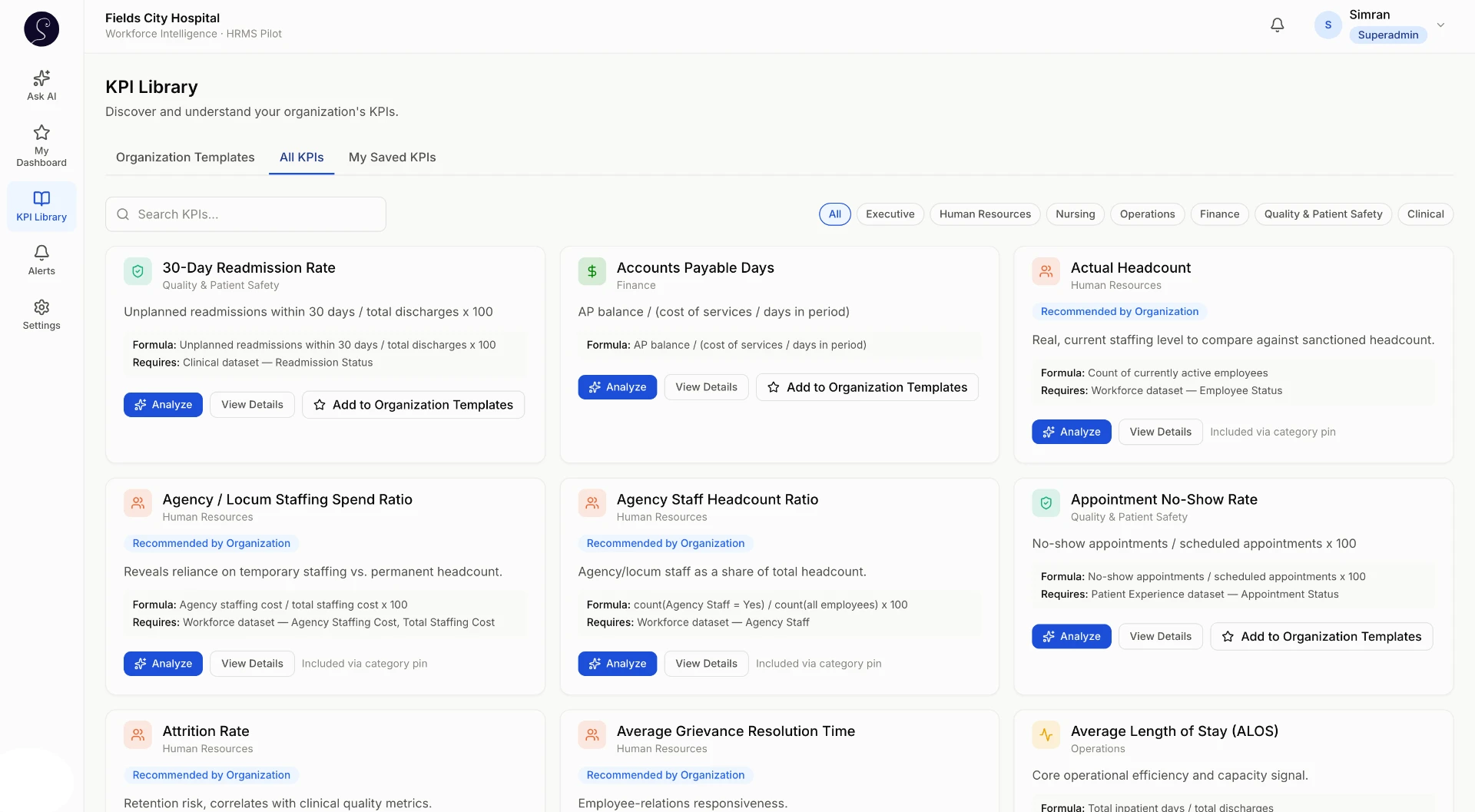
Type or speak "Why did ALOS jump in surgery last week?" and get an answer, not a ticket. 84 executable KPIs span Operations, Finance, Quality & Patient Safety, Human Resources, Nursing and Clinical, with an Executive view that cuts across all of them. Ask for something nobody has catalogued and the planner builds and validates the calculation on the fly.
84 Executable KPIs, 7 Departments
Real formulas across Executive, Operations, Finance, Quality & Safety, HR, Nursing and Clinical.
13 Question Types, Not Just "What"
Rank, compare, correlate, trend, forecast, explain, summarise — plus a straight yes/no on whether the data exists at all.
Dynamic Analytical Planner
A metric outside the catalogue still returns a real, data-validated calculation instead of "no results".
Bring-Your-Own LLM
Claude, OpenAI, Gemini and Gemini on Vertex AI all live. Your key, encrypted, your choice of model.
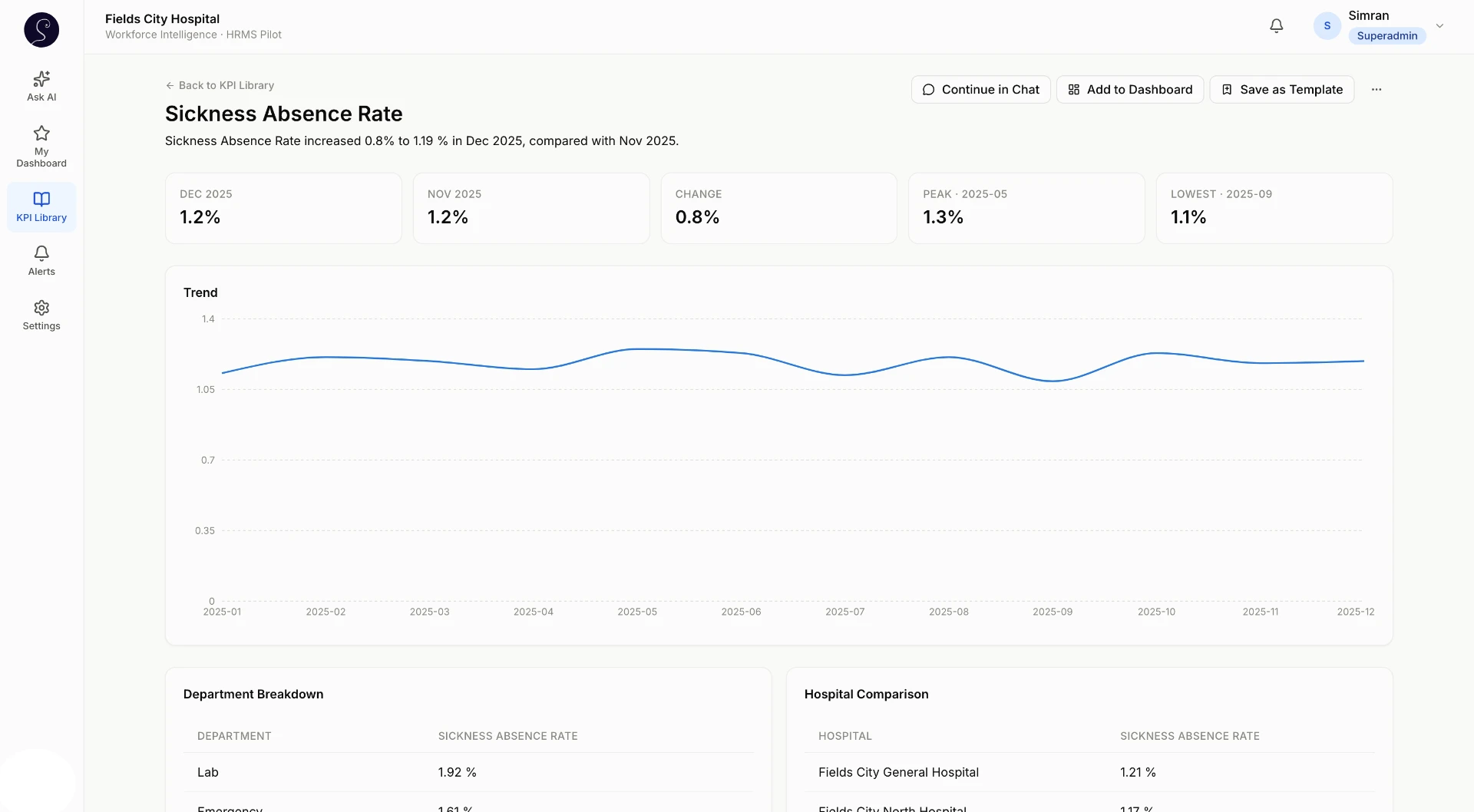
The model writes the sentence. It never touches the arithmetic.
Most AI analytics tools generate SQL and hope. SurgyInsights doesn't generate SQL at all. The language model's only job is to understand the question; every number is computed by a deterministic formula engine over your real rows. That is why it can tell you when it can't answer — and why the figure survives being challenged.
No Text-to-SQL, By Design
The model plans, the KPI engine calculates. There's no generated query to silently get wrong.
Never Substitutes A Metric
Ask for training spend per employee and you will never be handed revenue per employee instead.
Never Invents A Benchmark
NABH and industry comparisons resolve against benchmark data you supply, and say so plainly when none exists.
Declines Instead Of Guessing
Missing data, an impossible calculation, and a query error are three different answers, and you're told which one you got.
From a drifting KPI to the department head who owns it
Build a rule on any KPI in the library — a threshold, a percentage move, or a drift that has to persist for several periods before anyone gets disturbed. When it fires, the alert explains itself in plain language, routes to the roles that own the number, and closes itself when the metric recovers. Ask "why" and the answer takes the KPI's own formula apart over real rows.
Rules On Any KPI
Seven operators, custom time windows, and consecutive-period persistence so you're not paged on noise.
Self-Closing Alerts
Auto-resolve on recovery; triage open → acknowledged → resolved in the Alert Center.
Formula-Level Root Cause
"Why did attrition rise?" decomposes the KPI into its own numerator and denominator movements, not a guess.
Save-Tile-To-Dashboard
Turn any answer into a role-scoped tile on any of your dashboards, refreshing live.
From a CFO's laptop to a 50-hospital group
Same platform, different commitment level. Start self-serve, scale to OEM.
CSV / Excel
Drag-drop and ask. No IT involved. Pay as you use.
Scheduled Sync
Cron pulls from your HIS exports — daily or hourly.
API + SLA
Deep integration, tenant isolation, 99.9% uptime SLA.
OEM
Embed SurgyInsights inside your HIS, EHR or platform.
No PHI / PII ever stored. By design.
Ingest-time scanner blocks identifiers before they land. Supabase Vault for keys, pgvector for embeddings, tenant-isolated schemas per hospital.
Ingest
CSV / Excel / API · PII scanner blocks PHI at the door.
UCDM
Universal Clinical Data Model normalises every hospital schema.
AI Pipeline
Deterministic KPI engine · metric catalogue · anomaly + RCA agents.
Chat
Plain-language Q&A in EN / HI / AR (ES, FR, DE roadmap).
Dashboards
Role-scoped tiles, WhatsApp alerts, exports.
Outcomes in the first 30 days
Talk to our team
See Surgy Health improve your hospital workflow.
Book a focused walkthrough tailored to your teams, priorities, and current systems.


Our Customers









Book a demo
We’ll reply within one business day.
SurgyInsights FAQs
What is SurgyInsights?
SurgyInsights is conversational analytics for hospitals: a leader uploads hospital data or connects a scheduled export, then asks questions in plain language and gets charts, dashboards, NABH/JCI-tagged KPIs, anomaly alerts and root-cause hypotheses in return. It is designed so the first dashboard is live in under an hour, without a BI project.
Do we need a data warehouse or an IT project to start?
No. In self-serve mode you drag and drop a CSV or Excel export straight from the HIS, AI proposes the field mappings, your team confirms them in minutes, and the first chart appears in under an hour. Scheduled sync, API with a 99.9% uptime SLA, and OEM embedding are available later for hospitals that want them.
Which questions can we ask, and in which languages?
Any question your data can answer, typed or spoken in English, Hindi or Arabic (Spanish, French and German are on the roadmap) — for example occupancy trends, OT utilisation, revenue per specialty or claim rejection reasons. SurgyInsights supports 13 analytical question types — rank, compare, correlate, trend, forecast, explain and summarise among them — and every number is computed by a deterministic KPI engine over your real rows, never by a generated query.
What KPIs come pre-built?
SurgyInsights ships 84 executable KPIs with real formulas across Executive, Operations, Finance, Quality & Patient Safety, Human Resources, Nursing and Clinical — each tagged to NABH and JCI requirements, so accreditation metrics are computed continuously rather than reconstructed at audit time. Anything outside the catalogue is handled by a dynamic analytical planner that builds and validates the calculation on the fly.
How does SurgyInsights keep patient data safe?
A PII scanner blocks identifiers at the point of ingest, so patient health information never enters the analytics tenant, and each hospital's data is isolated in its own tenant. Analytics run on de-identified operational data, which is what leadership questions actually need.
Can we use our own AI model?
Yes. Claude, OpenAI, Gemini and Gemini on Vertex AI are all live today — hospitals bring their own LLM using their own encrypted API key, which matters where data-residency or procurement rules dictate the provider.
How do anomaly alerts and root-cause analysis work?
You build a rule on any KPI in the library — a threshold, a percentage move, or a drift that persists over several consecutive periods, so you are not paged on noise. When a rule fires, the alert explains itself in plain language, routes on WhatsApp to the roles that own the number, and closes itself when the metric recovers. Ask "why" and the root-cause analysis decomposes the KPI's own formula into numerator and denominator movements over real rows.
Can SurgyInsights be embedded in our own platform?
Yes. The white-label OEM mode embeds SurgyInsights inside a HIS, EHR or health platform under the partner's own brand, with tenant isolation preserved.
Which KPIs should a hospital CEO track every week?
Most hospital CEOs track bed occupancy, average length of stay, revenue per occupied bed, AR days, claim rejection rate, OPD footfall and patient satisfaction every week. SurgyInsights comes with 84 ready KPIs across executive, operations, finance, quality, HR, nursing and clinical teams, tagged to NABH and JCI.
Related reading
- AI in healthcare statistics: hospital adoption
- How hospitals buy surgical analytics: 9 factors
- NABH 6th Edition roadmap
- How to evaluate hospital AI software: buyer's guide
Last updated 26 October 2026