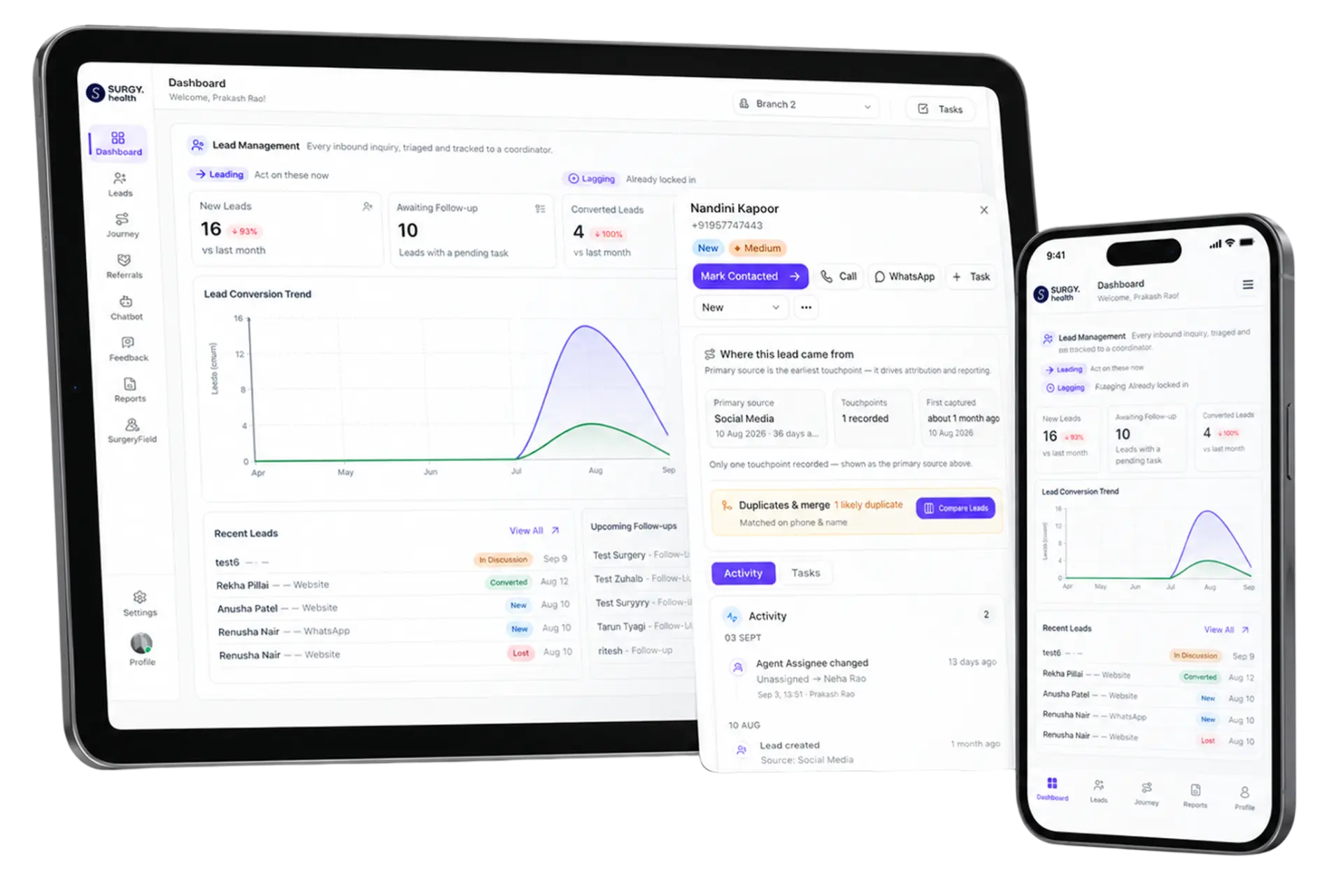
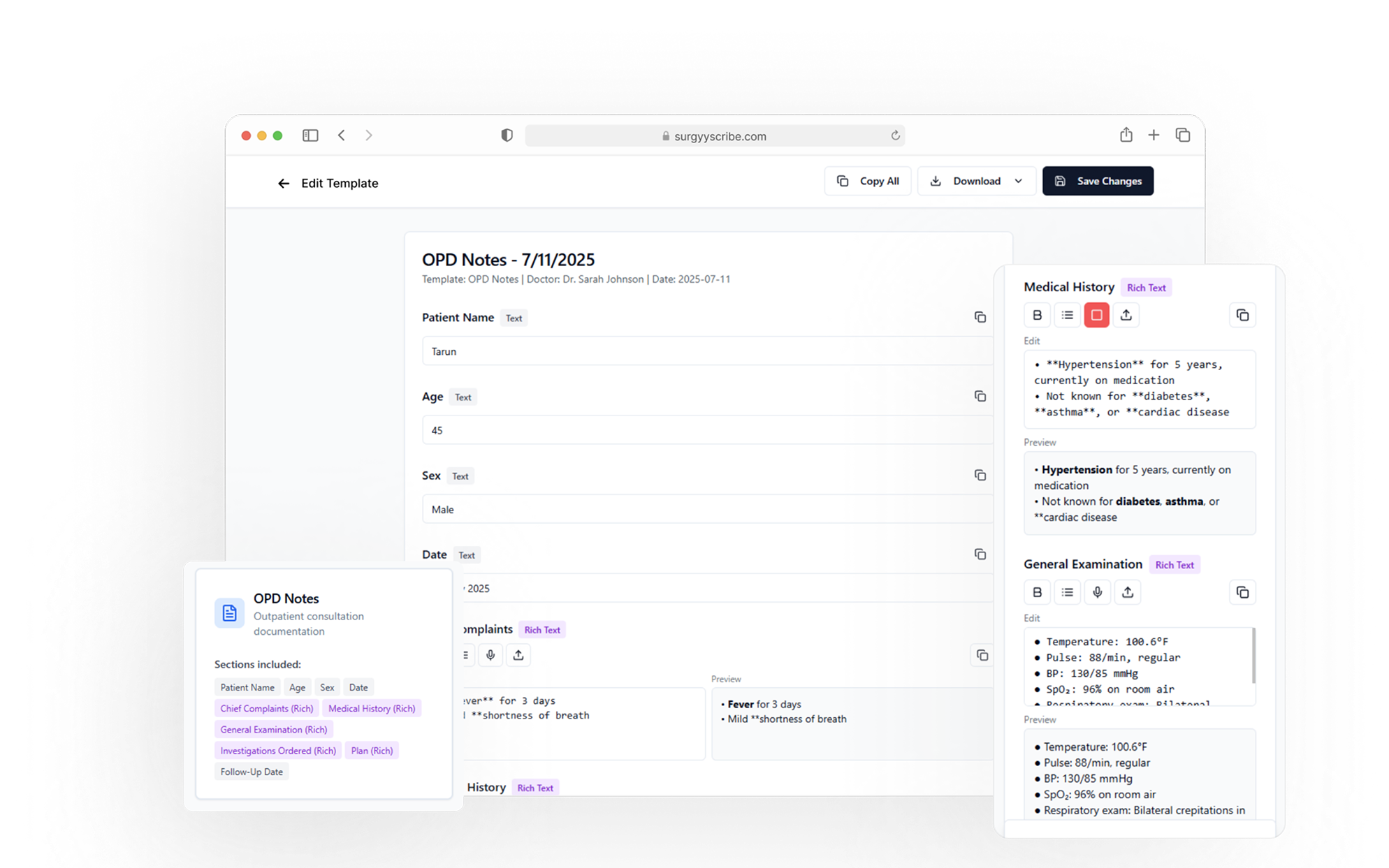
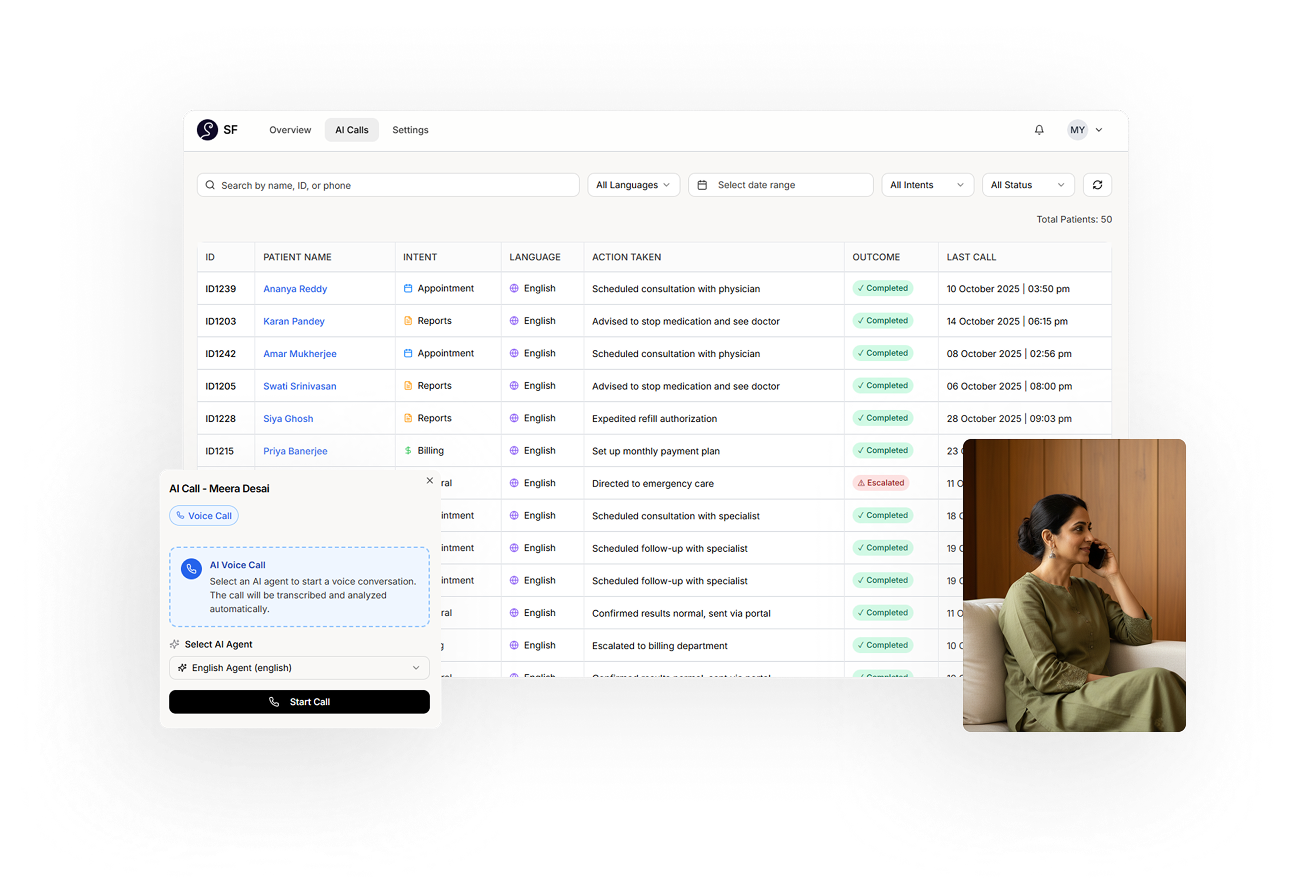
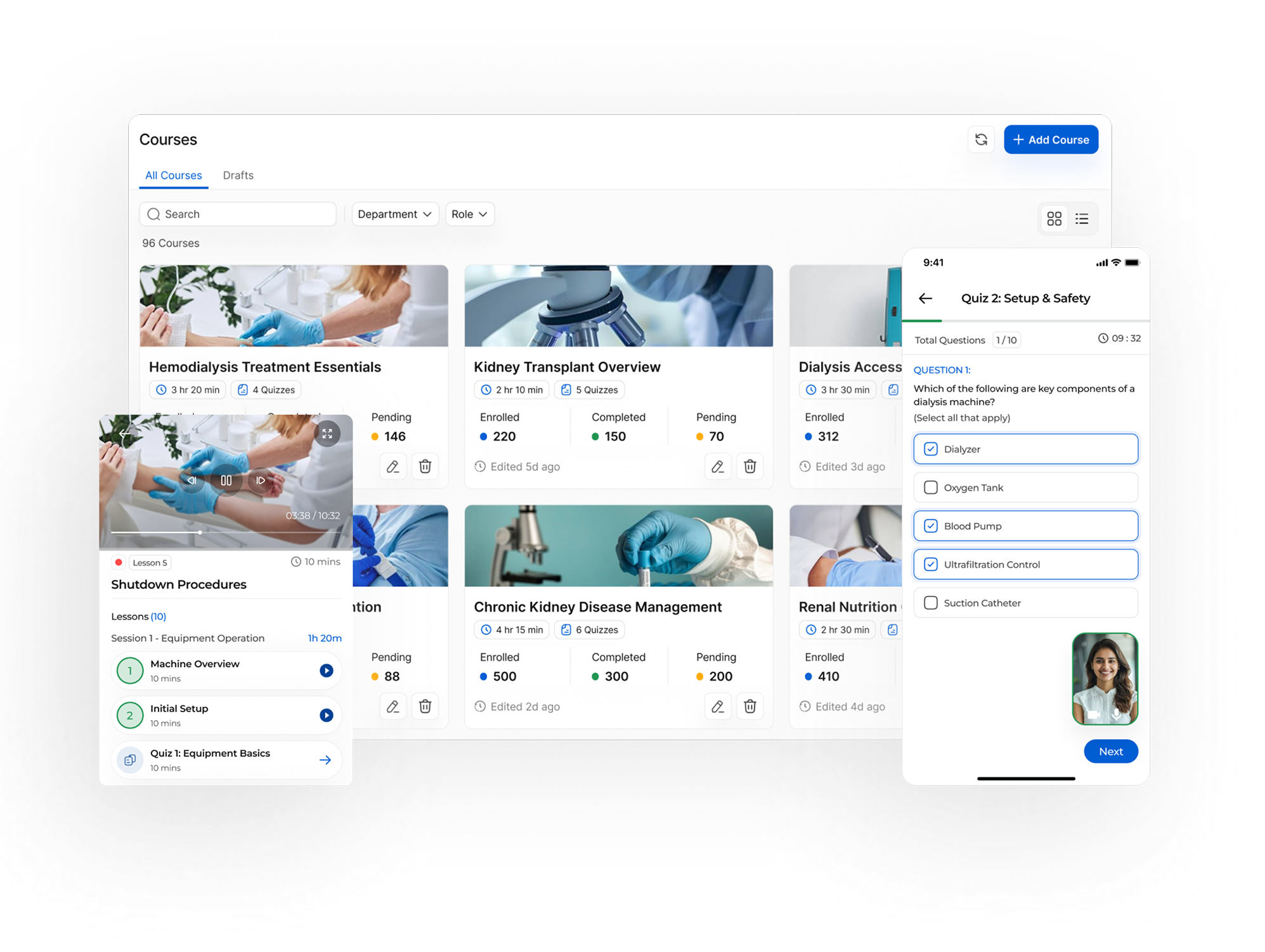
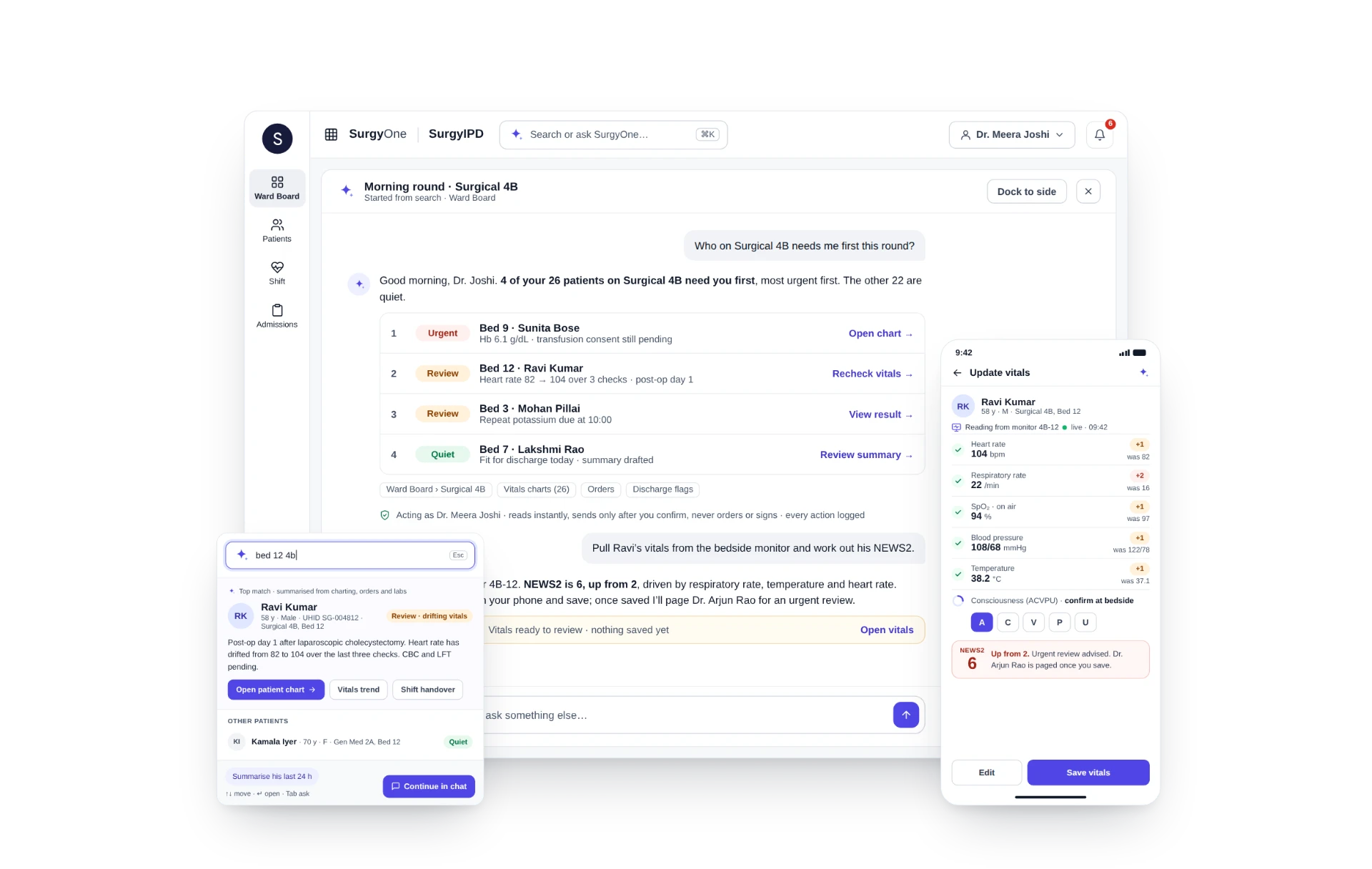
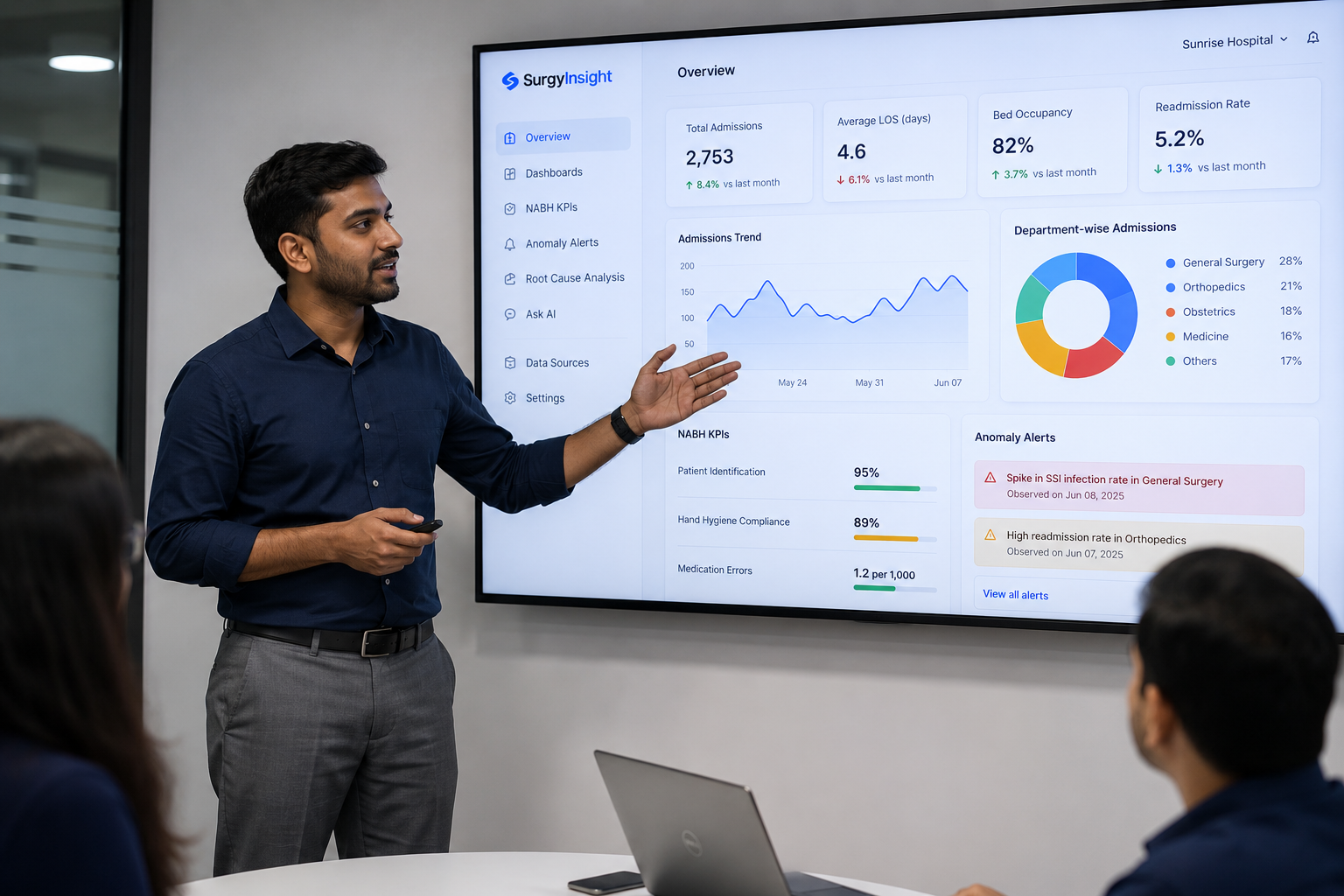
Surgy Health is a healthcare technology company that provides seven AI-first, seamless products for hospitals: SurgyOne, an agentic-AI hospital information system (HIS) covering OPD, IPD, ER, labs, pharmacy and billing on one patient record; SurgyLearn for staff training and NABH compliance, SurgyCRM for patient leads and journeys, SurgyFrontdesk as an AI front-desk voice agent, SurgyScribe for AI clinical documentation, SurgySettle for discharge-to-claim settlement, and SurgyInsights for conversational hospital analytics. Surgy Health is operated by Surgy Innovation Labs Private Limited, headquartered in Bengaluru, India, and serves hospitals across India and the GCC.
Who uses Surgy Health?
Surgy Health is used by multi-specialty hospital groups, dialysis networks, diagnostic chains and clinic chains across India and the GCC — including Mediversal Hospitals, DCDC Kidney Care, Al Salam Hospitals (Kuwait), Apollo Clinic, Bhagat Chandra Hospital, Apex Hospitals, Accord Superspeciality Hospital, Ayushman Hospital and Redcliffe Labs. More than 4,000 healthcare professionals use Surgy Health products.
Do I have to buy all seven Surgy Health products together?
No. Each product is sold and deployed independently. Hospitals can run SurgyOne as their core HIS, or plug the other products into the HIS they already use, and most start with one — commonly SurgyLearn for accreditation training or SurgyCRM for patient lead management. Because the products share one connected data platform, adding a second product later needs no re-implementation: for example, SurgyScribe consultations can feed leads into SurgyCRM, and SurgyFrontdesk can run CRM follow-ups automatically.
How is Surgy Health different from a HIS or HMS?
Surgy Health offers both. SurgyOne is its agentic-AI HIS: one patient record across OPD, IPD, ER, labs, pharmacy and billing, with an AI assistant built into every module. The other Surgy Health products — SurgyCRM, SurgyScribe, SurgyFrontdesk, SurgyLearn, SurgySettle and SurgyInsights — also work on top of any existing HIS or HMS through APIs or scheduled data syncs, so hospitals can modernise without replacing their current system. Hospitals without an integration can start on CSV/Excel uploads.
What is SurgyOne?
SurgyOne is Surgy Health's agentic-AI hospital information system (HIS/EHR). It runs OPD, IPD, emergency, labs, pharmacy and billing on one shared patient record, with an AI assistant that understands requests, acts on them and orchestrates work across departments. It is built for hospitals in India and the GCC, supports ABDM, and is designed for India's DPDP Act. Hospitals typically start with core modules and add more in phases.
How does Surgy Health pricing work?
Surgy Health products are sold as annual subscriptions quoted per hospital after a short scoping call, priced on the products selected, number of sites, and user or volume tiers. There is no public per-seat price list because hospital deployments differ widely in branches, integrations and languages. Optional extras such as full whitelabelling (custom root domain, branded emails, brand-owned app listing) are scoped and priced separately during onboarding.
How long does implementation take?
Implementation is scoped based on the data and integrations a hospital needs — it can take anywhere between 1 week and 2 months depending on the requirements, together with a user training plan. Surgy Health deliberately supports a CSV/Excel start mode for every product so a hospital is never blocked waiting on a multi-quarter HIS integration.
Is patient data secure, and is Surgy Health DPDP-compliant?
Yes. Data is tenant-isolated per hospital, encrypted in transit and at rest, and governed by role- and branch-scoped permissions with a full audit trail. Surgy Health is built for India's Digital Personal Data Protection (DPDP) Act and aligned with global healthcare data norms. In SurgyScribe, patient identifiers received from the EHR are never sent to third-party AI services, and enterprise AI accounts are configured for zero data retention; in SurgyInsights, a PII scanner blocks identifiers at ingest.
Which countries and languages does Surgy Health support?
Surgy Health operates across India, the UAE, Saudi Arabia, Kuwait, Oman and Singapore. Patient- and staff-facing surfaces support English, Hindi and Arabic, SurgyScribe transcribes 89 languages, and SurgyLearn delivers the same course in multiple languages for multilingual workforces.
Does Surgy Health support NABH and JCI accreditation?
Yes. SurgyLearn maps staff training to NABH human-resource-management requirements and produces Excel and PDF evidence exports for accreditation, HR and board packs, including annual re-certification cycles. SurgyInsights ships 84 executable KPIs tagged to NABH and JCI, so quality metrics are computed continuously instead of being reconstructed at audit time.
From the Journal
Latest insights
Field notes on AI, NABH accreditation and clinical operations — written for Indian hospital leaders.
No certificate, no outsourcing shortcut. What India's DPDP Act and DPDP Rules 2025 require of hospitals, the May 2027 deadline, penalties and how to start.
Primary-source AI in healthcare statistics for 2026: physician and hospital adoption, FDA AI devices, AI scribes, patient trust, plus India and GCC data.
Why preventable TPA claim losses often begin with missed queries, unmatched payments and invisible deduction patterns — and the operating controls hospitals can put in place now.