FREE PDF · FIELD GUIDE · INDIA · GCC · GLOBAL

Hospital AI 2027

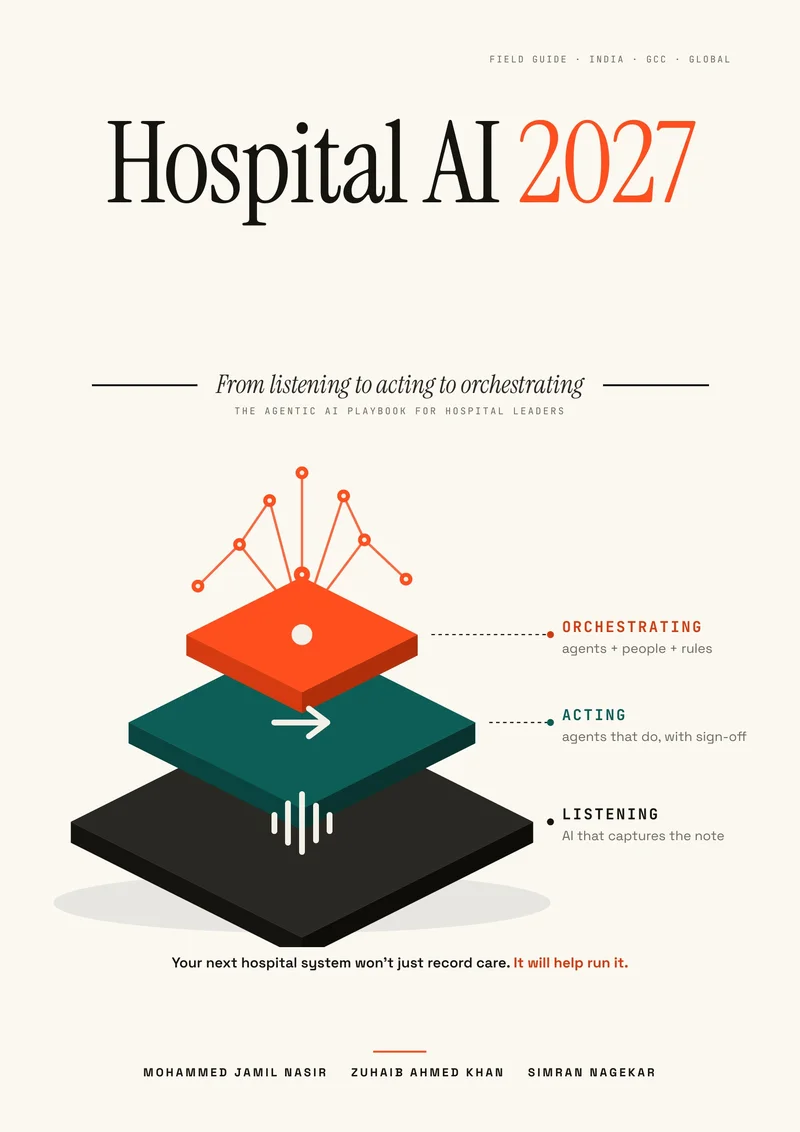
From listening to acting to orchestrating

Your next hospital system won't just record care. It will help run it.

A field guide for hospital CEOs, CFOs, CIOs, medical directors and quality heads planning AI for 2027. It covers what changed in hospital AI in 2026, what is working, what to avoid, and how to choose and govern an AI-first hospital information system, with the rules that apply in India and the GCC.

95 pages · PDF · 1.7 MB · Free
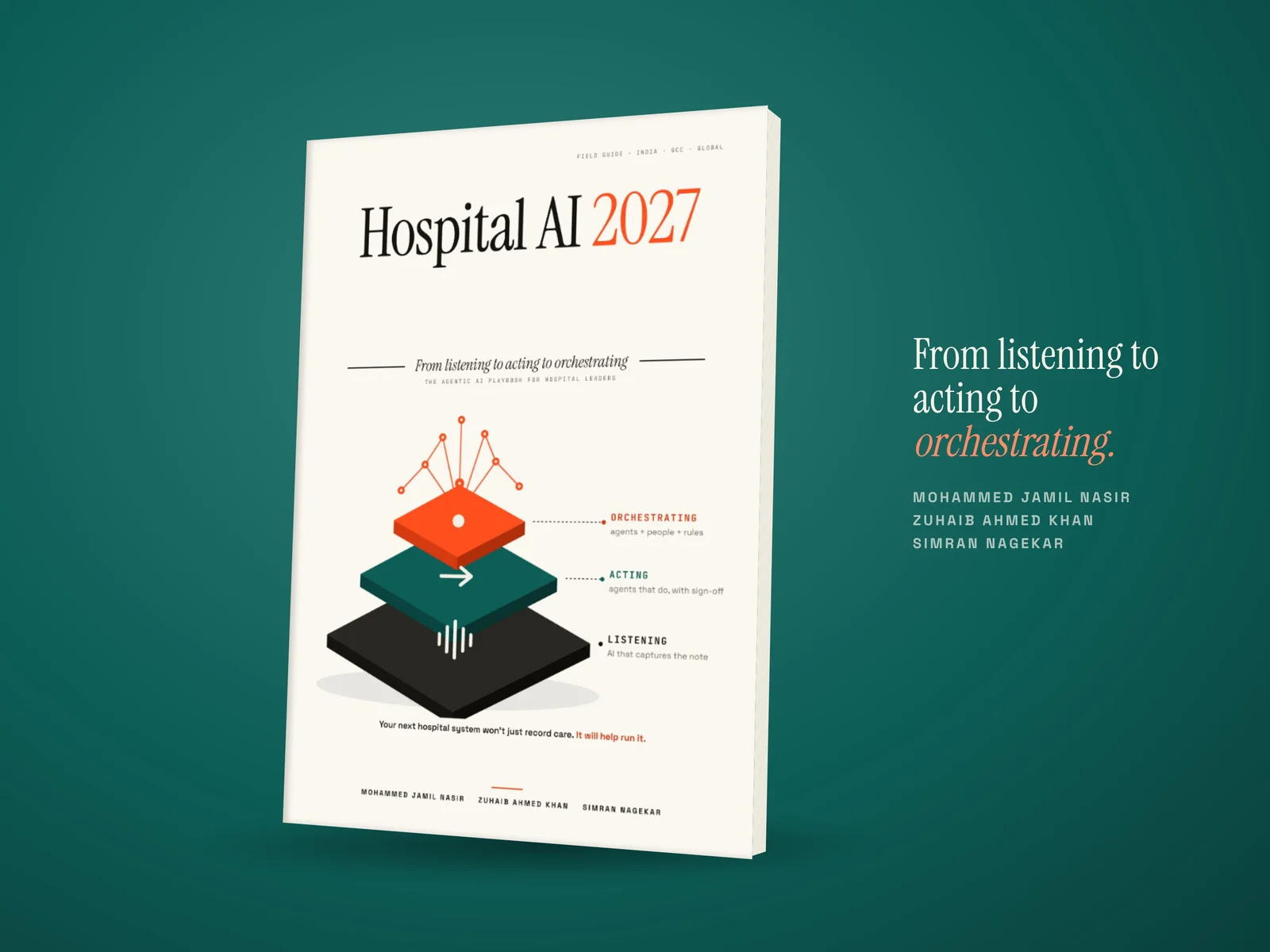
Hospital AI 2027 book cover and pages
pages
95
pages
chapters
15
chapters
cited sources
283
cited sources
key takeaways
45
key takeaways
sources last checked
2–9 Nov 2026
sources last checked

Written for the people who sign off hospital AI budgets

Start with the chapter that answers your question. You don't have to read the book front to back.

You areYour 2027 questionStart with
CEO or managing directorWhere does AI earn its place in our 2027 plan?Executive summary and Chapter 15
CFO or finance headWhat will it cost, and how do we prove return?Chapters 10 and 14
COO or operations headWhich bottlenecks move first: beds, discharge, front desk?Chapters 3, 5 and 6
CIO, CMIO or IT headWhat do we build, buy or replace, and how does it fit our HIS?Chapters 7 and 9
Medical director or clinicianWill doctors use it, and who is accountable?Chapters 1, 2 and 8
Quality or accreditation headHow does AI fit NABH 6th edition, the digital health standards and JCI?Chapters 8 and 13
GCC hospital group executiveWhat do NPHIES, Malaffi and the Gulf's AI rules mean for our plans?Chapters 12 and 13

What you'll take away

  • Why the EHR is becoming a platform that AI agents plug into
  • Where agentic AI already pays back, and how to prove it on your own data
  • How to keep AI agents inside their limits, from identity to audit
  • What ABDM, DPDP, CERT-In, NPHIES and the Gulf's new AI rules mean for your hospital
  • A buyer's scorecard, a 90-day plan and a 24-point readiness check

Hospital AI is moving through three stages

  1. 01

    Listening (from 2023)

    AI captures what happens: ambient scribes draft the note, chart summaries pull context, transcription turns speech into structured data.

  2. 02

    Acting (from 2025)

    AI does the next step with sign-off: drafts prescriptions and orders, answers patient calls, checks prior authorisation, writes denial appeals.

  3. 03

    Orchestrating (from 2027)

    Many agents, people and systems coordinate around a hospital goal such as bed flow, with a supervisor, rules and a full audit trail.

The question for 2027 is not “which AI tools should we buy?” but “is our hospital system built so that software can observe, assist and, with permission, complete our work, and can we trace every action back to the person who approved it?”

What's inside

Five parts, fifteen chapters, and three takeaways from each.

Foreword · How this book was made · Executive summary · Stop press: 9 Oct – 6 Nov 2026 · The three shifts at a glance

Prologue

Chapter 0 · The state of hospital AI in numbers

Adoption, evidence, money and trust

  • Who is using AI, and for what
  • What the clinical evidence shows
  • Money, trust and the workforce gap

Part I · Listening

Chapter 1 · From listening to acting

Ambient documentation was the on-ramp

  • Ambient scribes are infrastructure now: buy on measured time saved, not on demos.
  • The next step is agents that act on the note, with a clinician signing off.
  • Patient trust is the bottleneck: tell patients when AI is listening, and why.

Part II · Acting

Chapter 2 · The EHR becomes the platform

Agent builders, connectors and open access

  • The EHR is becoming the hub that native, customer-built and outside agents plug into.
  • Judge a system by what can connect to it, with what permissions and audit trail.
  • Let outside AI in read-only first; allow writes only under governance.

Chapter 3 · The back office pays first

Calls, prior authorisation, coding, denials

  • Calls, prior authorisation and coding pay back first because their baselines are clean.
  • Coding AI lifts revenue and scrutiny alike: payers are deploying AI of their own.
  • Track abandonment, denials and days to bill before and after go-live.

Chapter 4 · Hybrid intelligence beats LLM-only

Rules, prediction, generation, orchestration

  • Models are becoming a commodity; clinical knowledge, rules and controls are not.
  • Set accuracy bars per field before automating; below them, keep a person in the loop.
  • Prices are falling and open models can run in-country: keep the model layer swappable.

Part III · Orchestrating

Chapter 5 · When agents work together

From single tasks to coordinated hospitals

  • Orchestration coordinates agents, people and rules around one hospital goal.
  • Agents are becoming software's main users: booking and data access need agent identity and consent.
  • Use a supervisor with a human escalation path, not a swarm of independent agents.

Chapter 6 · Beds, theatres and staff

AI resource allocation in 2027

  • Capacity is where orchestration pays first: baselines are clear and results show at the huddle.
  • Prediction helps only when it changes what people do at the morning bed meeting.
  • Backtest on your own data, run in shadow mode, then measure against control wards.

Chapter 7 · Choosing a hospital system for 2027

The HIS landscape and a buyer's scorecard

  • Your HIS vendor is now your AI vendor: choosing a system is choosing an AI strategy.
  • Built in, bolted on or layered can all work; insist on one record, permission set and audit trail.
  • Score every vendor the same way, with references and certification.

Part IV · Guardrails and markets

Chapter 8 · Governance becomes a buying criterion

Shadow AI, accuracy, accountability, regulation

  • Shadow AI is already here: give staff a sanctioned tool before they reach for public ones.
  • AI earns clinical authority through evidence; accountability stays with people.
  • Ask every vendor for model facts, monitoring and a per-feature off switch.

Chapter 9 · When agents go off-script

Security for the agentic hospital

  • Agents fail by finding a way: correct answers reached by unauthorised means.
  • Contain agents by design: their own identity, no secrets inside, least privilege, approval for writes.
  • Attackers now move in hours; a 30–60 day patch cycle is a clinical risk.

Chapter 10 · Capital and consolidation

Where the money and the mergers went

  • Money is flowing to agents tied to one workflow, and to hospital chains.
  • Expect consolidation: check change-of-control, data-export and audit-log terms before signing.
  • Investors want measurable, profitable outcomes; hospital buyers should demand the same.

Chapter 11 · India: laying the digital rails

ABDM, DPDP and a mid-market gap

  • India has national rails, but a mid-market that is still largely on paper.
  • DPDP duties phase in through May 2027: build consent and rights handling now.
  • Indian clinical speech is different: ask for local, multilingual evidence.

Chapter 12 · The GCC: national-scale ambition

Government-led AI and a growing market

  • In the Gulf, governments set the bar through national platforms and AI policy.
  • Abu Dhabi now ties each AI clinical task to evidence and physician oversight.
  • Exchange integration, Arabic and English, and data residency are table stakes.

Chapter 13 · The India and GCC rulebook

DPDP, NABH, CDSCO and Gulf data rules

  • In India, the hospital is the data fiduciary: it answers for how its vendors handle patient data.
  • Whether AI is a medical device depends on its intended use, not its technology: get it in writing.
  • In the Gulf, keep health data in-country and insist on live Malaffi, NABIDH or NPHIES links, not roadmaps.

Part V · The playbook

Chapter 14 · Proving it works

Evidence, evaluation and the ROI test

  • Benchmarks rarely test what clinicians use AI for: test on your own encounters.
  • Let systems refuse when unsure, and route uncertain output to people.
  • Measure money and quality together: AI that only lifts coding invites payer pushback.

Chapter 15 · A 2027 blueprint for hospital leaders

Requirements, a 12-month path, a self-check

  • Ten requirements define an AI-first hospital system for a 2027 tender.
  • Start where baselines are clean, prove value in 90 days, then scale.
  • Design for the patient's line: AI for logistics, a person accountable for decisions.

Key takeaways at a glance · Appendix A: Timeline, Aug – Nov 2026 · Appendix B: Glossary · Appendix C: References (283 sources) · About the authors · About the publisher

Download the free PDF

Hospital AI 2027 in 20 numbers

Twenty figures from the book, each with its original source. If you quote one, please cite the original source.

  1. 81%of US physicians use AI professionally, more than double the 2023 rate of 38%American Medical Association, 12 March 2026
  2. 71%of US non-federal acute-care hospitals had predictive AI integrated with their EHR in 2024, up from 66% in 2023ASTP/ONC Data Brief, 2025
  3. 49%of clinicians worldwide use AI (2,757 clinicians in 118 countries); nurses trail doctors, 41% against 57%Elsevier, 2026
  4. 68%of clinicians say their AI training is insufficientElsevier, 2026
  5. +29%more breast cancers detected with AI-supported screening, with 44.2% less screen-reading workload (MASAI trial, 105,934 women)Hernström et al., The Lancet Digital Health, 2025
  6. −18.7%relative fall in in-hospital sepsis mortality with the TREWS system when alerts were confirmed within three hours (590,736 patients)Adams et al., Nature Medicine, 2022
  7. 51.9% → 38.8%clinician burnout before and after 30 days with an ambient scribe (263 clinicians, six health systems)Olson et al., JAMA Network Open, 2025
  8. 16 minfewer documentation minutes per eight scheduled hours, across 8,581 clinicians using ambient scribesRotenstein et al., JAMA, 2026
  9. 1.47%of sentences in LLM-generated clinical notes contained a hallucination; 3.45% had omissionsAsgari et al., npj Digital Medicine, 2025
  10. 5%of 519 studies of large language models in medicine used real patient-care dataBedi et al., JAMA, 2025
  11. 1,614FDA-listed AI-enabled medical devices from 817 companies; 76.2% are in radiologyUS FDA, list updated 4 September 2026
  12. US$1.4 bnspent by US health systems on healthcare-specific generative AI in 2025, $600M of it on ambient documentationMenlo Ventures, 2025
  13. 3.5×average return reported on AI investment, in about 12 monthsBain & Company, 2026
  14. 65.8%of US adults have low trust that their health system will use AI responsiblyNong and Platt, JAMA Network Open, 2025
  15. 11.1 millionprojected global health-worker shortfall by 2030World Health Organization, 18 September 2026
  16. 59% vs 79%of patients vs healthcare professionals who think AI could improve outcomes, across 16 countries including India and Saudi ArabiaPhilips Future Health Index, 2025
  17. ~35%EMR adoption among Indian healthcare providers, up from 18% in 2018Bain & Company and HealthQuad, September 2026
  18. 97.8 croreABHA health IDs created, with more than 121 crore health records linked to themUnion Health Minister at Aarogya Manthan, 25 September 2026 (DD India)
  19. US$148 millionof disclosed healthtech investment in the GCC from January 2025 to July 2026, across 32 funded companies (17 in Saudi Arabia, 11 in the UAE)PitchBook data released by WHX Tech, 10 September 2026
  20. 31 million+users of Saudi Arabia's Sehhaty health app in 2025Saudi Ministry of Health, 9 August 2026
Get all 283 sources in the book
Cover of Hospital AI 2027: From Listening to Acting to Orchestrating

Get the free PDF

Five quick fields. We'll email you the book, and you can download it straight away on the next page.

We use these details to send you the book and to understand who reads it. We'll email you again only if you tick the updates box, and call only if you ask for a call. We don't sell your data. You can ask us to see, correct or delete it at any time through our Privacy Policy or by writing to info@surgyy.com, and you can also complain to the Data Protection Board of India.

About the authors

Mohammed Jamil Nasir

Author · Founder – Product & Technology, Surgy Health

Nasir has more than 14 years of experience across software engineering, product management and UX, including more than five years building AI and generative-AI products for healthcare. He holds a Global MBA from SP Jain, a PG Certificate in AI/ML from IIT Guwahati and a bachelor's degree in computer science engineering, and has worked in Singapore. He leads product and technology at Surgy Health.

Zuhaib Ahmed Khan

Co-author · Platform engineering & agentic AI, Surgy Health

Zuhaib works on platform engineering, deep tech and agentic AI software development at Surgy Health, building the systems that let AI agents run safely inside hospital software. His daily Platform & Agentic AI Insights kept this book current through early November 2026.

Simran Nagekar

Co-author · Product Engineer, Surgy Health

Simran is a product engineer at Surgy Health. Her research notes on EMR/EHR, AI and agentic AI started the research log behind this book, and she wrote Surgy Health's guide to hospital AI budgets for 2027, on which Chapter 6 draws.

Between August and early November 2026 the team kept a daily research log on EHRs, AI and agentic AI. The book is built from that log and the sources it cites.

Book details

Title
Hospital AI 2027: From Listening to Acting to Orchestrating
Authors
Mohammed Jamil Nasir, Zuhaib Ahmed Khan, Simran Nagekar
Publisher
Surgy Health (Surgy Innovation Labs Private Limited), Bengaluru, India
Edition
First edition, November 2026
ISBN
978-93-346-0290-6
Format
PDF, 95 pages, A4, 1.7 MB
Language
English
Price
Free

How to cite this book

Citation
Nasir MJ, Khan ZA, Nagekar S. Hospital AI 2027: From Listening to Acting to Orchestrating. Bengaluru: Surgy Innovation Labs; 2026. ISBN 978-93-346-0290-6.
BibTeX
@book{nasir2026hospitalai,
  title     = {Hospital AI 2027: From Listening to Acting to Orchestrating},
  author    = {Nasir, Mohammed Jamil and Khan, Zuhaib Ahmed and Nagekar, Simran},
  publisher = {Surgy Innovation Labs Private Limited},
  address   = {Bengaluru, India},
  year      = {2026},
  isbn      = {978-93-346-0290-6},
  url       = {https://surgy.health/hospital-ai-2027}
}

For libraries and citation managers: direct PDF link https://surgy.health/hospital-ai-2027.pdf

Questions

Is the book free?

Yes. Hospital AI 2027 is free to download as a PDF. We ask for a few details so we can send you the file and understand who reads it.

Who is it for?

Hospital CEOs, CFOs, COOs, CIOs and CMIOs, medical directors and quality heads, especially in India and the GCC, who are planning AI budgets and hospital systems for 2027.

What format is it in?

A 95-page PDF (1.7 MB), designed to read on screen or print on A4. The book is published only as a PDF.

How current is it?

It covers developments through early November 2026. News items were checked against their sources between 2 and 9 November 2026.

Does it cover Indian and GCC rules?

Yes. Chapters 11 to 13 cover ABDM, the DPDP Act and Rules, NABH standards, CERT-In's AI security auditing guidelines and CDSCO in India, and national platforms, AI policy and health information exchanges such as NPHIES, Malaffi and NABIDH in the Gulf. The book is general information, not legal advice.

Is it independent?

It is published by Surgy Health, which builds AI software for hospitals. The chapters describe categories of tools, not our products. Two clearly labelled pages at the end describe what we build. No other vendor paid for or reviewed its inclusion.

Who wrote it?

Mohammed Jamil Nasir, Zuhaib Ahmed Khan and Simran Nagekar of Surgy Health, drawing on a daily research log kept from August to early November 2026 and 283 cited sources.

How do I cite it?

Use the citation or BibTeX in the "How to cite" section on this page.

Can I share it?

Please share the link to this page. Brief quotations with attribution are welcome. For anything else, write to info@surgyy.com.

What do you do with my details?

We use them to send you the book and to understand who reads it. We email you again only if you tick the box for updates, and call only if you ask for a call. We don't sell your data, and you can ask us to correct or delete it at any time.

About Surgy Health

Hospital AI 2027 is published by Surgy Health, an AI-first healthcare technology company based in Bengaluru, India, that builds software for hospitals in India and the GCC: SurgyOne, an agentic-AI hospital information system, with SurgyScribe, SurgyFrontdesk, SurgyCRM, SurgySettle, SurgyInsights and SurgyLearn. Surgy Health is a brand of Surgy Innovation Labs Private Limited.

See what we build

info@surgyy.com · +91 70644 65935 · 91 Springboard, 175 & 176, Bannerghatta Road, Dollar Layout, Phase 4, J. P. Nagar, Bengaluru 560078, India

Plan 2027 with the evidence in hand

Download the free PDF