

Hospital AI Budget 2027: Where to Invest and How to Choose
For hospital leaders setting 2027 AI budgets in India and the GCC: where to invest first, what to budget for, a quarter-by-quarter plan, nine weighted criteria, 20 RFP questions and an honest look at where SurgyOne fits.


Key takeaways
- Fund the bottleneck, not the hype: for most hospitals the first 2027 AI money belongs in bed flow (late discharges, ED boarding, long stays), because it has clear baselines and released bed-days turn straight into capacity.
- Release the budget in stages: approve a 90-day shadow-mode pilot in Q1, run it in Q2, and sign the multi-year licence in Q3 only once your own data shows the gain.
- 13 May 2027 is a hard deadline: India's DPDP core obligations apply from this date, so any system you fund must meet them from day one. In Saudi Arabia, NPHIES plays the same role.
- Score every vendor the same way, SurgyOne included, using the nine weighted criteria and 20 RFP questions. SurgyOne fits hospitals whose main constraint is bed flow.
Updated for 2027 · Reading time: ~17 minutes · Last reviewed: 28 October 2026 by Simran Nagekar, Surgy Health
Disclosure: This guide is published by Surgy Health (Surgy Innovation Labs Private Limited, Bengaluru), maker of SurgyOne. Under each criterion we show honestly how SurgyOne measures up, including where it does not yet fit. Score SurgyOne with the same scorecard you use for every other vendor.
The short answer
Where should a hospital put its first AI budget in 2027? Into the bottleneck you can measure and that costs you the most, which for most hospitals is bed flow. Fund a 90-day pilot first, then commit the full budget only once your own data shows the gain.
How do I choose an AI resource allocation solution for hospitals? Start by naming the constraint you need to fix: beds, staff or operating theatres. Check that your admission, discharge and transfer data can support predictions. Then score vendors on integration, validated accuracy, human-in-the-loop workflow, compliance and total cost. Prove value in a 90-day shadow-mode pilot before you sign a multi-year contract.
For 2027, start in January. Set your baseline and shortlist vendors in Q1, run the pilot in Q2 while you close compliance gaps before India's DPDP obligations apply on 13 May 2027, and make the buying decision in Q3 with your own results in hand.
Where SurgyOne fits: if your biggest constraint is bed flow (late discharges, ED boarding, long length of stay) and you want the AI built into your hospital information system rather than bolted on, SurgyOne is designed for exactly that. It gives OPD, IPD and ER one shared ward board and flags patients likely to be ready for discharge 24–48 hours ahead, with every AI action approved by a staff member.
On this page
Table of contents
1. How should hospitals plan their AI budget for 2027?
Direct answer: Treat 2027 as a four-quarter programme. Measure your bottleneck and shortlist vendors in Q1, run a shadow-mode pilot and close DPDP gaps before 13 May 2027 in Q2, decide and contract in Q3, then scale and build the 2028 budget in Q4. Hospitals that start in January can decide on their own data by mid-year.
Why 2027 is the year to decide
- India's DPDP deadline lands mid-year. Core obligations under the DPDP Rules 2025 (notice, consent, security safeguards, breach intimation, erasure and data-principal rights) apply from 13 May 2027. Any system you buy in 2027 must support them from day one.
- Budgets are set early. India's financial year 2027–28 begins on 1 April 2027, so January to March is when most hospital groups lock capital and IT budgets. Align the plan below with your own budget cycle if it differs.
- Interoperability is now expected. With more than 97 crore ABHA IDs issued under ABDM by September 2026, buyers should treat FHIR R4 and ABDM integration as a baseline, not a bonus. In Saudi Arabia, NPHIES plays the same role.
- New options will have live references. New AI-first systems such as SurgyOne have their first hospital go-lives scheduled around the turn of the year. Buyers evaluating during 2027 can ask for live references instead of relying on demos.
Your 2027 plan, quarter by quarter
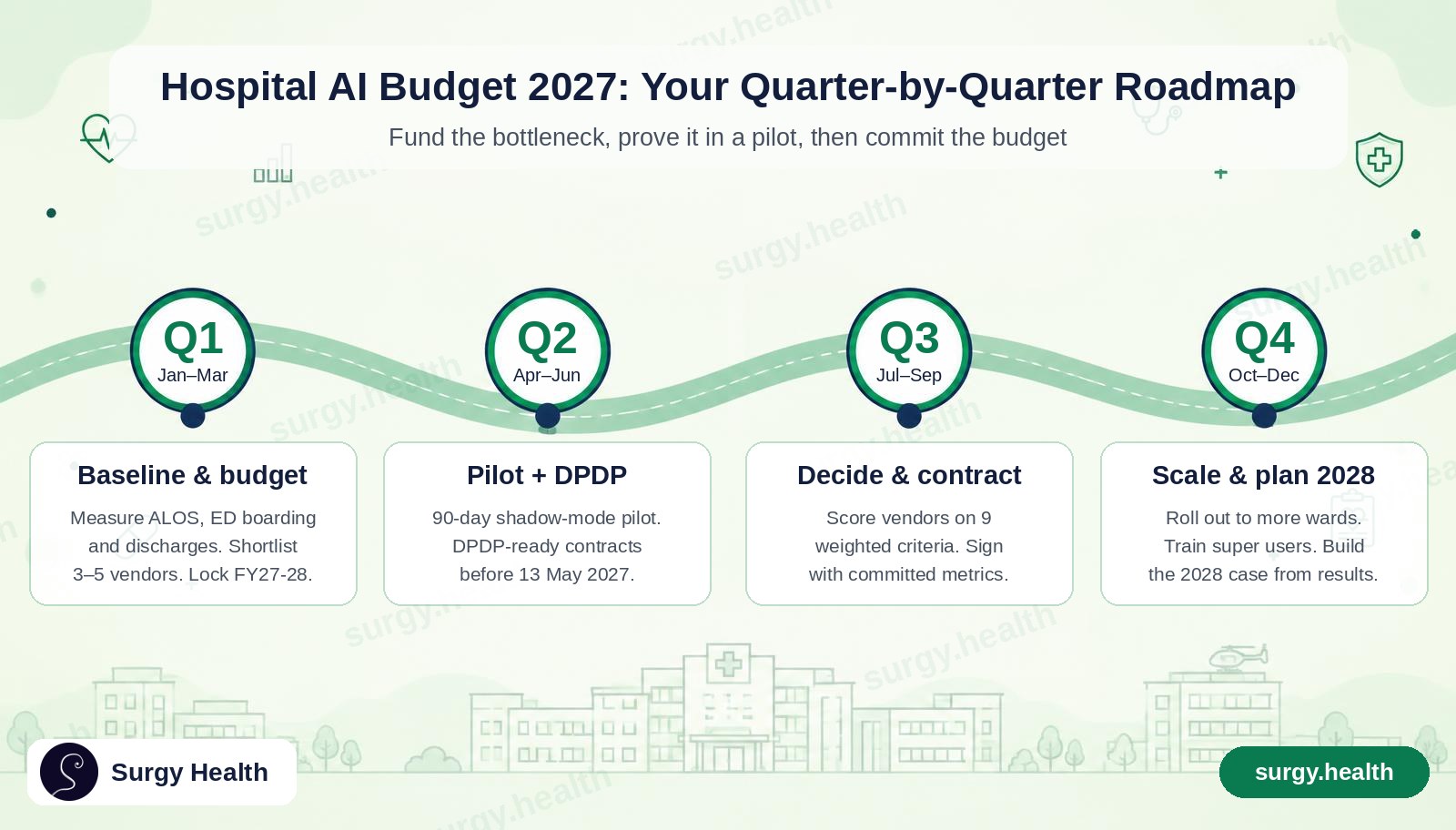
| Quarter | Focus | Key actions | What you should have at the end |
|---|---|---|---|
| Q1 (Jan–Mar 2027) | Baseline and shortlist | Measure three months of discharge-before-noon %, ALOS, ED boarding hours and bed turnaround. Name your single biggest constraint. Send the 20 RFP questions in this guide to 3–5 vendors. Secure a budget line for FY 2027–28. | Baseline report, shortlist, approved budget |
| Q2 (Apr–Jun 2027) | Pilot and compliance | Start a 90-day pilot on one or two wards with predictions in shadow mode. Complete a DPDP gap analysis and sign data-processing terms before 13 May 2027. | Accuracy measured against your case managers; DPDP-ready contracts |
| Q3 (Jul–Sep 2027) | Assisted use and decision | Move the pilot into daily bed huddles with human approval of every action. Score vendors on the weighted scorecard. Negotiate committed metrics. | Go/no-go decision and signed contract |
| Q4 (Oct–Dec 2027) | Scale and plan 2028 | Roll out to more wards or sites, train super users, and build the 2028 business case from measured results. | Rollout plan and 2028 budget |
Planning with SurgyOne in 2027: a Q1 demo and a Q2 shadow-mode pilot fit this timeline, because SurgyOne's AI agent already runs in shadow mode before any action is switched on. As part of your Q1 reference checks, ask Surgy for the status of its first hospital go-live, scheduled for December 2026–January 2027.
How much should a hospital budget for AI in 2027?
Direct answer: Size the budget against the value of the bottleneck you are fixing, not against a vendor's price list. Plan for five cost buckets and release money in stages, so the largest spend follows proven pilot results.
| Budget bucket | What it covers | When to release it |
|---|---|---|
| Pilot | 90-day shadow-mode pilot on one or two wards | Q1 approval, spent in Q2 |
| Integration | Links to your HIS, FHIR R4, ABDM or NPHIES | Q2 (pilot scope), Q3–Q4 (full rollout) |
| Compliance | DPDP gap analysis and data-processing terms | Q2, before 13 May 2027 |
| Licence | Multi-year software contract | Q3, after the go/no-go decision |
| Training and change | Super users, bed huddles, new workflows | Q3–Q4, with each ward going live |
| Front-door AI (optional) | Patient CRM, AI voice agent, AI scribe | Q3–Q4, after the bed-flow pilot |
Building the business case: value the gain in released bed-days, extra elective throughput and lower overtime, using your own census, ALOS and payer mix. Johns Hopkins said its command center created the equivalent of 16 additional beds of capacity. Then use the weighted scorecard to show the board why one vendor wins.
2. What does AI resource allocation in hospitals mean?
Direct answer: An AI resource allocation solution predicts demand for scarce hospital resources (beds, nurses, operating rooms, equipment and supplies) and recommends how to deploy them. It moves a hospital from reporting yesterday's occupancy to anticipating tomorrow's discharges and admissions, so bed managers and charge nurses can act before a bottleneck forms.
AI resource allocation works at three levels:
| Level | Question answered | Example output |
|---|---|---|
| Descriptive | What is happening now? | Live bed status, current census, today's admissions and pending discharges |
| Predictive | What will happen? | "14 patients likely ready for discharge in 24–48 hours"; tomorrow's ED arrivals |
| Prescriptive | What should we do? | "Prioritise discharge paperwork for Ward 5B"; "open the discharge lounge at 10:00" |
Resources in scope:
- Beds: bed assignment, bed turnaround, expected discharge date (EDD), ED boarding.
- Staff: acuity-based staffing, nurse-to-patient ratio, overtime, float pools.
- Operating rooms: block utilization, case-duration prediction, release of unused blocks.
- Equipment and supplies: infusion pumps, ventilators, theatre consumables.
Why it matters: in a landmark Lancet study across 300 hospitals in nine European countries, Aiken and colleagues found that each additional patient per nurse was associated with a 7% increase in the odds of a surgical patient dying within 30 days of admission. Getting resource allocation wrong is a patient-safety problem, not just a cost problem.
3. Which type of solution do you need? Three types and a decision tree
Direct answer: Hospitals usually choose between three types of AI resource allocation solution. HIS/EHR-native modules, such as SurgyOne, are the simplest to integrate because the AI runs on the hospital's own record. Dedicated capacity platforms offer deeper optimization for specific areas. Command centers add a central team and the highest cost.
The three types
- HIS/EHR-native modules. Capacity and discharge features built into the hospital information system itself. Examples include SurgyOne for India and GCC hospitals, Epic's capacity tools and Oracle Health capacity management. Strength: no extra interfaces, one patient record, predictions shown where staff already work. Trade-off: usually narrower than specialist tools in areas such as OR scheduling.
- Dedicated capacity platforms. Specialist software for OR, infusion, inpatient flow and staffing, such as LeanTaaS (iQueue), Qventus and TeleTracking. Strength: mature algorithms and published results. Trade-off: needs robust HL7/FHIR feeds from your EHR, and is mostly built for US workflows.
- Command centers. A physical or virtual hub with real-time data walls, predictive tiles and a cross-functional team, such as GE HealthCare Command Center. Strength: system-wide coordination across many hospitals. Trade-off: the highest cost and change-management load.
Decision tree
An AI-first HIS with a built-in ward board, such as SurgyOne (Type 1)
A patient-flow platform on top of your current EHR (Type 2)
Multi-hospital group with a transfer centre? → also evaluate a command center (Type 3)
Dedicated OR capacity platform (Type 2), or an EHR-native OR module if mature
Acuity-based staffing / AI nurse scheduling tool integrated with HR and rostering (Type 2)
Front-door demand
The other half of capacity: patients before the ward
Bed-flow AI frees capacity, but demand starts earlier, with enquiries, appointments and follow-ups. SurgyCRM captures enquiries from the website, WhatsApp, calls and referrals and manages each patient journey. It has two AI arms:
- SurgyFrontDesk: an AI voice agent that answers patient calls, books appointments and sends reminders on your existing phone line.
- SurgyScribe: turns consultations into EHR-ready clinical notes, so doctors spend more time with patients.
Alongside SurgyOne, front-door demand data helps you plan admissions on the ward board. Budget for it as a second phase, in Q3–Q4.
4. The 9-criteria checklist (with how SurgyOne measures up)
Direct answer: Evaluate every AI resource allocation vendor on nine criteria: problem fit, data readiness, integration, forecast accuracy, workflow and explainability, security and compliance, ROI/TCO, implementation, and vendor viability. For each criterion, ask the listed questions, watch for the red flag and require evidence rather than slideware. SurgyOne is assessed against each one below.
Criterion 1 — Problem fit and use-case coverage
- Why it matters: A tool that optimizes OR blocks will not fix ED boarding. Buy for your measured constraint.
- Questions to ask: Which resources do you cover today: beds, staff, OR, equipment? Which are on a published roadmap? Do you cover OPD, IPD and ER on one view?
- Red flag: "Our AI optimizes everything" with no use-case-specific reference sites.
- Evidence: Johns Hopkins opened its Judy Reitz Capacity Command Center, built with GE Healthcare Partners, in 2016. It reported a 60% improvement in its ability to accept complex patients from other hospitals and a 70% reduction in transfer delays from the operating room after procedures. Those were targeted problems with targeted metrics.
- How SurgyOne measures up: Strong fit for bed flow. SurgyOne puts OPD, IPD and ER on one shared ward board, and SurgyIPD flags patients likely to be ready for discharge 24–48 hours ahead. It does not cover OR scheduling, staff rostering or census forecasting, so pair it with a specialist tool if those are your main constraint.
Criterion 2 — Data readiness
- Why it matters: Predictions are only as good as admission, discharge and transfer (ADT) timestamps, bed status and orders data. Many Indian hospitals still record discharges hours after the patient leaves.
- Questions to ask: What minimum data fields and history do you need? How do you handle missing or late ADT events? How long before predictions are reliable?
- Red flag: The vendor cannot tell you which fields drive the model.
- Evidence: Wei and colleagues (Communications Medicine, 2024) used three years of EHR data from Oxfordshire, UK, to predict discharges in the next 24 hours, and found that performance varied across patient subgroups. Data quality and completeness drive accuracy.
- How SurgyOne measures up: Because SurgyOne is the hospital information system, admissions, transfers, orders and discharges are recorded in the same system the AI reads from. There is no separate feed to build or keep in sync. The trade-off is that adopting SurgyOne means adopting a new HIS, not adding a layer to your existing one.
Criterion 3 — Integration (HL7 v2, FHIR R4, ABDM M1–M3, NPHIES)
- Why it matters: Capacity tools depend on real-time data, and national health exchanges now mandate standards.
- Questions to ask: Do you expose and consume HL7 FHIR R4 resources? In India, what is your ABDM status for M1 (ABHA), M2 (Health Information Provider) and M3 (Health Information User)? In Saudi Arabia, are you certified on NPHIES?
- Red flag: "We integrate with anything" but no named live interfaces.
- Evidence: India had 97.61 crore ABHA IDs and 119.95 crore linked health records as of 17 September 2026 (Press Information Bureau). NPHIES, run by Saudi Arabia's Council of Health Insurance, uses FHIR version 4.0.1.
- How SurgyOne measures up: SurgyOne supports HL7 FHIR R4 and is built for ABDM in India and NPHIES in Saudi Arabia, with GST and ZATCA e-invoicing settings. Ask Surgy for current milestone and certification status during evaluation.
Criterion 4 — Forecast accuracy and validation
- Why it matters: Accuracy varies widely by horizon and setting. Vendor-reported numbers rarely transfer unchanged to your hospital.
- Questions to ask: What is the accuracy on a back-test using our data? How does it compare with our current case-manager estimate? How do you detect drift?
- Red flag: A single headline accuracy number from another country, with no local back-test.
- Evidence: Vanderbilt researchers (JAMIA, 2021) predicted next-day discharge across 26,283 inpatient stays with an AUC of 0.92 when EHR audit-log data was included, against 0.86 without it. A single-centre study at Houston Methodist, published in JAMA Network Open on 3 September 2026 (22,349 stays), found that 24 hours before discharge, 79.5% of case-manager estimates fell within one day, against 37.9% for a commercial EHR-integrated AI tool. Always benchmark against your own people.
- How SurgyOne measures up: Surgy has not yet published accuracy figures for SurgyOne's discharge-readiness predictions. What SurgyOne does provide is a shadow mode: the AI agent runs with actions disabled until it passes an evaluation that includes clinician-written cases. Use the shadow-mode phase of a pilot to measure accuracy against your own case managers.
Criterion 5 — Workflow and explainability (human-in-the-loop)
- Why it matters: Predictions only create value when a bed manager, charge nurse or consultant acts on them in the daily huddle.
- Questions to ask: Where does the prediction appear? Must a human approve before any action is taken? Is every action logged under a named user?
- Red flag: The AI "auto-assigns" beds or shifts without approval or an audit trail.
- Evidence: Levin and colleagues (BMJ Innovations, 2021) found that machine-learning discharge predictions decreased length of stay when they were embedded in multidisciplinary rounds.
- How SurgyOne measures up: This is SurgyOne's core design principle. Predictions appear on the ward board staff already use. The AI agent drafts tasks but acts only after a staff member approves, and every step is logged under that user. The agent cannot order tests, sign results, triage or discharge patients.
Criterion 6 — Security and compliance (DPDP Rules 2025, ISO 27001/SOC 2, data residency)
- Why it matters: Capacity data is patient data. In India, core DPDP obligations apply from 13 May 2027, covering notice, consent, security safeguards, breach intimation and data-principal rights.
- Questions to ask: Which certifications do you hold today? Where is data stored and processed? Is any patient data sent to a third-party AI service? How do you support DPDP consent, erasure and breach reporting?
- Red flag: "HIPAA-compliant" stated as a certification (there is no HIPAA certification), or "in progress" presented as "certified".
- Evidence: The DPDP Rules 2025 were notified by MeitY on 13 November 2025 and phase in over 18 months, with the core obligations effective 13 May 2027.
- How SurgyOne measures up: SurgyOne's agent is designed to run on MedGemma, Google's open medical AI models, hosted and managed on Surgy's own infrastructure, so patient records are not passed to a third-party AI service. The agent only sees what the signed-in user is permitted to see. Data is tenant-isolated, encrypted in transit and at rest, with role- and branch-scoped permissions, a full audit trail and DPDP consent controls. Surgy does not currently claim ISO 27001, SOC 2 or HIPAA certification; ask for its security documentation in your RFP.
Criterion 7 — ROI and total cost of ownership
- Why it matters: The return comes from released bed-days, more elective throughput, lower overtime and avoided capital spend, not from licence discounts.
- Questions to ask: What is the full 5-year TCO, including integration, training and internal staff time? Which baseline metrics will you commit to moving?
- Red flag: ROI calculated on national averages instead of your census and payer mix.
- Evidence: Johns Hopkins said its command center had "essentially created 16 additional beds of capacity" without opening new beds, alongside an 80% fall in OR holds and a 20% reduction in ED boarding (HealthLeaders).
- How SurgyOne measures up: SurgyOne has no customer outcome numbers yet because its first go-live has not happened. Its cost case rests on consolidation: OPD, IPD, ER, labs, pharmacy and billing run on one login and one record, so the AI does not require a separate capacity platform plus interfaces. Use a pilot to set your own baseline.
Criterion 8 — Implementation and change management
- Why it matters: Flow tools succeed because they change who meets, when, and with what information.
- Questions to ask: What is the typical time to first value? Who on our side must be dedicated? What do you do when adoption stalls?
- Red flag: "Plug and play, no change required."
- Evidence: In a JAMA Surgery randomized trial of 683 patients at Memorial Sloan Kettering, putting machine-learning case-duration predictions into the scheduling process improved accuracy and cut average patient wait time by 33 minutes, without increasing surgeon wait time between cases.
- How SurgyOne measures up: SurgyOne is available for demos and pilots now, and Surgy's first hospital go-live is scheduled for December 2026–January 2027. Early adopters should expect to co-design rollout with Surgy and plan for a full HIS implementation, not a plug-in.
Criterion 9 — Vendor viability and references
- Why it matters: Your operations will depend on this vendor for 5–10 years.
- Questions to ask: Can we speak with reference hospitals of similar size and region? What are your KLAS, G2 or Capterra ratings? What is your support footprint in India and the GCC?
- Red flag: No references in your region, or only logo slides.
- Evidence: Independent evaluation can diverge from vendor claims. In July 2026, a Health Foundation analysis reported by Novara Media found "no meaningful difference" in discharge delays at NHS trusts using a Palantir-based discharge tool, while NHS England's claimed improvement covered long-stay discharges only.
- How SurgyOne measures up: SurgyOne launched on 23 October 2026, so it has no live HIS references yet. Surgy Health began in 2020 as a design studio in Bengaluru and moved into hospital AI software in 2024. Its AI products serve more than 4,000 healthcare users across 10 hospital groups and 500-plus centres in India, Kuwait and Bahrain. Ask to speak with those customers about Surgy as a partner.
5. Weighted scorecard
Direct answer: Weight the nine criteria to your priorities, then score each vendor from 1 to 5 using the scoring guide below, based on evidence rather than demos. Multiply each score by its weight and add them up for a total out of 5. Any vendor scoring below 3 on security and compliance is disqualified, whatever its total.
Step 1: Score each criterion with this guide
| # | Criterion | Weight | 1 = Weak | 3 = Acceptable | 5 = Strong | Evidence to request |
|---|---|---|---|---|---|---|
| 1 | Problem fit / use-case coverage | 15% | Doesn't address your main constraint | Covers your main constraint, but without a comparable live site | Covers your main constraint with a live reference site like yours | Use-case reference site |
| 2 | Data readiness | 10% | Can't say which data fields it needs | Clear field list, but needs extra data work before go-live | Works with the data you already have, with a written gap analysis | Data-field specification, gap analysis |
| 3 | Integration (FHIR R4, ABDM, NPHIES) | 15% | No named live interfaces | FHIR R4 support, with ABDM/NPHIES in progress | Live FHIR R4 plus the ABDM milestones or NPHIES certification you need | Live interface list, certification |
| 4 | Forecast accuracy and validation | 15% | Only headline numbers from other sites | Accuracy reported from a similar setting | Back-tested on your own data and at least as good as your case managers | Back-test on your data |
| 5 | Workflow and explainability | 10% | Separate app, no approval step | Shown in staff workflow, with limited explanation | In the ward board or huddle, with reasons, human approval and a named-user audit trail | Live workflow demo with your staff |
| 6 | Security and compliance | 15% | No certifications or DPDP plan | Written security documentation and a DPDP plan | Current certifications, a DPDP mapping for 13 May 2027 and confirmed data residency | Certificates, DPDP mapping, data residency |
| 7 | ROI / TCO | 10% | Licence price only | Full 5-year TCO | Full 5-year TCO, with committed baseline metrics or fees at risk | 5-year TCO, committed metrics |
| 8 | Implementation and change management | 5% | "Plug and play" | Project plan and a training approach | Named team, staffing ask, super-user model and an adoption plan | Project plan, staffing ask |
| 9 | Vendor viability and references | 5% | No references in your region | References outside your region | Comparable references in India or the GCC, plus KLAS/G2/Capterra data | References, KLAS/G2/Capterra |
Step 2: Calculate the weighted total
Multiply each score by its weight, then add the nine results. The maximum is 5.0, and multiplying by 20 gives a score out of 100. Have operations, nursing, IT and finance each score independently, then agree a final score for each criterion.
Worked example (illustrative vendors)
| # | Criterion | Weight | Vendor X score | Vendor X weighted | Vendor Y score | Vendor Y weighted |
|---|---|---|---|---|---|---|
| 1 | Problem fit | 15% | 4 | 0.60 | 5 | 0.75 |
| 2 | Data readiness | 10% | 3 | 0.30 | 4 | 0.40 |
| 3 | Integration | 15% | 4 | 0.60 | 3 | 0.45 |
| 4 | Forecast accuracy | 15% | 3 | 0.45 | 4 | 0.60 |
| 5 | Workflow and explainability | 10% | 4 | 0.40 | 3 | 0.30 |
| 6 | Security and compliance | 15% | 3 | 0.45 | 2 | 0.30 |
| 7 | ROI / TCO | 10% | 3 | 0.30 | 4 | 0.40 |
| 8 | Implementation | 5% | 4 | 0.20 | 3 | 0.15 |
| 9 | Viability and references | 5% | 4 | 0.20 | 5 | 0.25 |
| Weighted total | 100% | 3.50 / 5 (70/100) | 3.60 / 5 (72/100) |
Result: Vendor Y has the higher total but scores 2 on security and compliance, which is a hard stop. Vendor X goes forward to the pilot. This is why the compliance rule matters more than the total.
Scoring SurgyOne honestly
Score SurgyOne with the same guide. Because its first hospital go-live is scheduled for December 2026–January 2027, it can't reach 5 on forecast accuracy (criterion 4), ROI (criterion 7) or references (criterion 9) until pilot results and live sites exist. Use a Q2 2027 shadow-mode pilot to score those criteria on your own data.
Download the free RFP template and weighted scorecard (Excel + PDF)
6. SurgyOne compared with other approaches
Direct answer: SurgyOne is an HIS-native option built for India and the GCC. It leads on integration effort, local compliance and keeping AI inside clinicians' existing workflow. Dedicated capacity platforms lead on optimization depth and published outcomes. Command centers lead on system-wide coordination. The right choice depends on your bottleneck and your current HIS.
| Criterion | SurgyOne (HIS-native) | Dedicated capacity platform | Command center |
|---|---|---|---|
| Main focus | Bed flow: shared OPD/IPD/ER ward board, discharge readiness 24–48 h ahead | OR, infusion, inpatient flow, staffing | System-wide flow and transfers |
| Data feed needed | None extra (same record) | High (feeds from your EHR) | Highest (many systems) |
| Integration effort | Lowest once SurgyOne is your HIS | Medium–high | High |
| AI governance | Approve-before-act, named-user audit trail, shadow mode | Varies by vendor | Varies |
| India/GCC compliance | Built for ABDM, NPHIES, DPDP consent, GST/ZATCA | Varies; mostly US-built | Varies |
| Published outcomes | None yet (first go-live Dec 2026–Jan 2027) | Yes, mainly US | Yes, mainly US/UK |
| Gaps | No OR scheduling, rostering or census forecasting | Requires a separate HIS | Highest cost and change load |
| Dated recognitions | Launched 23 October 2026 | LeanTaaS iQueue: Best in KLAS Capacity Optimization 2025 and 2026; TeleTracking: Best in KLAS Patient Flow 2024; Qventus: KLAS score 92.5 (Nov 2024) | GE HealthCare: Frost & Sullivan 2020 Global Healthcare Command Center Company of the Year |
Recognitions reflect primarily US (KLAS) markets on the dates shown. Verify current standing before citing in board papers.
7. India and GCC compliance box
Direct answer: In India, require ABDM integration (M1–M3), FHIR R4 exchange and a written DPDP Rules 2025 compliance plan for the 13 May 2027 deadline, plus NABH-aligned audit trails. In Saudi Arabia, require NPHIES on FHIR 4.0.1. Across the GCC, confirm data residency, Arabic-language support and ZATCA e-invoicing. SurgyOne is built for ABDM, NPHIES, DPDP consent and GST/ZATCA.
India
- DPDP Act 2023 and DPDP Rules 2025: Rules notified 13 November 2025. Consent Manager provisions from 13 November 2026. Core obligations (notice, consent, security safeguards, breach intimation, retention/erasure, data-principal rights) from 13 May 2027.
- ABDM: 97.61 crore ABHA IDs and 119.95 crore linked records (PIB, 17 September 2026). Ask for M1, M2 and M3 status separately.
- Accreditation: NABH-aligned audit trails and evidence exports. JCI where applicable.
Saudi Arabia and GCC
- NPHIES: mandatory insurance exchange (eligibility, pre-authorization, claims) under the Council of Health Insurance, built on FHIR version 4.0.1.
- ZATCA e-invoicing for billing-linked modules.
- Data residency: confirm in-country or approved hosting under each GCC state's health-data rules.
- Language: Arabic UI and documents for patient-facing outputs.
8. How to run a 90-day AI pilot before committing budget (Q2–Q3 2027)
Direct answer: Run a 90-day pilot on one or two wards, ideally starting in April 2027. Use days 1–30 for a baseline with predictions in shadow mode, days 31–60 for assisted use in daily bed huddles, and days 61–90 for measured impact. Track discharge-before-noon %, bed turnaround time, ED boarding hours, overtime % and ALOS against the pre-pilot baseline.
| Phase | Days | What happens | Exit criteria |
|---|---|---|---|
| 0. Set-up | −30 to 0 | Data-sharing agreement, DPDP notice/consent review, baseline period defined | Data quality at or above agreed threshold |
| 1. Shadow mode | 1–30 | Predictions generated but hidden from frontline staff; compared with case-manager estimates daily | Accuracy meets the pre-agreed bar |
| 2. Assisted use | 31–60 | Predictions shown on the ward board and in 9 a.m. bed huddles; humans approve every action | At least 80% of huddles use the tool |
| 3. Measured impact | 61–90 | Compare metrics with baseline and control wards | Go/no-go against targets |
Starting in April puts the set-up phase in Q1 and finishes the pilot by early Q3, in time for a buying decision. SurgyOne's built-in shadow mode maps directly onto phase 1, so the AI can be evaluated against your own staff before any action is enabled.
Pilot metrics:
| Metric | Definition | Why it matters |
|---|---|---|
| Discharge-before-noon % | Discharges departing before 12:00 ÷ all discharges | Frees beds for afternoon ED and elective admissions |
| Bed turnaround time | Departure → bed marked clean and available | Exposes housekeeping and transport delays |
| ED boarding hours | Hours from admit decision to departure from ED | Boarding beyond 4 hours is a recognised safety threshold |
| Overtime % | Overtime hours ÷ total paid nursing hours | Proxy for staffing mismatch |
| ALOS | Total inpatient days ÷ discharges, case-mix adjusted | The headline capacity lever |
Context: when US hospital occupancy exceeded 85%, ED boarding exceeded the Joint Commission's 4-hour standard 88.9% of the time, with a median of 6.58 hours (Janke et al., JAMA Network Open, 2022). Johns Hopkins reported 21% more discharges before noon after opening its command center.
Planning a 90-day pilot?
Book a SurgyOne pilot conversation
We'll help you set the baseline and success metrics before day 1.
9. 20 RFP questions to send every vendor
Direct answer: Send the same 20 questions to every shortlisted AI resource allocation vendor, including Surgy, and require written, evidence-backed answers. They cover scope, data, integration, accuracy, workflow, security, commercials and references. Disqualify vendors who answer with marketing claims instead of artefacts.
Scope and fit
- Which resources do you allocate today (beds, staff, OR, equipment, supplies)? Which are roadmap-only, and with what published dates?
- Do you cover OPD, IPD and ER on one shared view?
- Are your outputs predictive, prescriptive or both? Give one example of each from a live site.
Data and integration
- List the minimum data fields and months of history your models need.
- Which FHIR R4 resources do you read and write? Do you consume HL7 v2 ADT?
- What is your ABDM status for M1, M2 and M3 (India)? Are you NPHIES-certified (KSA)?
- How do you handle data from systems you do not replace?
Accuracy and validation
- Will you back-test on our data before contract? Which metrics will you report?
- How do you compare with our case managers' current estimates?
- How do you monitor drift, and how often do you retrain?
Workflow and safety
- Does every AI action require human approval? Is every action logged to a named user?
- Can the system run in shadow mode before going live?
- How are predictions explained to the bed manager or charge nurse?
Security and compliance
- Which certifications (ISO 27001, SOC 2 Type II) do you hold today? Please attach them.
- Where is data stored and processed? Is any patient data sent to third-party AI services?
- Map your product to the DPDP Rules 2025 obligations effective 13 May 2027.
Commercials and delivery
- What is the 5-year TCO, including training and internal staff requirements?
- Which baseline metrics will you commit to moving?
- What is the implementation plan, time to first value and our required staffing?
Viability
- Provide references of similar size and region, plus current KLAS, G2 and Capterra data.
10. SurgyOne at a glance
Direct answer: SurgyOne is an agentic AI-first HIS/EHR from Surgy Health for mid-market hospital groups in India and the GCC. It allocates bed capacity through a shared OPD/IPD/ER ward board and discharge-readiness prediction 24–48 hours ahead, keeps clinicians in control with approve-before-act AI, and is available for demos and pilots now.
| Capability | Detail |
|---|---|
| Shared ward board | OPD, IPD and ER patient history and bed status on one view |
| Discharge-readiness prediction | SurgyIPD flags patients likely to be ready for discharge 24–48 hours ahead, with continuous early-warning score tracking |
| ER support | SurgyER suggests triage acuity and supports sepsis, stroke and heart-attack protocols (suggestions only) |
| Approve-before-act AI agent | Drafts tasks and acts only after a staff member approves; every step logged under that user |
| Safety limits | The agent cannot order tests, sign results, triage or discharge patients |
| Shadow mode | Actions stay disabled until the agent passes an evaluation including clinician-written cases |
| Private AI | Designed to run on MedGemma models hosted and managed on Surgy's own infrastructure; the agent sees only what the signed-in user is permitted to see and cites the source of each figure |
| Standards and compliance | HL7 FHIR R4; built for ABDM (India) and NPHIES (Saudi Arabia); DPDP consent controls; GST/ZATCA e-invoicing |
| One record | SurgyOPD, SurgyIPD, SurgyER, SurgyLabs (including radiology reading), SurgyPharmacy and SurgyBilling on one login and one patient record |
| Built for | Mid-market multi-specialty groups, typically 2+ hospitals with 500–1,500 beds |
| Availability | Demos and pilots now; first go-live scheduled December 2026–January 2027 |
What SurgyOne does not do (yet)
- OR scheduling, staff rostering and census forecasting are not part of SurgyOne's documented scope. If these are your main constraint, pair a specialist tool with your HIS, or ask Surgy about its roadmap.
- ISO 27001, SOC 2 or HIPAA certification is not claimed. Ask for Surgy's current security documentation.
- Customer outcome numbers do not exist yet, because the first go-live has not happened. Treat a pilot as a joint validation.
Next steps with Surgy
- Book a 30-minute SurgyOne ward board demo — see the shared OPD/IPD/ER board and discharge-readiness flags on sample data.
- Download the RFP template and weighted scorecard
- Estimate your ROI
- Chat on WhatsApp: +91 70644 65935 · Email: info@surgyy.com
SurgyOne by Surgy Health (surgy.health) is not affiliated with surgyone.com or any similarly named company.
11. Glossary
Direct answer: These definitions cover the operational and compliance terms hospital leaders meet when evaluating AI resource allocation, bed management and patient flow software. Align clinical, nursing, IT and finance teams on them before scoring vendors, because inconsistent definitions are a leading cause of failed pilots.
- ADT data: Admission, discharge and transfer events; the backbone of every bed-management tool.
- Census: Number of inpatients at a point in time, usually midnight.
- LOS / ALOS: Length of stay / average length of stay (inpatient days ÷ discharges).
- Expected discharge date (EDD): Clinician- or model-estimated date a patient will be medically and logistically ready to leave.
- Discharge readiness: A prediction that a patient is likely to be ready to leave within a set window, such as 24–48 hours.
- Ward board: A shared live view of patients, beds and pending tasks used in bed huddles.
- ED boarding: Admitted patients held in the emergency department awaiting an inpatient bed.
- Bed turnaround: Time from patient departure to the bed being clean and assignable.
- Block utilization: Share of allocated OR block time actually used.
- Acuity-based staffing: Allocating nurses by patient dependency and acuity rather than headcount alone.
- Early-warning score (EWS): Composite vital-signs score that flags deterioration (e.g., NEWS2).
- Shadow mode: Running an AI system with actions disabled so its outputs can be checked against human decisions.
- Approve-before-act: An AI design in which a named staff member must approve any action before it happens.
- ABDM M1–M3: Ayushman Bharat Digital Mission milestones: ABHA (M1), record linking and sharing as an HIP (M2), consent-based retrieval as an HIU (M3).
- NPHIES: Saudi Arabia's national platform for insurance eligibility, pre-authorization and claims, built on FHIR 4.0.1.
- FHIR R4: HL7 Fast Healthcare Interoperability Resources, Release 4.
- NABH / JCI: India's National Accreditation Board for Hospitals & Healthcare Providers / Joint Commission International.
FAQ
Frequently asked questions
Quick answers for hospital leaders planning the 2027 AI budget. Tap a question to open the answer.
How much should a hospital spend on AI in 2027?
There is no single right figure. Budget for five buckets: software licence, integration with your HIS and ABDM/NPHIES, staff training, a 90-day pilot, and change management. Size the total against the value of the bottleneck you are fixing, such as released bed-days, and fund the pilot first so the full spend is backed by your own results.
Which AI projects should hospitals fund first in 2027?
Fund the project that fixes your single biggest measured constraint. For most hospitals that is bed flow: late discharges, ED boarding and long length of stay. Bed flow has clear baseline metrics, and released bed-days convert directly into capacity and revenue.
How do we justify AI spend to the board?
Show a three-month baseline (discharge-before-noon %, ALOS, ED boarding hours), the weighted vendor scorecard, and results from a shadow-mode pilot on your own data. Tie the ask to released bed-days, extra elective throughput and lower overtime, and confirm the system meets DPDP obligations that apply from 13 May 2027.
Should hospitals budget for a patient CRM alongside bed-flow AI in 2027?
Yes, as a second phase. Bed flow frees capacity; a hospital CRM such as SurgyCRM fills it by capturing enquiries from calls, WhatsApp and the website and managing each patient journey. SurgyFrontDesk answers calls and books appointments, and SurgyScribe turns consultations into EHR-ready notes. Budget for these in Q3–Q4, after the bed-flow pilot.
How should hospitals plan their AI budget for 2027?
Treat 2027 as four quarters: baseline and shortlist in Q1, a shadow-mode pilot and DPDP readiness in Q2 (before 13 May 2027), a decision and contract in Q3, and scale-up plus 2028 budgeting in Q4.
When should a hospital start evaluating AI resource allocation for 2027?
In January 2027. In India, the financial year 2027–28 starts on 1 April, so Q1 is when budgets are set, and starting early leaves time to pilot before the DPDP deadline in May.
How do I choose an AI resource allocation solution for hospitals?
Identify your measured bottleneck (beds, staff or OR) and choose the matching type of solution. Then score vendors on nine weighted criteria: fit, data, integration, accuracy, workflow, compliance, ROI, implementation and viability. Validate with a 90-day shadow-mode pilot on your own data before committing.
What is SurgyOne?
SurgyOne is an agentic AI-first hospital information system (HIS/EHR) from Surgy Health, Bengaluru, built for mid-market hospital groups in India and the GCC. It runs OPD, IPD, ER, labs and radiology, pharmacy and billing on one record, with a shared ward board and AI that predicts discharge readiness 24–48 hours ahead.
How does SurgyOne help with bed allocation?
SurgyOne puts OPD, IPD and ER on one shared ward board and flags inpatients likely to be ready for discharge 24–48 hours ahead. Bed managers and charge nurses can plan discharges and admissions earlier. Every AI-drafted task needs staff approval before anything happens.
Is SurgyOne live in hospitals?
SurgyOne launched on 23 October 2026 and is available for demonstrations and pilots. Surgy Health's first hospital deployment is under contract and scheduled to go live between December 2026 and January 2027. Surgy's AI products already serve 10 hospital groups across India, Kuwait and Bahrain.
Does SurgyOne do OR scheduling or nurse rostering?
Not today. SurgyOne focuses on bed flow: a shared OPD/IPD/ER ward board, discharge-readiness prediction, ER triage acuity suggestions, FHIR R4, ABDM and NPHIES support. Ask Surgy directly about its roadmap.
Does SurgyOne send patient data to external AI services?
No. SurgyOne's agent is designed to run on MedGemma models that Surgy Health hosts and manages on its own infrastructure, so patient records are not passed to a third-party AI service. Data is tenant-isolated and encrypted in transit and at rest, with role-scoped permissions and a full audit trail.
How accurate is AI discharge prediction?
It depends on setting and horizon. Vanderbilt researchers (JAMIA, 2021) reported an AUC of 0.92 for next-day discharge. A 2026 JAMA Network Open study at Houston Methodist found case managers outperformed a commercial AI tool 24 hours before discharge (79.5% vs 37.9% within one day). Always validate locally, for example in shadow mode.
What ROI can hospitals expect from AI resource allocation?
Returns come from released bed-days, more elective throughput and lower overtime. Johns Hopkins said its command center created the equivalent of 16 additional beds of capacity. Model ROI on your own census, ALOS and payer mix, and set a baseline before any pilot.
Do AI tools replace bed managers or nurses?
No. Effective tools support human decisions. Require approve-before-act workflows, explanations for recommendations and a full audit trail. SurgyOne's agent cannot triage or discharge patients.
When do DPDP Rules 2025 obligations apply to hospitals?
The Rules were notified on 13 November 2025. Consent Manager provisions apply from 13 November 2026. Core obligations (notice, consent, security safeguards, breach intimation, erasure and data-principal rights) apply from 13 May 2027.
Is NPHIES required for hospital software in Saudi Arabia?
Yes, for insured transactions. Providers exchange eligibility, pre-authorization and claims through NPHIES, which uses FHIR version 4.0.1. SurgyOne is built for NPHIES.
13. Sources
- Aiken LH et al. Nurse staffing and education and hospital mortality in nine European countries. The Lancet, 2014.
- Wei J et al. Predicting individual patient and hospital-level discharge using machine learning. Communications Medicine, 2024.
- Zhang X, Yan C, Malin BA, Patel MB, Chen Y. Predicting next-day discharge via electronic health record access logs. JAMIA, 2021.
- Kantheti HS, Dolan C, Dale J. Artificial Intelligence–Generated Discharge Dates and Estimation Accuracy in Hospitalized Patients. JAMA Network Open, 3 September 2026.
- Levin S et al. Machine-learning-based hospital discharge predictions can support multidisciplinary rounds and decrease hospital length-of-stay. BMJ Innovations, 2021.
- Strömblad CT et al. Effect of a Predictive Model on Planned Surgical Duration Accuracy, Patient Wait Time, and Use of Presurgical Resources: A Randomized Clinical Trial. JAMA Surgery, 2021.
- Janke AT et al. Hospital Occupancy and Emergency Department Boarding During the COVID-19 Pandemic. JAMA Network Open, 2022.
- Becker's Hospital Review. Johns Hopkins Hospital launches NASA-inspired command center.
- HealthLeaders. 4 Insights to Build a Better Command Center.
- Health Data Management. Johns Hopkins Hospital command center is first of its kind.
- Novara Media. Hospitals see "no notable improvement" after using Palantir tool, July 2026.
- LeanTaaS. Named Best in KLAS for Capacity Optimization Management for the second straight year, 2026.
- Qventus. 2024 KLAS rating in capacity management.
- TeleTracking. Named 2024 Best in KLAS for Patient Flow.
- Frost & Sullivan. 2020 Global Healthcare Command Center Company of the Year.
- Press Information Bureau. Progressing Towards Universal Health Coverage (ABDM data, September 2026).
- DPDP Rules 2025 phased commencement.
- Council of Health Insurance (Saudi Arabia). NPHIES.
- Surgy Health launch release (ANI / Business Standard), 23 October 2026.
- Surgy Health.
© 2026 Surgy Innovation Labs Private Limited. Published by Surgy Health, 91 Springboard, 175 & 176 Bannerghatta Road, Dollar Layout, Bengaluru, Karnataka 560076, India.
Looking for the numbers? See the latest AI in healthcare statistics in our AI in healthcare statistics report.
Comparing vendors? Read our buyer's guide to hospital AI software
Written by
Simran Nagekar
Product Engineer — UX Design & Tech, Surgy Innovation Labs Private Limited
BSc, Computer Science with Multimedia & Animation, REVA University, Bengaluru
Connect on LinkedIn
Keep reading
DPDPA Simplified for Hospitals: What You Actually Need to Know
No certificate, no outsourcing shortcut. What India's DPDP Act and DPDP Rules 2025 require of hospitals, the May 2027 deadline, penalties and how to start.


AI in Healthcare Statistics 2026: 100+ Data Points from Primary Sources
AI in healthcare statistics for 2026 from primary sources: hospital and doctor adoption, market size, barriers, FDA AI devices, AI scribes, patient trust, India and GCC.