

Building the AI-First Hospital: Inside Surgy Health's Vision for Healthcare in India and the GCC
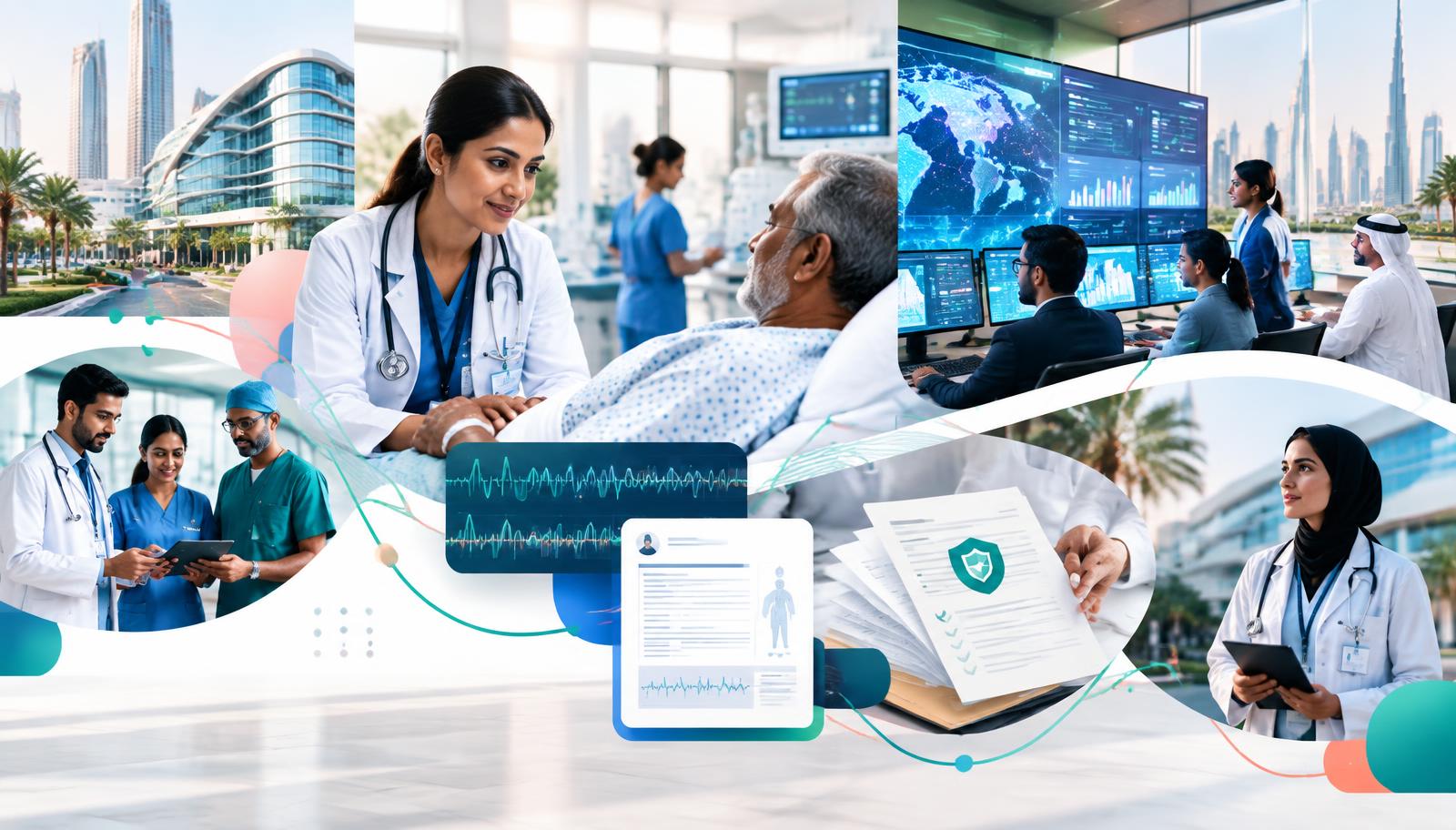
Inside Surgy Health’s AI-first vision for connected clinical, patient, workforce, revenue and operational workflows across hospitals in India and the GCC.
Key takeaways
- An AI-first hospital uses intelligence inside clinical, patient, workforce, operational and revenue workflows — not as a chatbot added after the workflow is built.
- Surgy Health’s six products work independently but share context, allowing documentation, follow-up, training, analytics and claims work to form a connected operating system.
- The strongest hospital AI outcomes come from closed loops: an insight becomes an approved action, and the resulting outcome returns to the same patient or operational record.
- AI-first healthcare still requires human review, consent, access controls and audit trails; AI-native architecture is not a substitute for governance.
Healthcare technology has quietly crossed a line. For a decade, “digital hospital” meant a records system that stored data. Today, the systems that matter are the ones that act on it — agents that draft the clinical note while a doctor is still talking, chase a denied insurance claim before it becomes bad debt, and answer a patient’s call at 2 a.m. without putting them on hold. At Surgy Health, this shift is not a feature we are adding. It is the reason the company exists.
We are Surgy Innovation Labs Private Limited, an AI-first healthtech company based in Bengaluru, building software for mid-market hospitals across India and the GCC. Our thesis is simple to state and hard to execute: remove the AI from any Surgy Health product and there should be no product left — just a form. That is a deliberate contrast to the industry norm, where AI is retrofitted onto decades-old hospital information systems as a chatbot or copilot. We build AI-native from the first line of code because hospitals that wait to retrofit intelligence later inherit the technical debt without the full advantage.
What does “AI-first” actually mean for a hospital?
It means every workflow — from the moment a patient books an appointment to the moment a claim is settled — can have an AI system watching, structuring or acting on it in real time, rather than a person retyping the same information into three screens. For a hospital administrator, the practical difference appears in four places we design around explicitly: clinical outcomes, patient experience, the daily burden on an overstretched workforce and, because none of the first three is sustainable if a hospital cannot collect what it is owed, revenue and claims receivables.
That four-part mandate is not marketing language; it is our product roadmap. Every module we ship is evaluated against it before anything else.
Why hospitals cannot out-wait this shift
The pressure is not hypothetical. The World Health Organization now projects a global shortfall of about 11 million health workers by 2030, concentrated largely in low- and lower-middle-income countries. Indian clinicians also spend substantial time on documentation; the often-cited two-to-four-hour daily range is an industry estimate that varies by specialty, facility and workflow. Meanwhile, a 2025 Bain & Company and HealthQuad analysis estimated India’s EMR adoption at roughly 35% — well below mature Western markets, with many facilities still using paper or fragmented point systems.
That gap is not simply a weakness in the Indian and GCC hospital market — it is an opportunity. A hospital that never fully digitised on 2010-era software has less to rip out. It can adopt an AI-native product as its first system rather than retrofit intelligence onto twenty-year-old infrastructure. Regional investment reflects the same direction: PitchBook data cited by WHX reported more than $148 million flowing into GCC digital health, AI diagnostics and telehealth companies from January 2025 through July 2026, with Saudi Arabia leading the activity.
The Surgy Health suite: six products, one connected hospital
Surgy Health’s product suite launched commercially in October 2025 and has since reached more than 4,000 users across 242+ centres in India, Kuwait and Bahrain, based on our internal deployment records. Six products make up that suite today. Each is independently useful, but each can connect with the others so hospital data moves between workflows instead of being entered again by hand.
SurgyScribe converts a doctor-patient conversation into structured clinical notes: voice in, documentation out, with minimal manual typing. At a Kuwait clinic deployment, documentation time fell from 10–15 minutes to roughly one minute per consultation, according to customer-reported implementation data from a multilingual outpatient department operating in English and Arabic. A separate multi-location hospital group reported comparable gains.
SurgyLearn is a hospital-run staff academy. Upload an SOP, policy document or training video and AI helps generate a course, quiz bank and certification trail. It is standardising training across a 240+ centre dialysis network and is live with Al Salam Hospitals in Kuwait and Bahrain.
SurgyFrontdesk is an AI voice agent for answering, routing and resolving patient calls. It handles appointment requests, reminders and follow-ups so front-desk teams can focus on conversations that genuinely need a person.
SurgySettle, currently piloting with Mediversal Hospitals, addresses pre-authorisation, payer queries and TPA, insurer and government-scheme claim reconciliation so preventable denials and delays do not become silent revenue leakage.
SurgyInsights gives hospital leaders a conversational view of operational, financial, workforce and clinical KPIs. It can begin with CSV or Excel exports, without requiring a separate integration project for every source.
SurgyCRM is the connective tissue
SurgyCRM was built around six recurring failures we found while studying mid-market hospital groups: enquiries scattered across WhatsApp, walk-ins and call centres; patients disappearing after OPD; complaints reaching department heads too late; referral visits recorded without an audit trail; invisible consultation-to-surgery and OPD-to-IPD funnels; and hospital websites that do little more than display a contact form.
Patient Experience captures feedback at the point of care and routes urgent issues to the responsible team. Lead Management brings website, WhatsApp, walk-in, chatbot, call-centre and referral enquiries into one tracked inbox. Patient Journey Management runs protocol-driven pathways across specialties, with missed milestones prompting follow-up. SurgyField extends that accountability outside hospital walls through geo-verified field visits, referral-partner records and revenue attribution.
The deeper connection is with SurgyScribe. A completed consultation can feed pharmacy, investigation, admission and surgical follow-up into SurgyCRM. When a patient does not fill a prescription, complete an advised investigation or return for a recommended admission, the platform can surface that gap as an action rather than leaving it hidden in separate systems. SurgyFrontdesk can then execute the approved outreach.
Proof, not promises: what’s already happening on the ground
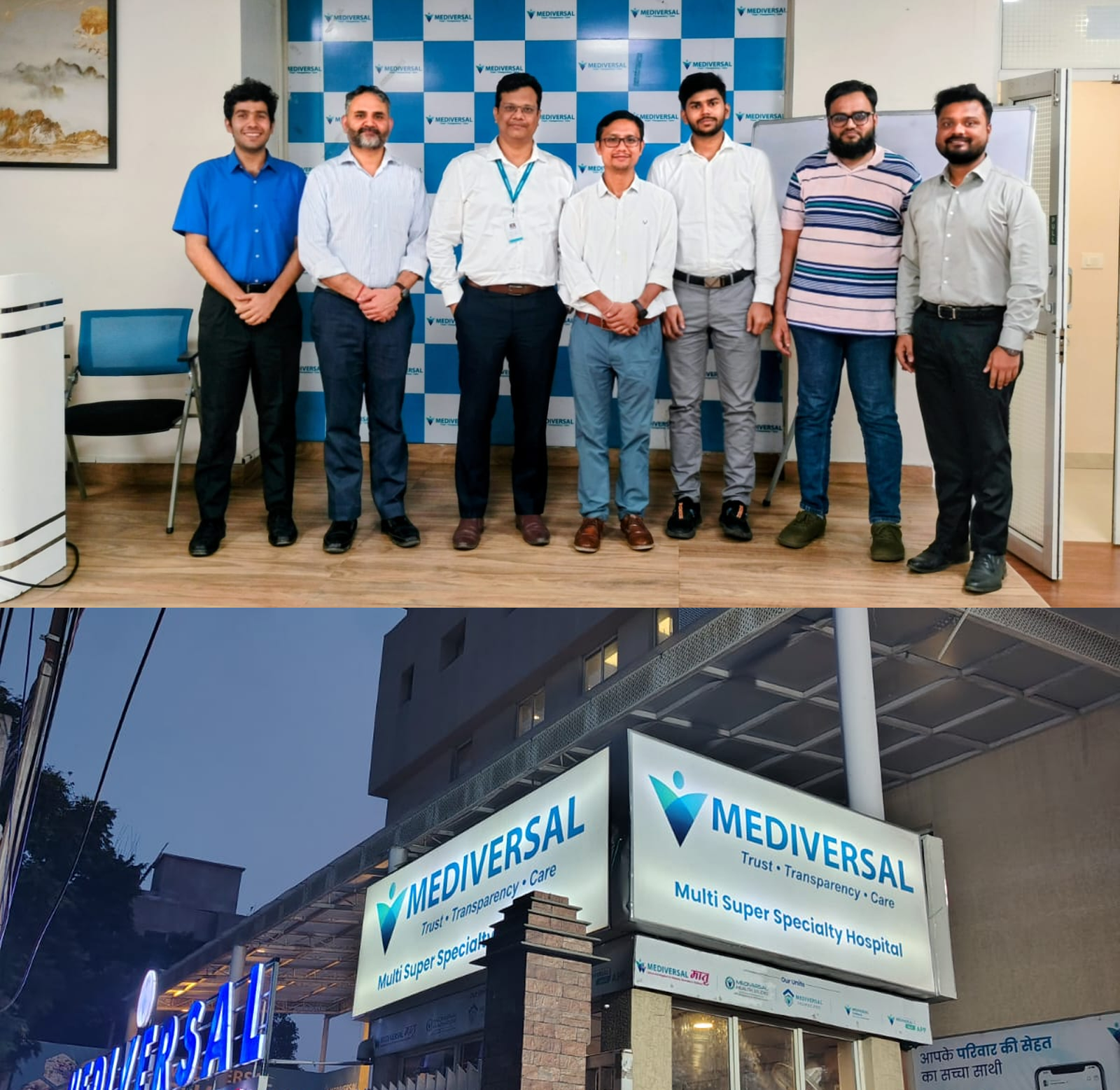
Numbers matter more than adjectives in healthcare software. We recently spent time at Mediversal Hospitals in Patna, Bihar, with its COO, CEO and operations leadership. Mediversal uses SurgyCRM and SurgyLearn across its ecosystem, alongside support for its 24/7 mobile app. The visit deepened three areas of work: strengthening the live SurgyCRM implementation, reviewing SurgyLearn across the staff base and scoping SurgySettle around TPA claims reconciliation. Seeing the problem inside a live revenue cycle, rather than in a specification, sharpened how SurgySettle needs to work.
Other published customer stories include Apollo Clinic Kuwait for SurgyScribe, Al Salam Hospitals across Kuwait and Bahrain for SurgyLearn, and DCDC Kidney Care, where SurgyLearn has standardised compliance and clinical training across a national network of 240+ dialysis centres. Read the detailed DCDC Kidney Care case study.
The flagship: powering India’s first compact proton therapy network
Our most significant deployment mandate to date is with ARISTION Proton Cancer Center. As reported by IndiaMedToday, ARISTION has partnered with Israeli proton-therapy manufacturer P-Cure to build India’s first compact, synchrotron-based proton therapy network — a reported investment of about ₹1,900 crore, beginning at Bengaluru’s Sentient Health City, with Kochi and another major metropolitan city planned. Surgy Health is ARISTION’s AI technology partner across hospital operations, clinical workflows and patient experience.
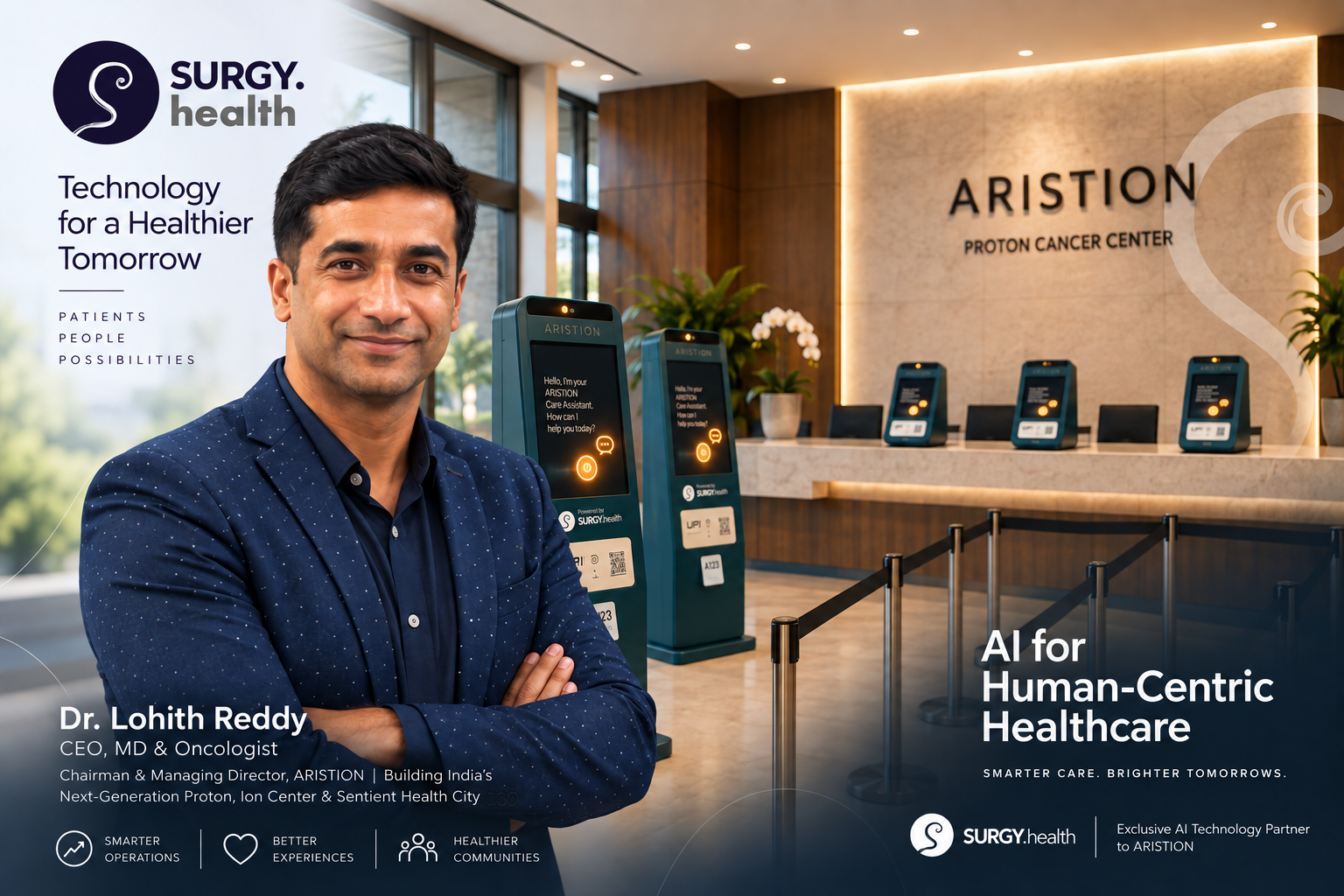
The mandate applies the four-part thesis from this article at the scale of a quaternary cancer campus: connect outpatient, inpatient, emergency, laboratory, pharmacy and billing workflows, with the clinical depth required for a longitudinal record spanning proton therapy, chemotherapy and surgery. It is evidence that an AI-first architecture can be designed for both a mid-market outpatient clinic and a technically demanding cancer-care environment without treating either as an afterthought.
Recognition beyond our own customers
Business Upturn profiled Surgy Health as a Bengaluru healthcare-AI startup automating hospital clinical documentation and patient engagement. It traced our path from Surgyy Design Labs, the UX studio our founders built, into a focused healthcare product company. The pivot came from wanting company growth to become less dependent on billable hours and more connected to outcomes delivered repeatedly through software.
Where healthcare AI is headed — and why that favours us
The industry is moving towards agentic systems that do not just summarise a chart but act inside an approved workflow: initiating follow-up, routing a claim, or flagging a care gap before it becomes a readmission. The value is not an impressive standalone answer. It is the closed loop between insight, action and a recorded outcome.
Regulation and accreditation are moving in the same direction. India’s Digital Personal Data Protection Act, NABH’s digital-health expectations and GCC accreditation frameworks such as CBAHI in Saudi Arabia and DHA standards in Dubai all increase the need for structured, interoperable and auditable data. AI-native products still need strong consent, access controls, human review and audit trails; being AI-first is not permission to be governance-last.
There’s a lot more coming
Six live products are the foundation, not the ceiling. Our roadmap extends towards a unified AI-native hospital operating system — internally, we call the broader vision Surgy-One — connecting outpatient, inpatient, emergency, laboratory, pharmacy and billing workflows. We are deepening SurgySettle into a claims-settlement and payment-reconciliation product, extending governance for India and the GCC, and continuing to expand from India, Kuwait and Bahrain into Qatar and Saudi Arabia.
We are also investing in multilingual clinical speech models for the English, Hindi and Arabic mix hospitals actually use. The next generation of healthcare AI needs to work in the languages spoken between doctors and patients, not only those most represented in foundation-model training data.
Our vision, in one sentence
Surgy Health exists to make hospitals AI-first by design and seamless in practice — products that clinicians, patients and hospital staff feel disappear into their workflow, measured against four outcomes we do not compromise on: better clinical outcomes, a genuinely better patient experience, real relief for an overburdened healthcare workforce, and stronger hospital revenue and claims receivables.
References
- World Health Organization — Health workforce: projected global shortfall by 2030. https://www.who.int/health-topics/health-workforce
- Bain & Company and HealthQuad — India Health Tech Report 2025: electronic medical record adoption in India.
- WHX / PitchBook — GCC digital health funding reported from January 2025 through July 2026.
- IndiaMedToday — ARISTION and P-Cure partnership for a compact proton therapy network in India.
- Business Upturn — Surgy Health company profile and founder interview.
- Surgy Health internal deployment and customer reporting, September 2026. Customer metrics are self-reported unless otherwise stated.
Written by
Mohammed Jamil Nasir
Founder — Product & Tech, Surgy Innovation Labs Private Limited
14+ years in Product, Design & Tech · PGC AI/ML, IIT-Guwahati · Global MBA, SP Jain · BE-CSE
Mohammed Jamil Nasir leads product and technology at Surgy Innovation Labs Private Limited, building AI-first, seamless healthcare products for hospitals and healthcare networks across India and the GCC. He writes about healthcare AI, accreditation, and clinical operations.
Connect on LinkedInKeep reading
AI-Driven Revenue Cycle Management: How Indian Hospitals Are Reducing AR Days by 30%
Stop revenue leakage at the source. How AI-powered clinical capture, automated discharge, and ABDM alignment are reshaping hospital finance in 2026.
The Hospital Chatbot Playbook: How SurgyCRM Turns Website Visitors Into Patients, 24/7
A healthcare-native chatbot doesn't just answer questions — it captures the lead, triages urgency, and hands your team a warm patient conversation. Here's how Surgy Assist, SurgyCRM's on-site AI chatbot, closes the gap between 'answered' and 'converted'.