

Hospital CRM Systems Compared: Which Should You Choose?
A weighted 12-point benchmark, five approaches compared on 16 capabilities, and 12 named platforms with October 2026 prices and India/UAE hosting.

Key takeaways
- Three kinds of software are sold as "hospital CRM": HIS modules, generic sales CRMs with a healthcare template, and healthcare-native CRMs. Know which one you are looking at.
- Score every vendor on the same weighted 12-point benchmark, live in the demo, on your own workflows.
- For most mid-sized hospitals and groups in India and the GCC, a healthcare-native CRM such as SurgyCRM is the strongest fit.
- Check WhatsApp, India or UAE hosting and DPDP support in writing before you sign, and add implementation and message fees to the true first-year cost.
Most hospitals don't lose patients to a better surgeon down the road. They lose them to an unanswered WhatsApp message, a call-back that never happened, or a follow-up nobody owned. A hospital CRM exists to stop that leakage, but the market sells three very different kinds of product under one label.
This guide compares 12 platforms and five approaches on the same benchmark, with October 2026 list prices and India and UAE hosting options.
Quick answer: for most mid-sized hospitals and hospital groups in India and the GCC, a healthcare-native hospital CRM such as SurgyCRM is the strongest fit. It runs enquiries, calls, treatment journeys, referrals and patient feedback on one record, and is configured in days. Choose Salesforce Health Cloud or Microsoft Dynamics 365 if you have a partner and budget for a long build, LeadSquared for a call-centre-led lead operation, and Zoho CRM or Freshsales if licence cost matters most and you can configure it yourself.
What is a hospital CRM, and how is it different from an HIS?
A hospital CRM manages the patient relationship around clinical care: every enquiry, call-back, appointment, treatment milestone, follow-up and piece of feedback, plus the channels and referral partners that brought each patient in. Your HIS or EHR records care and billing. The CRM covers everything before a patient is billed, and everything after, until they recommend you or don't.
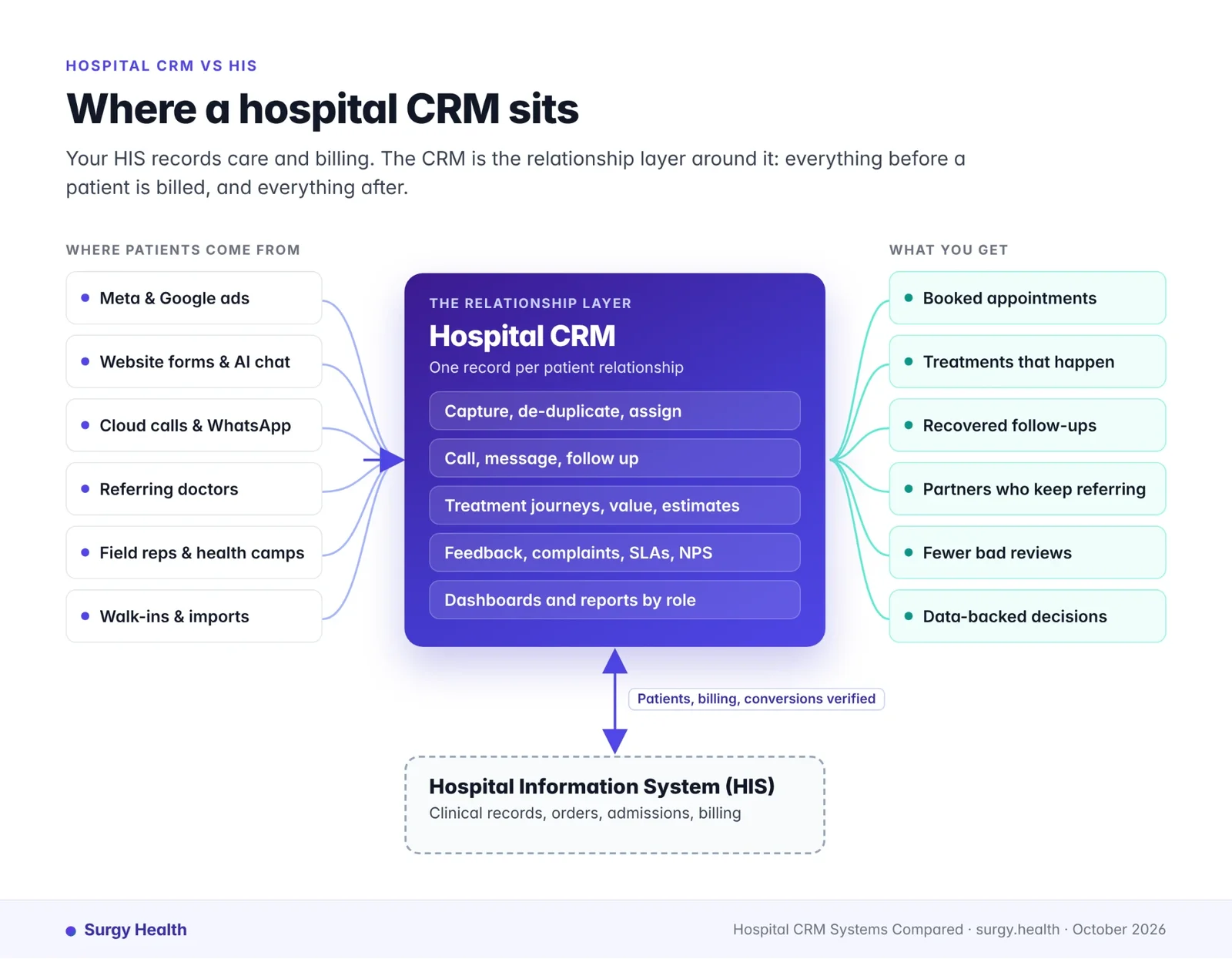
That distinction matters when you compare vendors, because three different kinds of software are sold as "hospital CRM":
| System | Built to answer | Strong at | Weak at |
|---|---|---|---|
| HIS / EHR / HMS | What care did this patient get, and what was billed? | Clinical records, orders, admissions, billing | Enquiries that never become a registration; follow-up and feedback outside the visit |
| Generic sales CRM | Which deal closes this quarter? | Pipelines, email, deep configurability | Patient journeys, milestones, treatment value and bedside feedback all need custom build |
| Hospital CRM | What is our relationship with this patient right now, and what happened to it? | Omnichannel enquiries, follow-ups, treatment journeys, referrals, patient experience | It is not a clinical record; it should connect to your HIS, not replace it |
A quick test in any demo: if it opens on "deals" and "opportunities", it is a sales CRM with a healthcare template. If it opens on "encounters" and "orders", it is an HIS module. A hospital CRM opens on the enquiry and the patient journey.
The benchmark: 12 criteria to score any hospital CRM
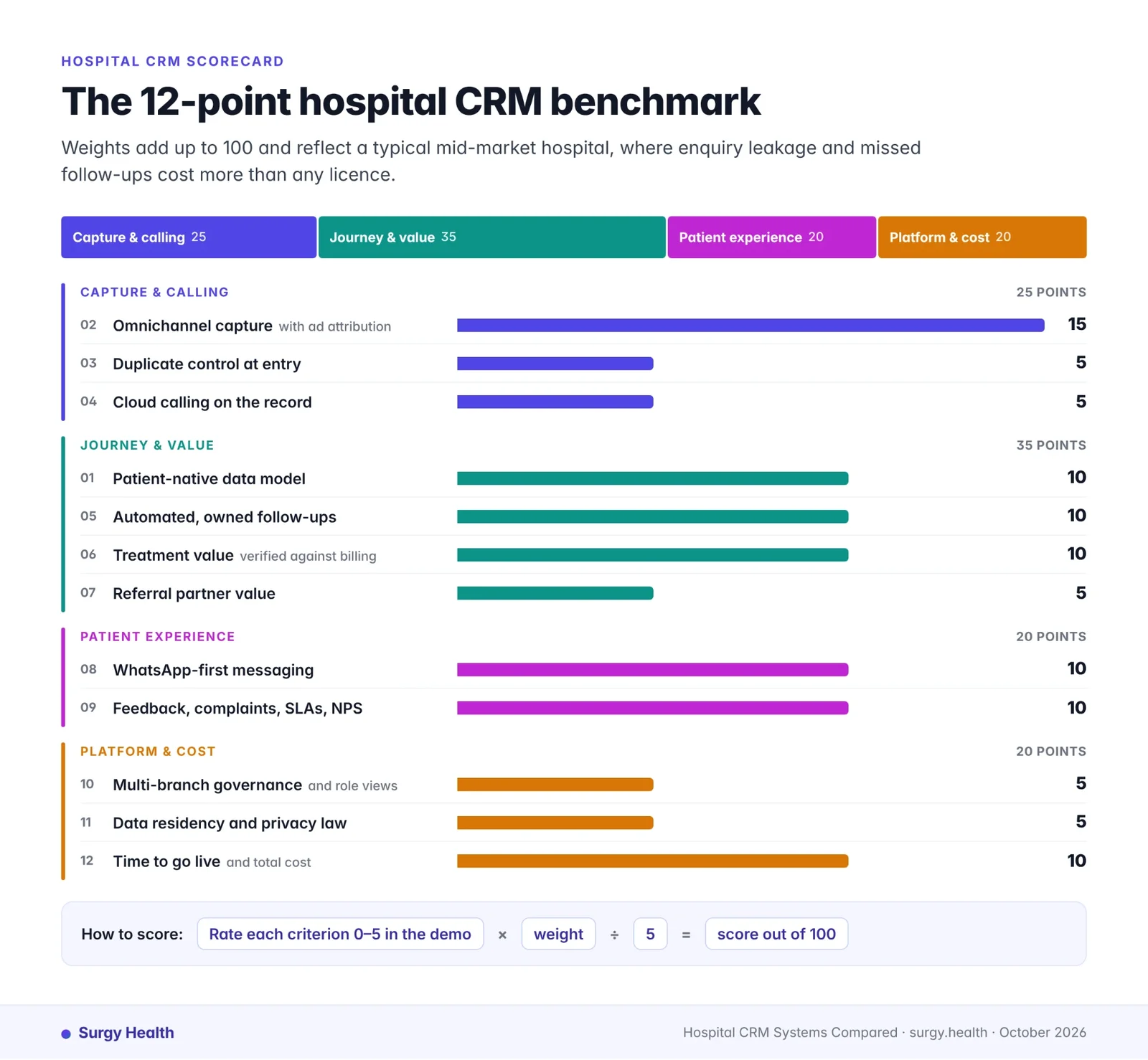
Score every shortlisted vendor on the same 12 criteria, weighted by what moves admissions, revenue and patient experience. Rate each criterion 0–5 in the demo, multiply by its weight, and divide by 5 for a score out of 100.
| # | Criterion | Weight | What good looks like | Red flag in the demo |
|---|---|---|---|---|
| 1 | Patient-native data model | 10 | Patients, treatment journeys and milestones are core objects | "We'll rename Deals to Patients" |
| 2 | Omnichannel capture with ad attribution | 15 | Meta and Google ads, website, chatbot, calls, walk-ins, field reps and referrals land in one inbox, campaign names kept | A separate inbox or export per channel |
| 3 | Duplicate control at entry | 5 | Repeat enquiries from the same number merge as touchpoints automatically | Duplicates cleaned up by a monthly report |
| 4 | Cloud calling on the record | 5 | One-tap dialling; direction, outcome and recording on the patient timeline | Agents log calls by hand |
| 5 | Automated, owned follow-ups | 10 | Each stage and milestone creates a task with a named owner and due date | Follow-ups live in reminders or spreadsheets |
| 6 | Treatment value verified against billing | 10 | Journey value realised, pending and at risk, checked against HIS billing | "Converted" is a status anyone can click |
| 7 | Referral partner value | 5 | Each referring doctor or clinic ranked by billed revenue | Referrals counted, never valued |
| 8 | WhatsApp-first messaging | 10 | Approved templates, automation, sent/delivered/read receipts on the record | WhatsApp only through a separate tool |
| 9 | Patient experience | 10 | QR feedback, complaint tickets with SLA escalation, NPS after treatment | Feedback lives in a survey tool nobody owns |
| 10 | Multi-branch governance and role views | 5 | Branch-level access; agents, managers and leadership each see their own view | One flat database for every branch |
| 11 | Data residency and privacy law | 5 | Hosting in your country; support for India's DPDP Act and the UAE health-data law | Vendor can't say where data is stored |
| 12 | Time to go live and total cost | 10 | Hospital presets switched on in days; licence, implementation and messaging costs written down | A six-month consulting project before the first lead |
The weights reflect a typical mid-market hospital where enquiry leakage and missed follow-ups cost more than any licence. Adjust them if, for example, you run no field team or no paid ads.
Hospital CRM comparison table: five approaches, 16 capabilities
Hospitals usually choose between five kinds of tool. Each does something well; only a healthcare-native hospital CRM is built to run the whole patient relationship on one record.
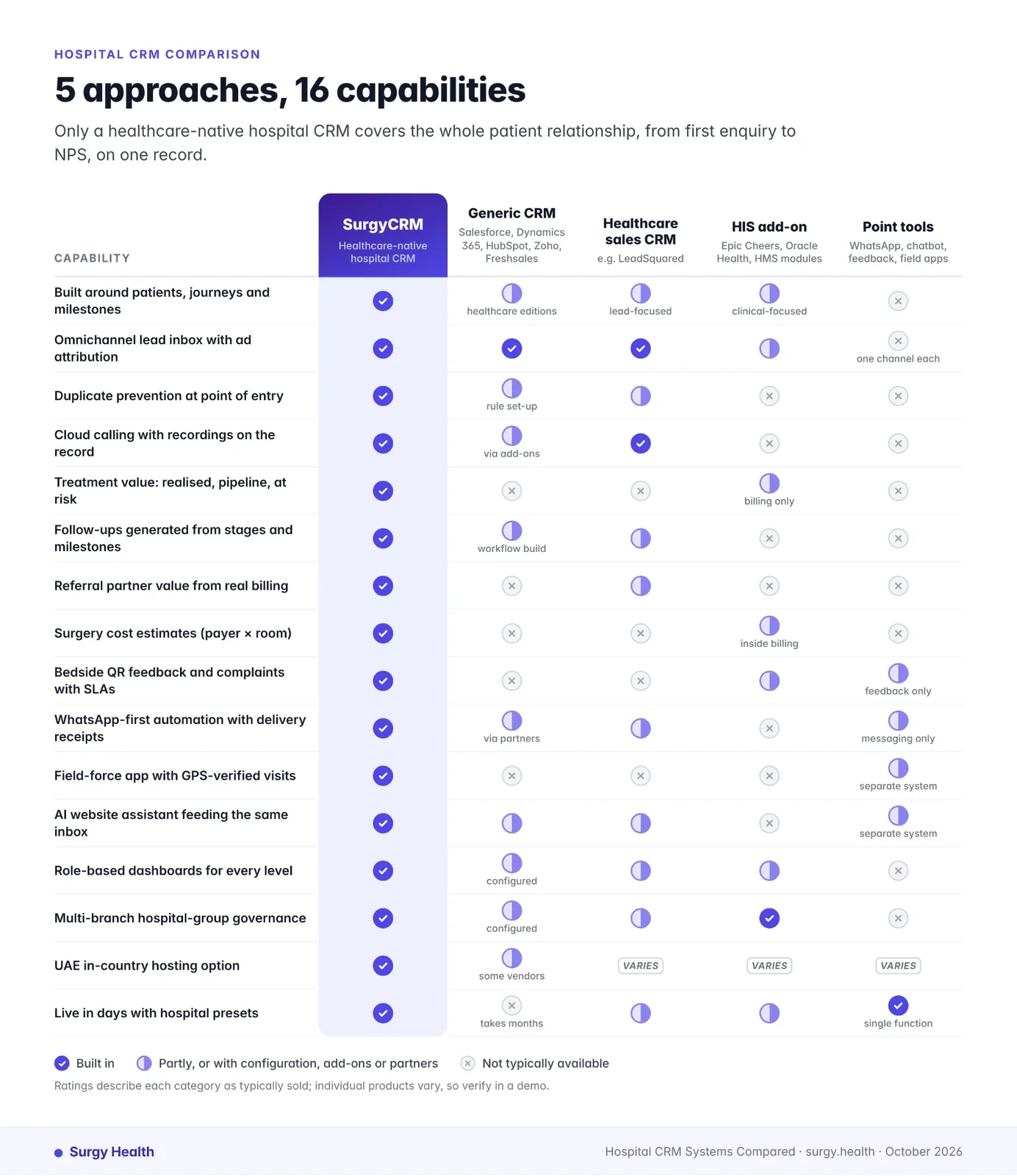
Which products sit in which column: generic CRM covers Salesforce Health Cloud (now Agentforce Health), Microsoft Dynamics 365, HubSpot, Zoho CRM and Freshsales. Healthcare sales CRM is LeadSquared. HIS vendor add-ons are Epic Cheers, Oracle Health and HMS modules such as Insta by Practo. Point tools are WhatsApp platforms such as WATI and Interakt, plus standalone chatbots, feedback apps and field-force apps.
| Capability | SurgyCRM | Generic CRM | Healthcare sales CRM | HIS vendor CRM add-on | Point tools |
|---|---|---|---|---|---|
| Built around patients, journeys and milestones | ✓ | ◐ healthcare editions; otherwise custom build | ◐ lead-focused | ◐ clinical-focused | ✗ |
| Omnichannel lead inbox with ad attribution | ✓ | ✓ | ✓ | ◐ | ✗ one channel each |
| Duplicate prevention at the point of entry | ✓ | ◐ rule set-up | ◐ | ✗ | ✗ |
| Cloud calling with recordings on the patient record | ✓ | ◐ via add-ons | ✓ | ✗ | ✗ |
| Treatment value: realised, pipeline, at risk | ✓ | ✗ | ✗ | ◐ billing only | ✗ |
| Follow-ups generated from stages and milestones | ✓ | ◐ workflow build | ◐ | ✗ | ✗ |
| Referral partner value from real billing | ✓ | ✗ | ◐ | ✗ | ✗ |
| Surgery cost estimates (payer × room) | ✓ | ✗ | ✗ | ◐ inside billing | ✗ |
| Bedside QR feedback and complaints with SLAs | ✓ | ✗ | ✗ | ◐ | ◐ feedback only |
| WhatsApp-first automation with delivery receipts | ✓ | ◐ via partners | ◐ | ✗ | ◐ messaging only |
| Field-force app with GPS-verified visits | ✓ | ✗ | ✗ | ✗ | ◐ separate system |
| AI website assistant feeding the same inbox | ✓ | ◐ | ◐ | ✗ | ◐ separate system |
| Role-based dashboards for agents, managers and leadership | ✓ | ◐ configured | ◐ | ◐ | ✗ |
| Multi-branch hospital-group governance | ✓ | ◐ configured | ◐ | ✓ | ✗ |
| UAE in-country hosting option | ✓ | ◐ some vendors | varies | varies | varies |
| Live in days with hospital presets | ✓ | ✗ months | ◐ | ◐ | ✓ single function |
✓ built in · ◐ partly, or with extra configuration, add-ons or partners · ✗ not typically available. Ratings describe each category as typically sold; individual products vary, so verify in a demo.
How to read it: a generic CRM can do most of this with enough configuration and consulting. A healthcare sales CRM is strong on lead capture and calling. An HIS add-on is strong on the clinical and billing record. Point tools each solve one problem but keep their data apart.
Hospital CRM platforms compared, one by one
No product wins every row. The right choice depends on what you already run, who will configure it, and where your patients leak today.
| Platform | Type | Best fit | Watch-outs | List price (Oct 2026) | India / UAE hosting |
|---|---|---|---|---|---|
| SurgyCRM | Healthcare-native hospital CRM | Multi-specialty hospitals and groups in India and the GCC that want enquiry-to-NPS on one record | HIS link depends on your HIS vendor; field app is Android-only today; Hospital Report Pack in beta | On request | India (AWS Asia-Pacific) and UAE in-country (AWS UAE) |
| LeadSquared | Healthcare sales CRM | Hospitals with a large call centre focused on lead conversion | WhatsApp needs a separate provider account; calling via telephony integrations; treatment value and bedside feedback are not core | Not published for healthcare | AWS India; a "Middle East" region is listed |
| Salesforce Health Cloud (now Agentforce Health) | Healthcare edition of a generic CRM | Large groups with a Salesforce partner and budget for a multi-month build | WhatsApp needs the Contact Center Digital add-on ($75/user/month) plus message fees | From $350/user/month, billed annually | India and UAE (Hyperforce) |
| Microsoft Dynamics 365 | Generic CRM with healthcare templates | Groups standardised on Microsoft, with a Dynamics partner | From 1 Oct 2026 new customers get the templates as source code to build on; managed-template support ends 31 Dec 2027; built-in WhatsApp channel deprecated | Sales or Customer Service Enterprise $105/user/month, billed annually | India and UAE |
| Zoho CRM | Generic CRM; custom Healthcare CRM on request | Cost-conscious hospitals with an admin who can configure | Journeys, feedback and SLA escalation must be built; call recording needs Zoho Voice | ₹800–₹2,600/user/month, billed annually, plus GST | India, UAE and Saudi Arabia |
| Freshsales | Generic sales CRM | Smaller hospitals wanting a simple pipeline with built-in phone and WhatsApp | No patient-journey, feedback or SLA module | $9–$59/user/month, billed annually | India; confirm UAE with the vendor |
| HubSpot | Generic CRM | Marketing-led clinics running inbound funnels | No India or Middle East data centre; BAA covers US HIPAA on Enterprise only | Sales Hub Pro $90/seat/month, billed annually, plus $1,500 onboarding | Neither |
| Epic Cheers | HIS vendor CRM add-on | Hospitals already on Epic's EHR | Practical only on Epic; WhatsApp not stated | Not published | Not stated |
| Oracle Health | HIS vendor; CRM via connectors and Oracle CX | Hospitals already on Oracle Health's EHR | No standalone hospital CRM; engagement is assembled from several products | Not published | Cloud regions in both; product hosting not stated |
| Insta by Practo | HIS / HMS with engagement features | Hospitals wanting reminders and surveys inside their HMS | No dedicated CRM module or call-centre features | Not published | Region not stated |
| WATI / Interakt | WhatsApp point tools | Adding WhatsApp booking and reminders quickly | One channel; no journeys, calling or referral value; Interakt states no data localisation | From $59/month (WATI) and $55/month (Interakt), plus Meta fees | Not offered or not stated |
Prices are vendor list prices seen in October 2026. They exclude GST or VAT and WhatsApp message fees, and change often, so confirm on the vendor's page before you budget.
Which hospital CRM should you choose?
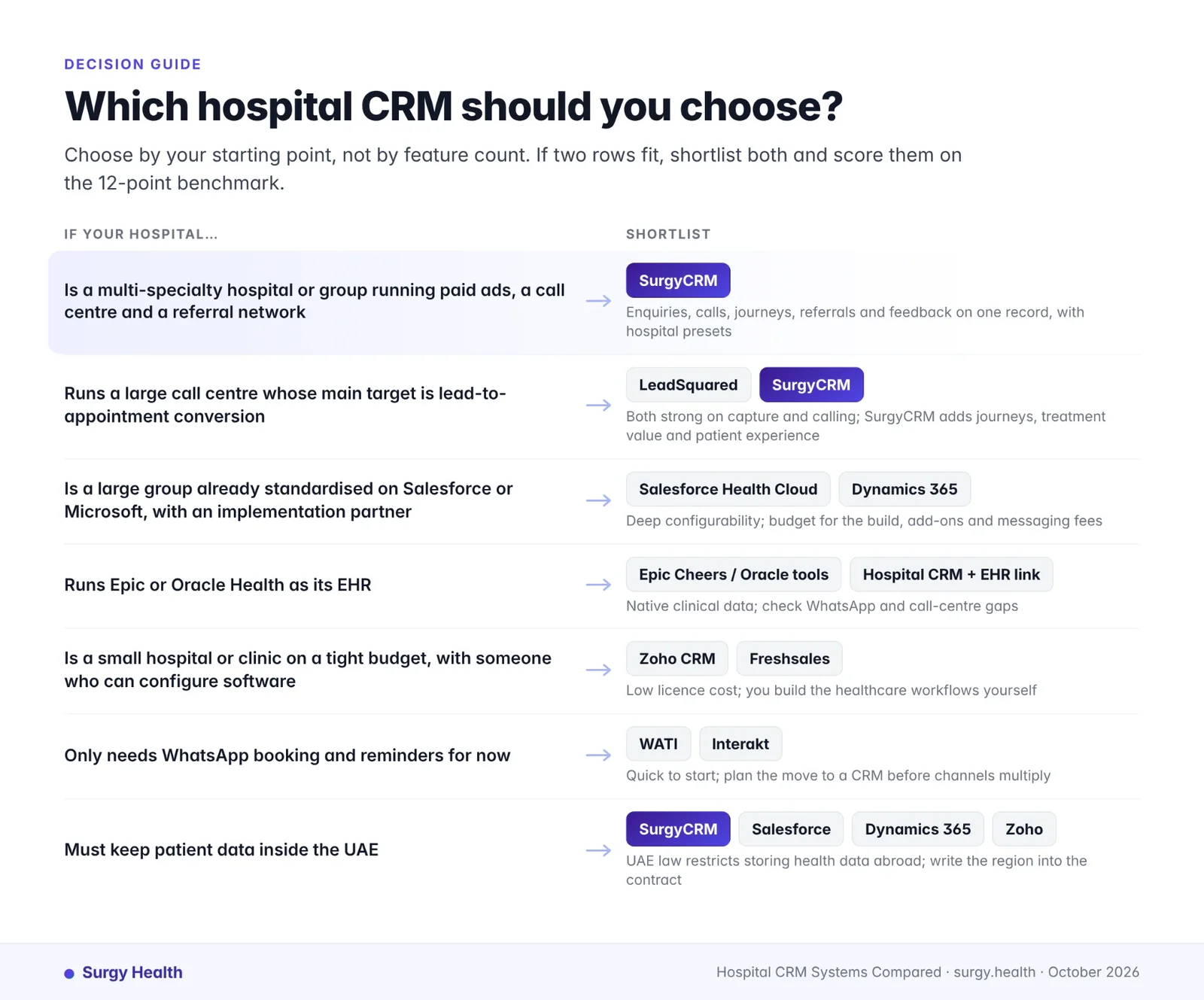
Choose by your starting point, not by feature count. Most mid-sized hospitals and groups in India and the GCC are best served by a healthcare-native CRM connected to their existing HIS. A generic CRM makes sense when you have an in-house admin or a partner budget for the build.
| If your hospital… | Shortlist | Why |
|---|---|---|
| Is a multi-specialty hospital or group running paid ads, a call centre and a referral network | SurgyCRM | Enquiries, calls, journeys, referrals and feedback on one record, with hospital presets ready on day one |
| Runs a large call centre whose main target is lead-to-appointment conversion | LeadSquared or SurgyCRM | Both are strong on capture and calling; SurgyCRM adds treatment journeys, treatment value and patient experience |
| Is a large group already standardised on Salesforce or Microsoft, with an implementation partner | Salesforce Health Cloud or Dynamics 365 | Deep configurability; budget for the build, add-ons and messaging fees |
| Runs Epic or Oracle Health as its EHR | That vendor's engagement tools, or a hospital CRM integrated with the EHR | Native clinical data; check for WhatsApp and call-centre gaps |
| Is a small hospital or clinic on a tight budget, with someone who can configure software | Zoho CRM or Freshsales | Low licence cost; you build the healthcare workflows yourself |
| Only needs WhatsApp booking and reminders for now | WATI or Interakt | Quick to start; plan the move to a CRM before channels multiply |
| Must keep patient data inside the UAE | A vendor with UAE in-country hosting, such as SurgyCRM, Salesforce, Dynamics 365 or Zoho | UAE law restricts storing health data outside the country (Al Tamimi); write the region into the contract |
If two rows describe you, shortlist both and score them on the 12-point benchmark above.
Why hospitals in India and the GCC choose SurgyCRM
SurgyCRM was built for hospitals from the start, not adapted from a sales CRM. It keeps one continuous record of each patient relationship, from the first enquiry to the NPS score after treatment, and sits beside your HIS rather than replacing it.
What that looks like at 10:40 pm: a patient fills a Facebook ad form for knee replacement. By 10:41 the lead is in SurgyCRM, tagged with the campaign and ad, assigned to the on-duty agent, and carrying a "call within 1 hour" task. The patient gets a WhatsApp acknowledgement. At 9 am that call is first on the agent's list.
Healthcare-native. Treatment journeys, milestones, bedside feedback, SLA escalation and surgery cost estimates are part of the product, not workarounds on a sales pipeline.
One record, end to end. The enquiry, calls, journey, follow-ups and NPS score sit on the same patient record.
Automation that acts. SurgyCRM creates the task, assigns the owner, sends the WhatsApp message and escalates the ticket, so nothing depends on memory.
Value you can verify. Journey and referral-partner value come from billing, not typed-in numbers, and reports carry real timestamps.
A view for every role. Agents see their own list, managers their team, leadership the whole group, and every number opens the rows behind it.
Built for how patients communicate in India and the Gulf. WhatsApp-first, bilingual patient pages, Indian phone formats, and a UAE in-country deployment.
Fast to go live. Built-in presets, bulk imports and one-line website embeds: configured in days, live in weeks rather than months.
Where SurgyCRM is not the answer: it is not a clinical record, so you still need an HIS (ours is SurgyOne). And if you only need WhatsApp reminders for a single clinic, a point tool will be cheaper for now.
10 questions to ask every hospital CRM vendor before you sign
Ask each vendor to answer these live in the demo, on your own sample data, not on slides.
Show me a Meta ad lead arriving, being de-duplicated and assigned. How long did it take?
Where does a call recording appear, and who is allowed to hear it?
How is a treatment journey set up, and where do I see value realised, pending and at risk?
How do you confirm a lead "converted": a status click, or a check against HIS billing?
How do you value a referring doctor: by referrals sent, or by revenue billed?
What happens when a patient complains at the bedside at 11 pm? Who is alerted, and when does it escalate?
Is WhatsApp native, or does it need a separate provider and contract? Who pays per message?
Which country will our data be stored in, and is that written into the contract?
What is the total first-year cost: licences, implementation, add-ons, telephony and messaging?
How many weeks from contract to the first live lead, and what do you need from our team?
A vendor that can't show 1, 3, 4 and 6 in the product is selling a sales CRM with a hospital label.
FAQ
Hospital CRM FAQs
What is the best hospital CRM in India?
There is no single best for every hospital. For multi-specialty hospitals and groups running ads, a call centre and a referral network, a healthcare-native CRM such as SurgyCRM covers the most on one record. LeadSquared suits call-centre-led lead operations. Zoho CRM and Freshsales suit small budgets with in-house configuration.
What is the difference between a hospital CRM and an HIS or HMS?
An HIS records clinical care and billing. A hospital CRM manages the relationship around that care: who enquired, who followed up, whether the patient came for each step, how they felt, and which channels and partners brought them in. The two should connect, not compete.
How much does a hospital CRM cost?
List prices in October 2026 run from ₹800 per user per month (Zoho CRM Standard, billed annually) to $350 per user per month and above (Salesforce Health Cloud, billed annually). Healthcare-specific vendors usually quote on request. Add implementation, telephony, WhatsApp message fees and taxes for the true first-year cost.
Can Salesforce, Zoho or HubSpot be used as a hospital CRM?
Yes, with configuration. Salesforce Health Cloud includes care programs and referral management. Zoho CRM and HubSpot need patient journeys, feedback and SLA workflows built for you. HubSpot has no India or Middle East data centre, and its BAA covers only US HIPAA, on Enterprise plans.
Why does WhatsApp integration matter for a hospital CRM?
In India and the Gulf, WhatsApp is where patients expect to hear from their hospital. A hospital CRM should send approved templates for acknowledgements, appointment confirmations, reminders and surveys, and record sent, delivered and read receipts on the patient's record, without a separate tool.
Which hospital CRMs can host data in the UAE?
As of October 2026, SurgyCRM, Salesforce (Hyperforce), Microsoft Dynamics 365 and Zoho list UAE hosting. HubSpot offers no Middle East hosting. Confirm the exact region in writing, because UAE law restricts storing health data outside the country.
Does a hospital CRM help with India's DPDP Act?
It can. India's Digital Personal Data Protection Rules were notified in November 2025, and most obligations apply from May 2027. Look for consent records, role-based access, a full audit trail and Indian hosting. SurgyCRM is designed to support hospitals' obligations under the Act and its Rules.
How long does it take to implement a hospital CRM?
A healthcare-native CRM with hospital presets can be configured in days and live in weeks. WhatsApp, Meta and telephony connections depend on each provider's approval steps. Generic CRMs typically need months of configuration before they fit hospital workflows.
See SurgyCRM against the benchmark
Bring the 12-point benchmark to a demo and we will score SurgyCRM against it, live, on your workflows. Book a SurgyCRM demo, or read how a hospital CRM compares with a generic CRM.
Sources
Vendor pages opened in October 2026; prices and features change, so check before you buy.
Salesforce: Health Cloud pricing, Contact Center Digital pricing, Hyperforce regions, Hyperforce in the UAE
Microsoft: Microsoft for Healthcare overview, healthcare template deployment changes, Contact Center deprecations, Dynamics 365 Sales pricing, data-centre regions
HubSpot: healthcare CRM, Sales Hub pricing, data centres
Freshworks: Freshsales pricing, Freshsales for healthcare, data-centre locations
LeadSquared: healthcare CRM, WhatsApp connector, security and hosting
Law: UAE health-data transfers (Al Tamimi) · India DPDP Rules, 2025 (MeitY)
Looking for the numbers? See the latest AI in healthcare statistics in our AI in healthcare statistics report.
Comparing vendors? Read our buyer's guide to hospital AI software
Written by
Mohammed Jamil Nasir
Founder — Product & Tech, Surgy Innovation Labs Private Limited
14+ years in Product, Design & Tech · PGC AI/ML, IIT-Guwahati · Global MBA, SP Jain · BE-CSE
Mohammed Jamil Nasir leads product and technology at Surgy Innovation Labs Private Limited, building AI-first, seamless healthcare products for hospitals and healthcare networks across India and the GCC. He writes about healthcare AI, accreditation, and clinical operations.
Connect on LinkedInKeep reading
DPDPA Simplified for Hospitals: What You Actually Need to Know
No certificate, no outsourcing shortcut. What India's DPDP Act and DPDP Rules 2025 require of hospitals, the May 2027 deadline, penalties and how to start.