
Best Hospital Management Software in India (2027): 10 Systems Compared, with Pricing
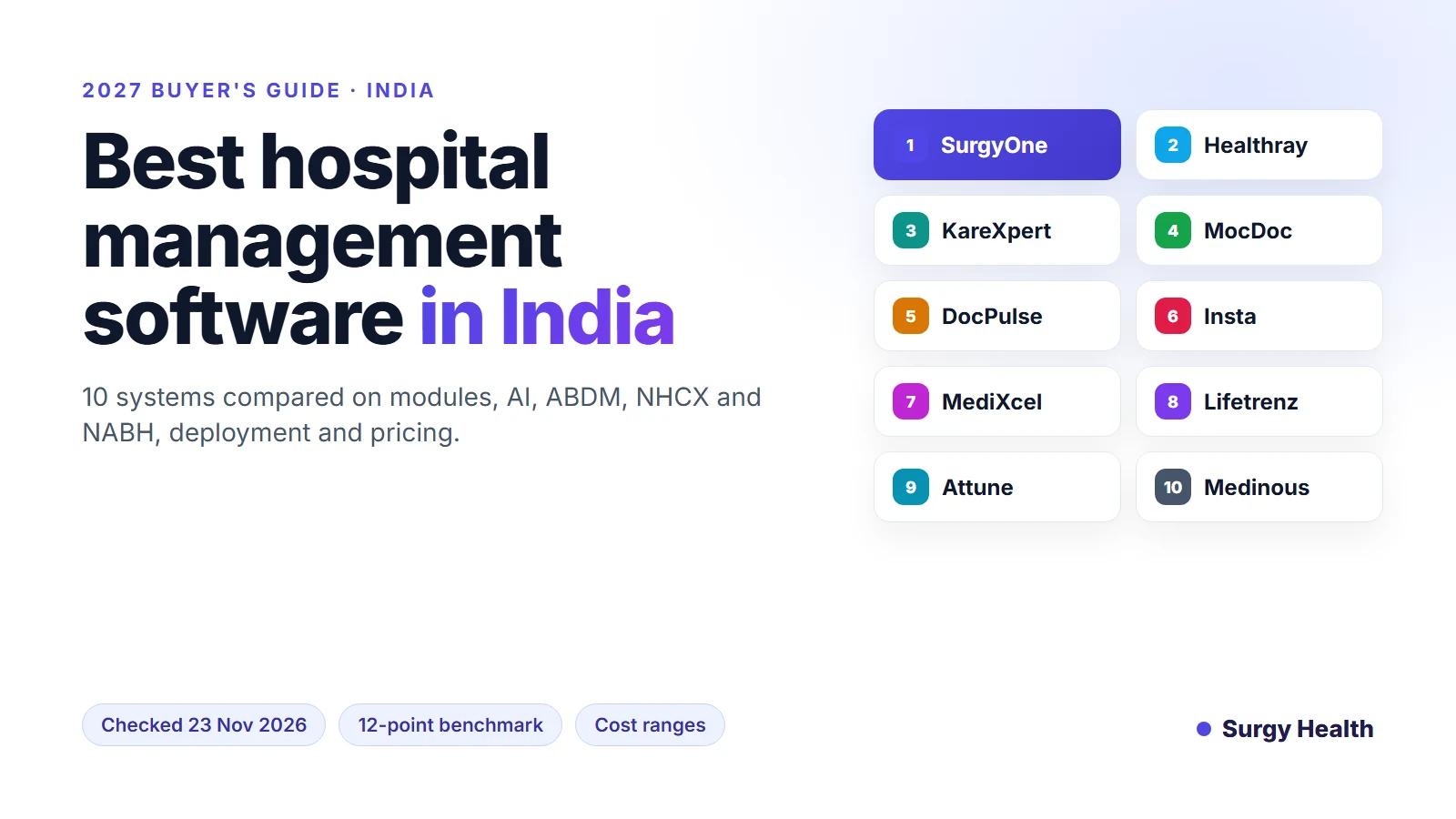
10 hospital management systems compared on a published 12-point benchmark, each checked on the vendor's own site, with a capability matrix, best picks by hospital type, India compliance rules, cost ranges and a demo script.

Key takeaways
- Pick by hospital type, not feature count. A 20-bed nursing home and a 300-bed multi-specialty hospital need different systems.
- Doctor adoption decides the payback. When doctors work around the system, charges leak between OPD, IPD, pharmacy and lab.
- Verify compliance claims. Ask which ABDM milestones (M1–M3) are cleared and for the NABH HIS/EMR certificate level, not a logo.
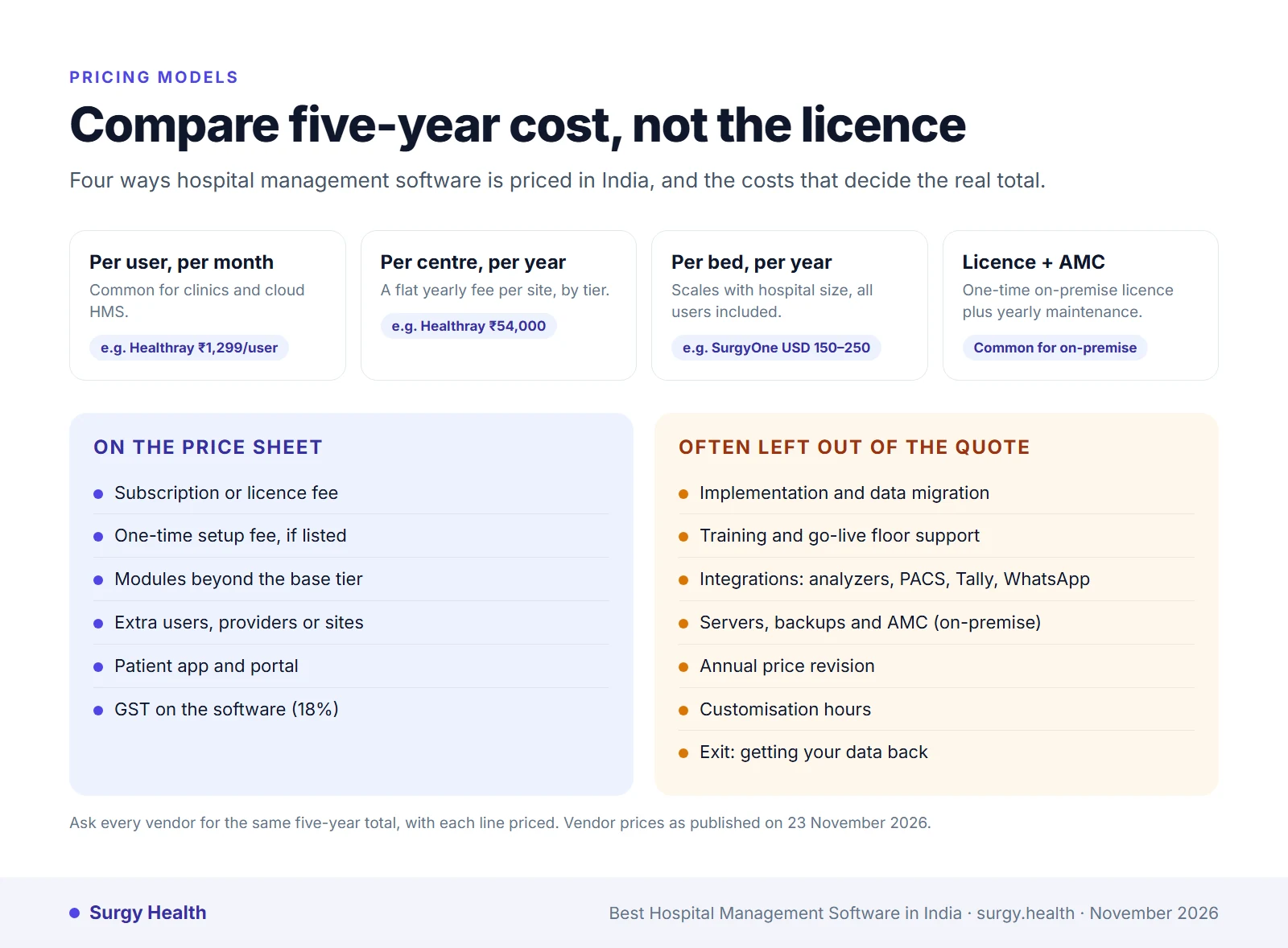
- Compare five-year cost. Implementation, integrations, training and AMC often add as much as the licence.
- Only two of the 10 publish prices. Healthray per centre and SurgyOne per bed; the rest quote on request.
How we compared hospital management software
Most “top 10” lists in this category are written by vendors that rank themselves first, or are years old with a new year in the title. We did three things differently. We published our scoring weights, we checked every vendor's claims on its own website on a stated date, and we separated what a vendor states from what we could verify.
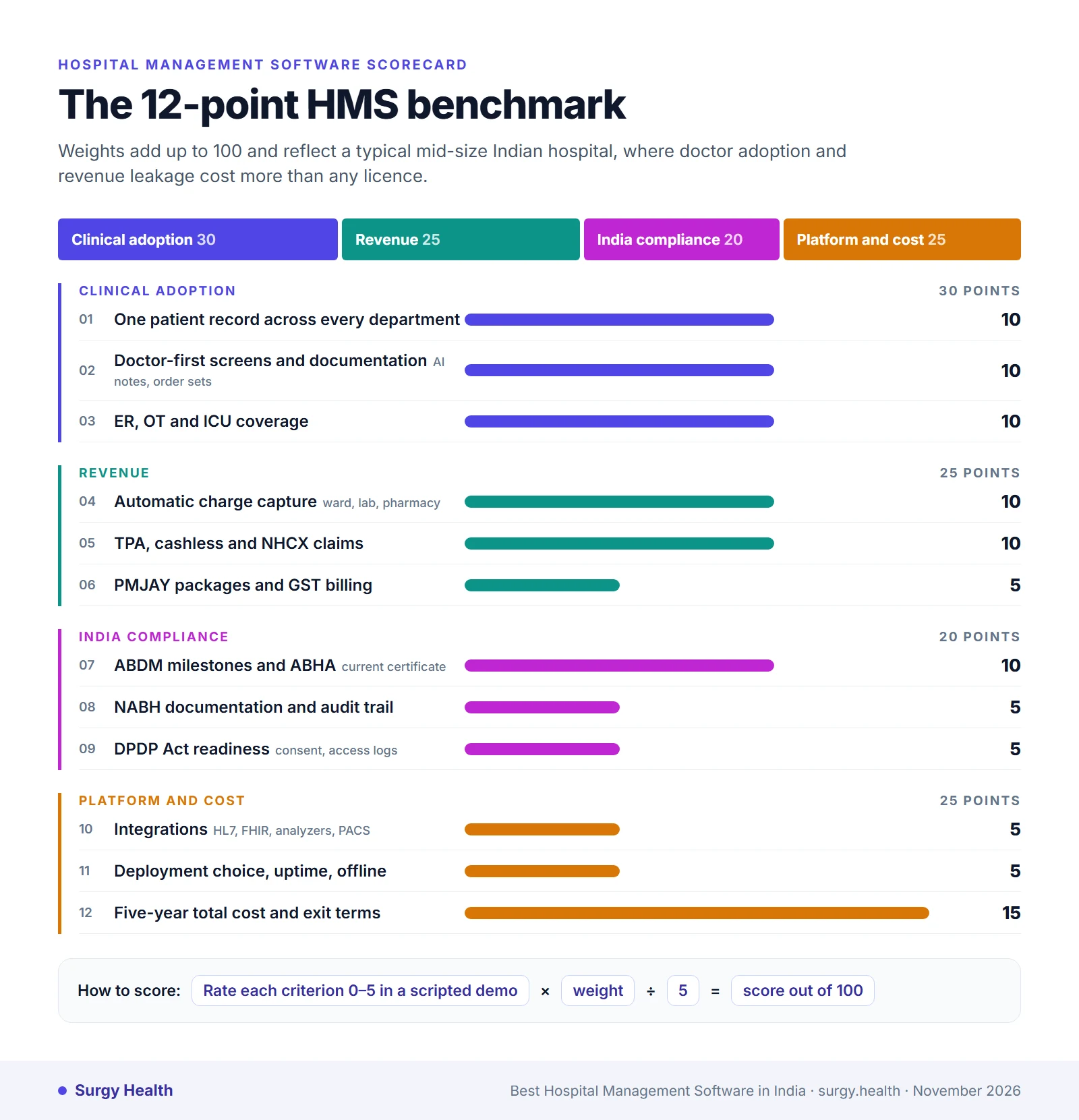
The weights reflect a typical mid-size Indian hospital. If you run a clinic, give more weight to cost and set-up time; if you run a medical college hospital, give more weight to ABDM.
Hospital management software in India compared
The matrix shows what each vendor states on its own website. A dash means “not stated on the site”, which is not the same as “missing”: ask about it in the demo.
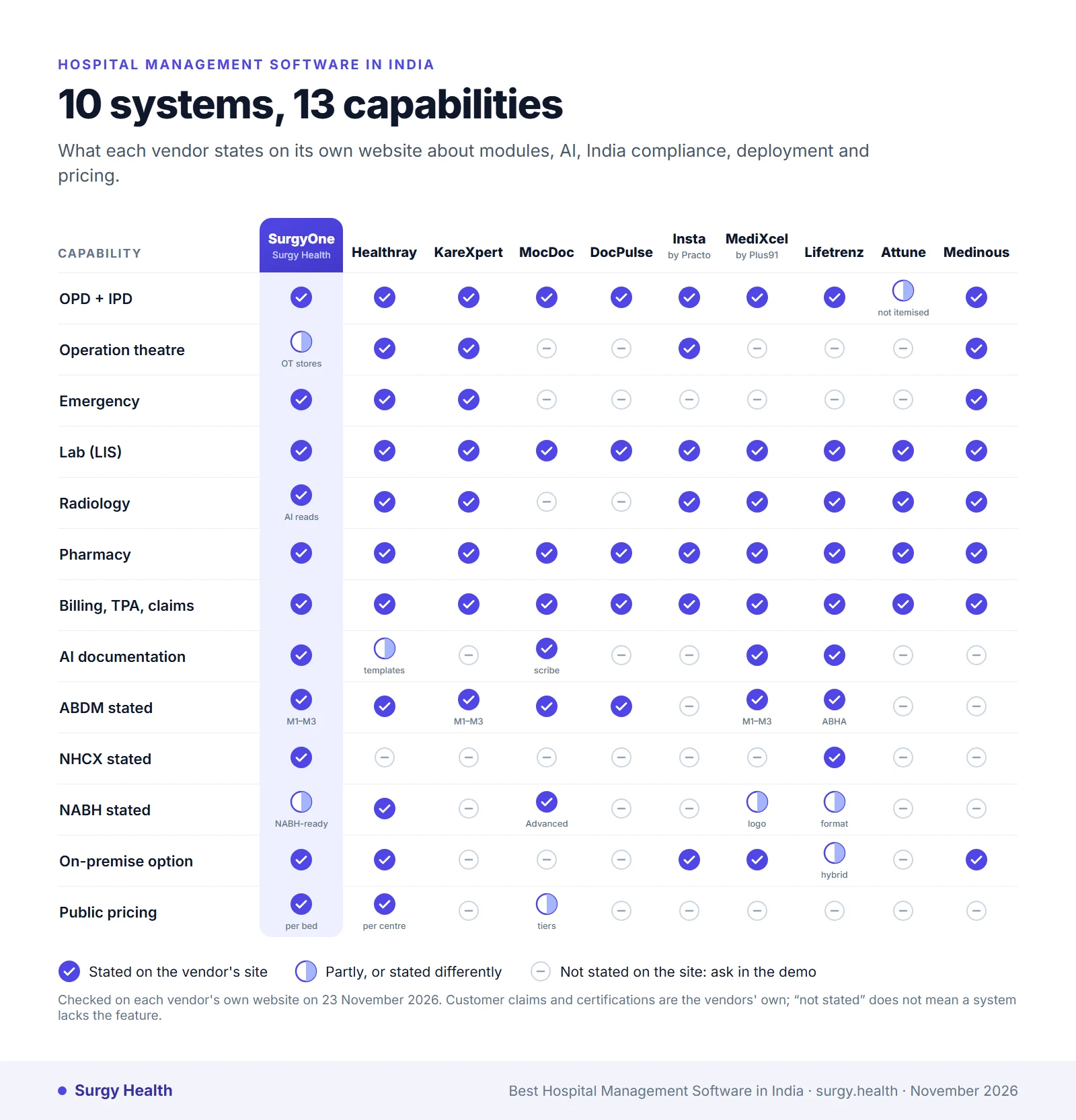
| System | Best for | Deployment | Pricing model |
|---|---|---|---|
| SurgyOne (Surgy Health) | Mid-size hospitals and hospital groups that want doctors to use the system | Cloud (AWS Mumbai) or on-premise | Public: USD 150–250 per bed per year; India priced lower, in INR |
| Healthray | Clinics up to mid-size multi-specialty hospitals (the vendor says from about 50 beds up to multi-city chains) | Cloud, on-premise or hybrid | Public: HMS Basic from ₹54,000 per year per care centre (or ₹1,299 per user per month); Enterprise on quote |
| KareXpert | Corporate and large hospitals, hospital groups and government e-health programmes | Cloud (fully managed) | Quote-based |
| MocDoc | Clinics and small-to-mid hospitals; specialty products for labs, pharmacy, IVF, eye and dental | Cloud | Tiered by users and beds (Starter up to 20 beds, Growth up to 50, Advanced up to 100); Ultimate on quote |
| DocPulse | Clinics, clinic chains, nursing homes and small-to-mid hospitals | Cloud (Google Cloud Platform) | Quote-based, described as modular with no hidden fees; 1-week assisted trial |
| Insta by Practo | Multi-specialty hospitals and multi-centre groups, especially those also operating in the GCC | Cloud or on-premise | Quote-based |
| MediXcel by Plus91 | Mid-size and large hospitals, government programmes, oncology and diagnostics (MediXcel LITE for clinics) | Cloud or on-premise | Quote-based |
| Lifetrenz | Mid-size to large hospitals and multi-location chains | Cloud-native, cloud or hybrid | Quote-based |
| Attune | Diagnostic lab chains, and small and mid hospitals wanting a cloud HIS with specialty modules | Cloud | Quote-based |
| Medinous | Large and corporate hospitals and hospital chains (Medinous Fusion for clinics) | Cloud or on-premise | Quote-based |
The 10 systems, one by one
Each profile uses the vendor's own words for its segment, modules, AI and compliance, followed by what to check before you buy.
1. SurgyOne (Surgy Health)
Our product · scored on the same criteria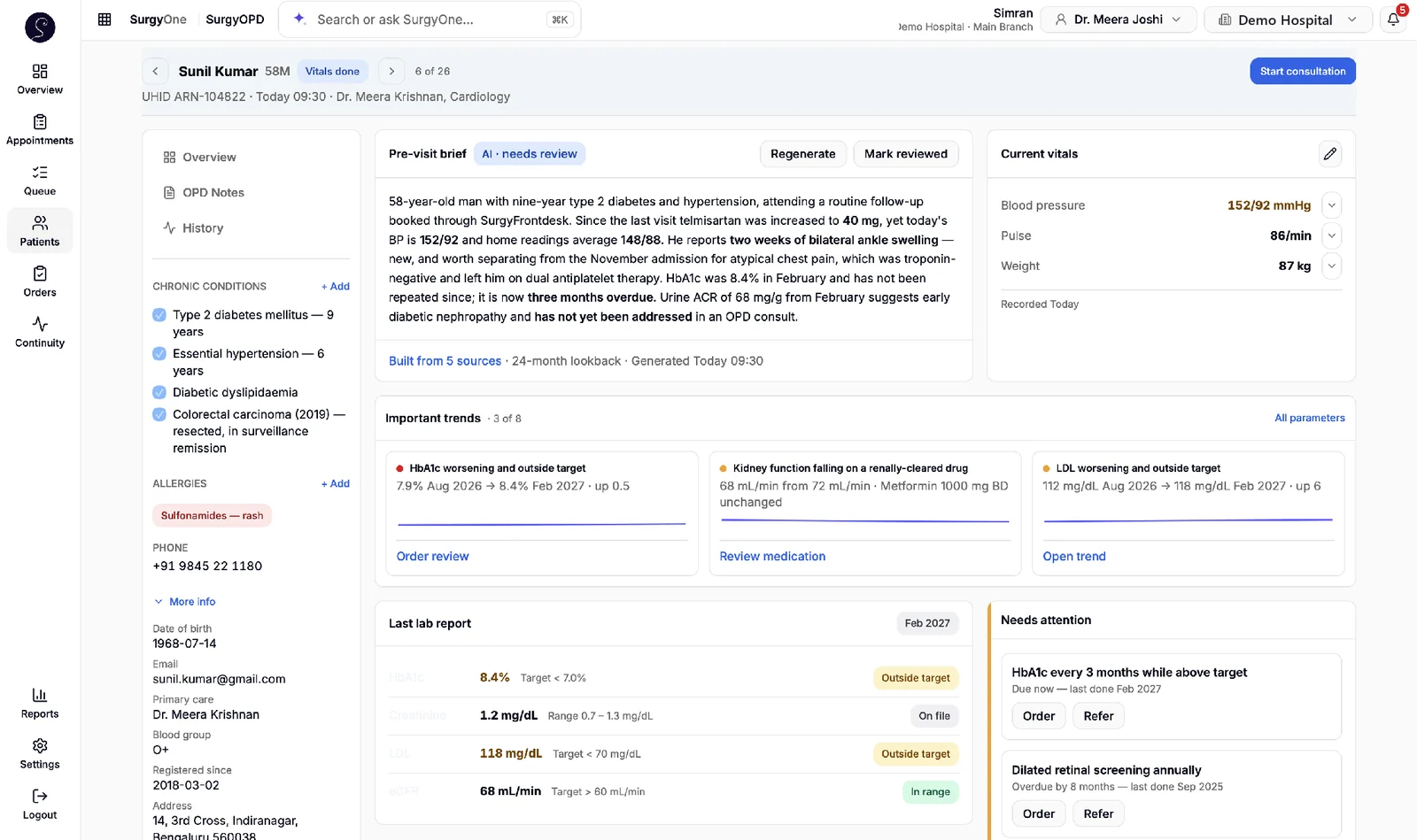
Best for: Mid-size hospitals and hospital groups that want doctors to use the system.
Modules: OPD, IPD, ER, labs, pharmacy and billing on one record.
AI: AI agents in every module (pre-visit briefs, discharge readiness, charge capture); MedGemma 27B radiology reads signed by a radiologist.
India compliance: Built for ABDM M1–M3 and NHCX; NABH-ready documentation.
Deployment: Cloud (AWS Mumbai) or on-premise.
Strengths
- AI agents act inside every module and only after staff approve; ordering, verifying and signing are never automated.
- One record across OPD, IPD, ER, labs, pharmacy and billing, with ambient notes from SurgyScribe.
- Cloud or on-premise, with AI inference on the hospital's own GPUs if needed.
Check before you buy
- Newer than most systems here: SurgyOne is available for demos and pilots, so ask for pilot terms and reference visits to other Surgy Health products.
2. Healthray
Checked 23 November 2026Best for: Clinics up to mid-size multi-specialty hospitals (the vendor says from about 50 beds up to multi-city chains).
Modules: Registration and ABHA, OPD, EMR, IPD, OT, emergency, LIMS, RIS/PACS, pharmacy, billing, TPA, teleconsultation.
AI: States AI for automating workflows, smart templates, faster documentation and analytics.
India compliance: States NHA-approved, ABDM-compliant and NABH-certified software.
Deployment: Cloud, on-premise or hybrid.
Strengths
- Public, itemised INR pricing, which is rare in this category.
- Broad module coverage including OT, emergency and RIS/PACS, with cloud, on-premise or hybrid hosting.
- Claims 2,500+ hospitals and clinics and a 200-bed go-live in 1–3 weeks.
Check before you buy
- The Basic HMS tier is stated as up to 10 users; confirm which modules each tier includes.
- The vendor notes annual price revision, and the patient app and extra providers are add-ons, so put them in the quote.
3. KareXpert
Checked 23 November 2026Best for: Corporate and large hospitals, hospital groups and government e-health programmes.
Modules: 60+ modules: ADT/IPD, OPD, OT, cath lab, emergency, billing and TPA, CSSD, LIMS, RIS/PACS, pharmacy, portals and apps.
AI: States an AI/ML-ready platform and data lake, with partners such as Intel and Microsoft.
India compliance: States ABDM M1, M2 and M3 certification.
Deployment: Cloud (fully managed).
Strengths
- Built for scale: claims 500+ hospitals, 30,000+ beds and 6 countries.
- Wide platform beyond the HIS, including ambulance, IoT and government platforms.
- Named customers include Tata Motors Hospital Jamshedpur and HCL Healthcare.
Check before you buy
- Pricing is not public; ask how it works by edition, module and bed count.
- Cloud-only as stated; confirm the hosting region if data residency matters.
4. MocDoc
Checked 23 November 2026Best for: Clinics and small-to-mid hospitals; specialty products for labs, pharmacy, IVF, eye and dental.
Modules: Appointments, EMR, OP and IP, billing and insurance, lab, pharmacy, inventory, patient apps.
AI: MocDoc SenZ AI medical scribe for structured clinical notes.
India compliance: States ABDM-compliant (certified ABDM connector) and NABH Advanced certified for EMR & HMS.
Deployment: Cloud.
Strengths
- Has an AI medical scribe built in.
- States NABH Advanced certification and ABDM compliance.
- A clear tier structure by bed count, and 12+ years in the market by its own account.
Check before you buy
- WhatsApp, Tally and the white-labelled app are paid add-ons, so price the full stack.
- Confirm OT and ICU coverage if you are an inpatient-heavy hospital.
5. DocPulse
Checked 23 November 2026Best for: Clinics, clinic chains, nursing homes and small-to-mid hospitals.
Modules: OPD and queue, IVR booking, EMR, IPD, billing, insurance and TPA, LIMS, pharmacy, inventory, telemedicine, CRM, multi-branch call centre.
AI: None stated.
India compliance: States ABDM certified.
Deployment: Cloud (Google Cloud Platform).
Strengths
- In the market since 2012, by its own account.
- Strong outpatient tools: IVR booking, queues, vaccination and a multi-branch call centre.
- States a 99.9% uptime SLA with support response under 4 hours.
Check before you buy
- Confirm OT, ER and ICU coverage for surgical or inpatient-heavy hospitals.
- No public prices; ask for module-wise quotes.
6. Insta by Practo
Checked 23 November 2026Best for: Multi-specialty hospitals and multi-centre groups, especially those also operating in the GCC.
Modules: Patient administration, OP and IP EMR, OT, bed management, hub-and-spoke lab, radiology, pharmacy, central inventory, RCM, patient portal.
AI: None stated.
India compliance: States JCI- and NABH-accredited customers; GCC integrations (NPHIES, Riayati, Malaffi, NABIDH, DHA); ABDM not stated.
Deployment: Cloud or on-premise.
Strengths
- Flexible hosting on most major clouds or on-premise.
- Strong multi-centre features (hub-and-spoke lab, central inventory) and revenue-cycle depth.
- 15+ years in the market, 1,250+ centres in 22+ countries by its own account.
Check before you buy
- ABDM and NHCX integration are not stated on the site; ask for current status.
- The marketing is GCC-focused; confirm the India roadmap and local support.
7. MediXcel by Plus91
Checked 23 November 2026Best for: Mid-size and large hospitals, government programmes, oncology and diagnostics (MediXcel LITE for clinics).
Modules: IP and OP records, pharmacy, lab (LIMS), billing, imaging (RIS/PACS), telehealth, early warning system.
AI: BHAIRAV Clinical AI: AI-assisted documentation, differential diagnosis, oncology pathways; AI clinical scribe and decision support.
India compliance: States ABDM M1–M3; NABH logo shown on the site.
Deployment: Cloud or on-premise.
Strengths
- The furthest along on clinical AI in this group (documentation, scribe, decision support).
- Large public deployments, including a statewide HMIS in Tripura.
- In the market since 2009, by its own account.
Check before you buy
- The vendor's certifications page was unavailable when we checked; ask for NABH and ABDM certificates directly.
- Module-level detail (OT, ICU, ER) is not itemised on the site; request a module list.
8. Lifetrenz
Checked 23 November 2026Best for: Mid-size to large hospitals and multi-location chains.
Modules: OP and IP, clinical documentation, billing, pharmacy, lab, radiology, inventory, RCM and claims, MIS, PHR sharing, home care.
AI: States AI-assisted documentation, coding and billing, and AI-enabled revenue cycle management.
India compliance: States ABHA linking, NHCX-compliant integration, NABH-format documentation, PM-JAY and GST/TPA billing.
Deployment: Cloud-native, cloud or hybrid.
Strengths
- The broadest set of India compliance claims in this group, including NHCX and PM-JAY.
- Long-running multi-site chain customers, including Cloudnine and Aster Clinics.
- AI applied to coding and billing as well as documentation.
Check before you buy
- No public pricing; ask about per-site licensing for chains.
- Confirm current reference sites and site counts with the vendor.
9. Attune
Checked 23 November 2026Best for: Diagnostic lab chains, and small and mid hospitals wanting a cloud HIS with specialty modules.
Modules: HIS with pharmacy, labs, imaging and branches; specialty modules (ophthalmology, antenatal, dialysis); LIS; claims (ClaimBook).
AI: None stated.
India compliance: States support for NABH, NABL and JCI accreditation; ABDM not stated.
Deployment: Cloud.
Strengths
- A strong lab and diagnostics heritage, with customers such as Metropolis and Medall.
- Cloud-based and quick to start.
- Presence in 15 countries, by its own account.
Check before you buy
- ABDM status is not stated; ask for certification.
- Most news on the site dates from 2015–16; confirm current HIS releases and the roadmap.
10. Medinous
Checked 23 November 2026Best for: Large and corporate hospitals and hospital chains (Medinous Fusion for clinics).
Modules: EMR, CPOE, nursing, OT, emergency, lab, radiology, pharmacy, blood bank, CSSD, OP/IP/ADT, billing and insurance, finance, fixed assets, infection control, MIS.
AI: None stated.
India compliance: ABDM, NHCX and NABH not stated; cites ICD, CPT, HL7 and DICOM.
Deployment: Cloud or on-premise.
Strengths
- The most comprehensively itemised enterprise scope in this group, including finance, blood bank and CSSD.
- 25+ years in healthcare IT, by its own account.
- References from large hospitals in the Middle East and Africa.
Check before you buy
- ABDM, NHCX and NABH are not stated; Indian buyers should ask for current ABDM certification.
- Customers are unnamed on the site; ask for Indian reference sites.
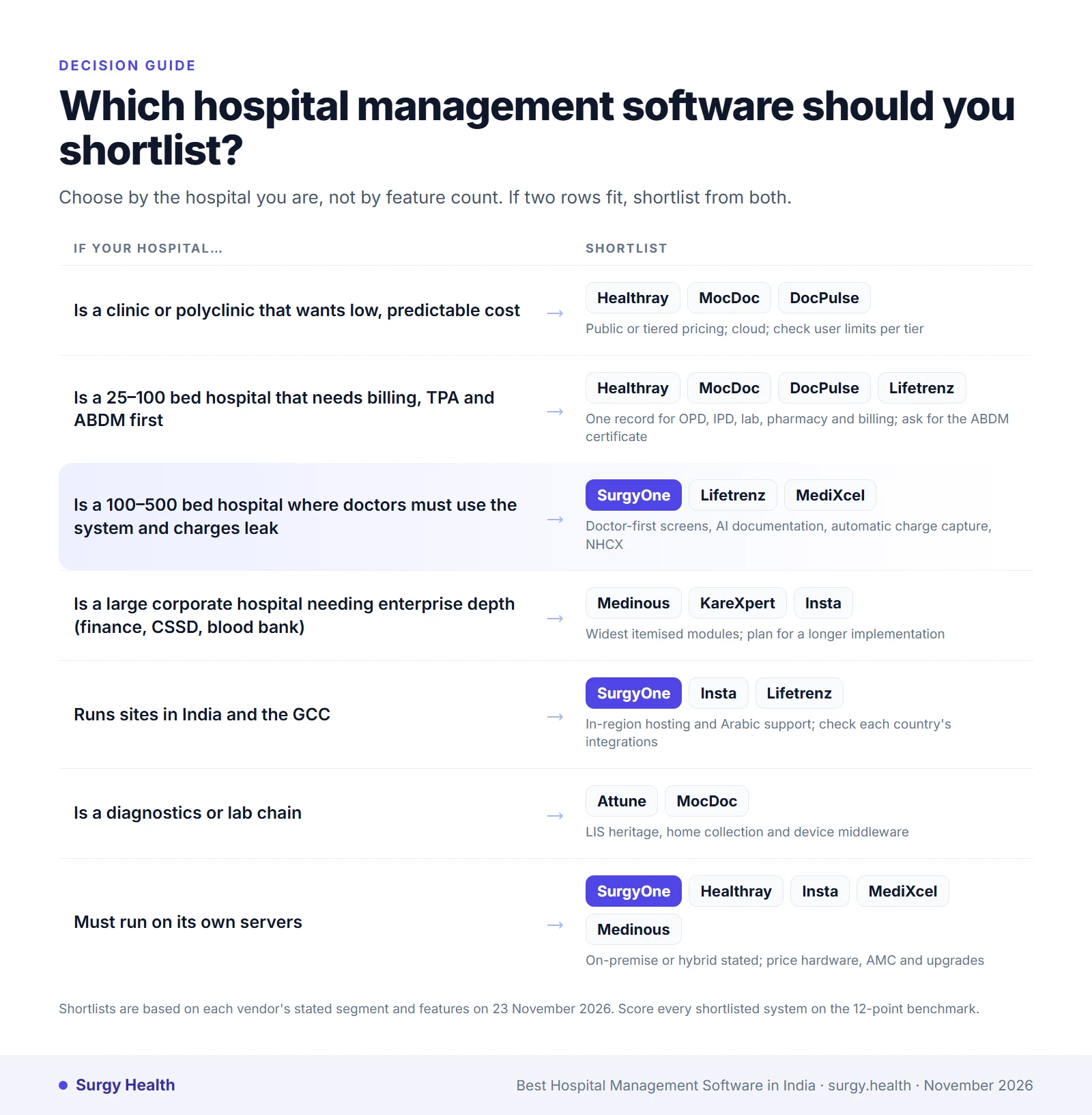
Best hospital management software by hospital type
Clinic or polyclinic, cost first
Healthray, MocDoc, DocPulse
Public or tiered pricing and quick cloud set-up.
Nursing home or 25–100 beds
Healthray, MocDoc, DocPulse, Lifetrenz
OPD, IPD, pharmacy, lab and TPA billing on one record.
100–500 beds, doctors must use it
SurgyOne, Lifetrenz, MediXcel
Doctor-first screens, AI documentation and charge capture.
Large corporate hospital
Medinous, KareXpert, Insta by Practo
The widest itemised enterprise modules.
Medical college hospital
Vendors with cleared ABDM milestones
The NMC now requires ABDM-integrated HMIS (July 2026).
Group with India and GCC sites
SurgyOne, Insta by Practo, Lifetrenz
In-region hosting, Arabic, country integrations.
Diagnostics or lab chain
Attune, MocDoc
LIS heritage and home-collection tools.
Must run on its own servers
SurgyOne, Healthray, Insta, MediXcel, Medinous
On-premise or hybrid stated by the vendor.
Not sure whether you need an HMS, an EMR or a full HIS? Read HIS vs HMS vs EMR vs EHR first; it changes which list you should be reading.
India compliance: what is mandatory, what is expected
Indian hospital software is judged on six rules that rarely appear in global comparisons. Not all of them are mandatory for every hospital, and vendors often blur the difference.
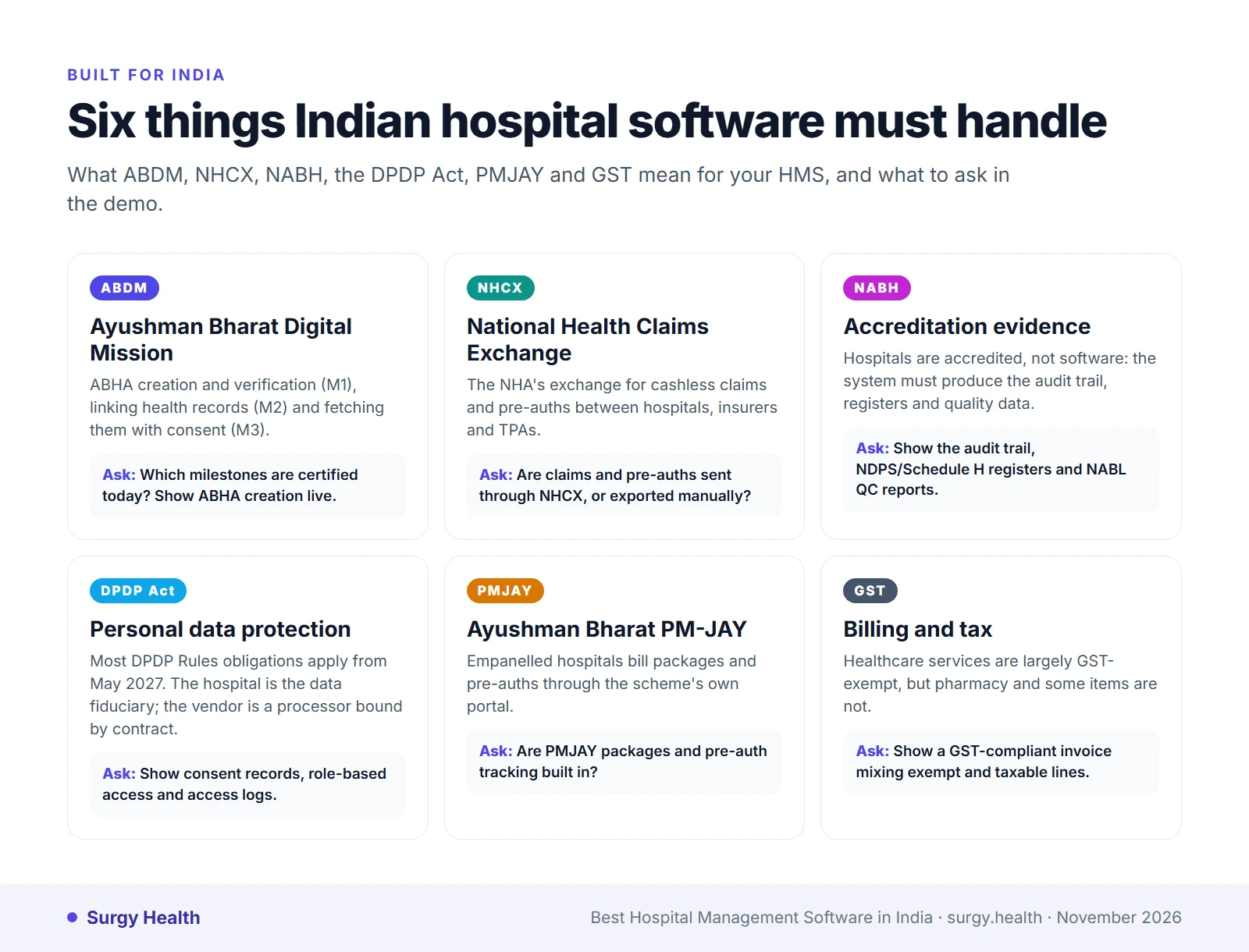
- ABDM: voluntary for most private hospitals, but medical colleges were directed by the National Medical Commission in July 2026 to integrate the HMIS of their attached hospitals with ABDM. Milestones: M1 (ABHA), M2 (share records as a health information provider), M3 (fetch records with consent).
- NABH: hospitals are accredited by NABH; software can separately hold NABH Digital Health Standards certification for HIS and EMR systems, at Basic or Advanced level. Ask for the level and validity date.
- NHCX: the National Health Claims Exchange run by the National Health Authority carries cashless claims between hospitals, insurers and TPAs. Ask whether claims are sent through it or exported by hand.
- DPDP Act: most obligations under the Digital Personal Data Protection Rules apply from May 2027. The hospital is the data fiduciary; the software vendor is its processor. See our DPDP Act checklist for hospitals.
- PMJAY and GST: empanelled hospitals need package billing and pre-auth tracking; invoices must handle GST-exempt healthcare services alongside taxable pharmacy lines.
What hospital management software costs in India
Hospital management software in India costs from about ₹10,000 a year for a small clinic to ₹50 lakh or more a year for a large hospital, depending on beds, users and modules. No neutral price benchmark exists; the ranges below were published by OneCity Technologies in 2026 and are indicative.
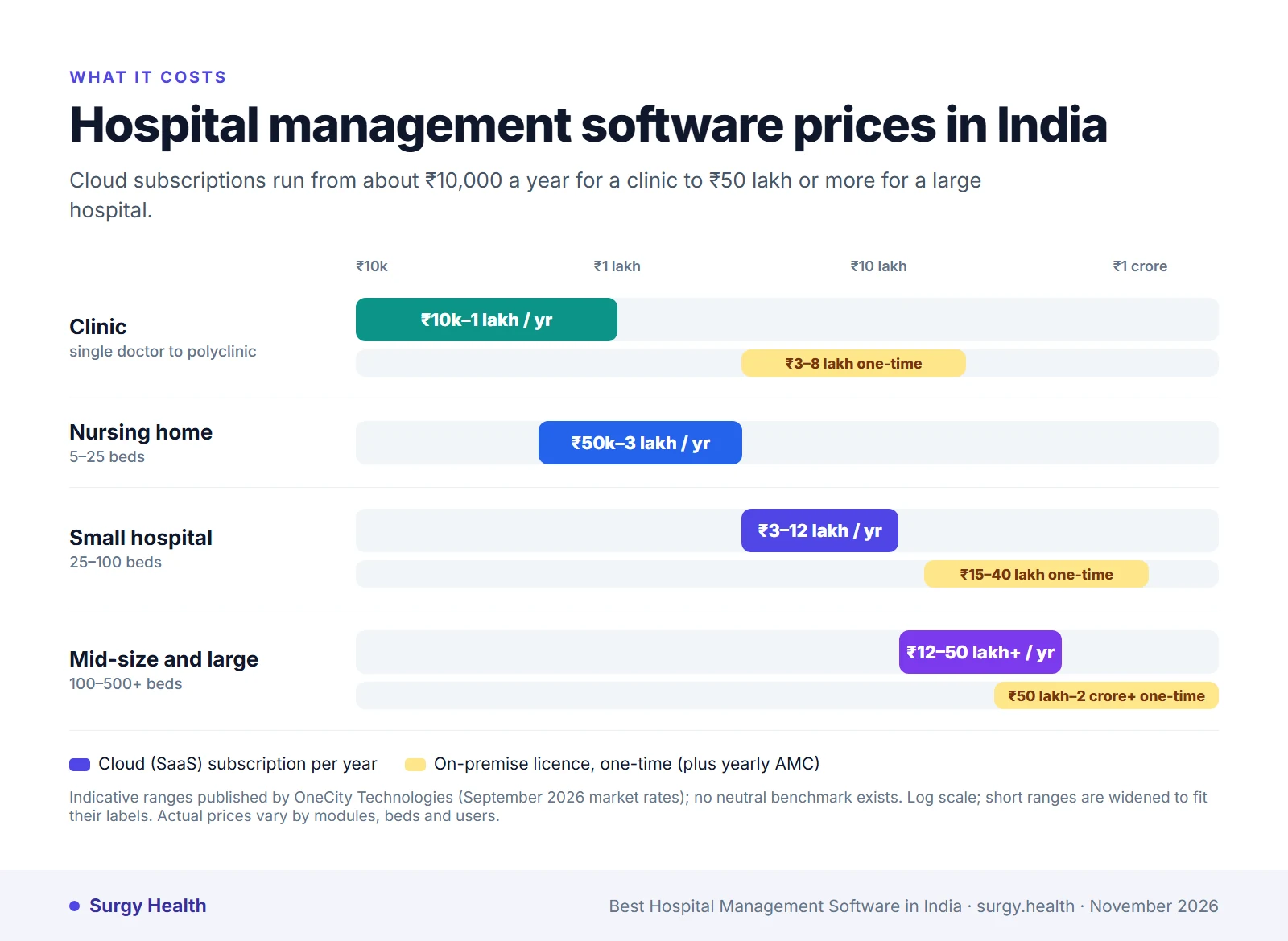
Only two systems in this comparison publish prices: Healthray (₹54,000 a year per care centre for Basic HMS, or ₹1,299 per user a month) and SurgyOne (USD 150–250 per bed per year, quoted lower in INR for India). Per-bed pricing scales with hospital size and includes every user; per-user pricing can rise quickly once nurses and front-desk staff are added.
How implementation actually goes
Vendors quote from one to three weeks for a basic go-live. Multi-department hospitals should plan in phases, with one module live and stable before the next starts:
- Discover: department walkthroughs, master data, tariffs and packages, interface specs.
- Configure and migrate: forms and roles, data migration from the current HIS, ABDM facility and professional registries.
- Day-1 core: OPD and billing, then pharmacy and lab, with floor support at go-live.
- Expand: IPD and emergency, analyzer and PACS interfaces, patient app.
- Optimise: claims and reconciliation, dashboards, monthly adoption reviews.
Run the old and new systems side by side for a short, defined window, and switch off the old one only when billing reconciles.
Seven red flags in a hospital software pitch
“ABDM compliant” with no milestone named and no certificate.
An NABH logo without the certificate level (Basic or Advanced) and validity date.
“AI-powered” with no feature you can watch working in the demo.
Pricing that changes per user once you add doctors, nurses and front-desk staff.
No written annual price-revision cap in the contract.
Data export only “on request”, or in a proprietary format.
A demo on generic sample data that never shows your own workflow.
12 things to make every vendor show in the demo
Send the same script to every shortlisted vendor and score the answers on the benchmark above.
- Register a new patient and create an ABHA number live.
- Run a full OPD consult: notes, prescription, lab order, follow-up.
- Admit the patient and show the running IP bill update as orders post.
- Show a lab result flowing from the analyzer to the doctor's screen.
- Raise a TPA pre-auth and show where it is tracked.
- Show how a claim goes out through NHCX, or how it is exported.
- Print a GST invoice mixing exempt services and taxable pharmacy lines.
- Show the NDPS and Schedule H registers.
- Show the audit trail for one record: who viewed and changed it.
- Pull our MIS report from last month's data.
- Show what happens when the internet drops for an hour.
- Export all our data in a standard format, now.
For a full scored template, use our healthcare AI RFP template and scorecard and the hospital AI buyer's guide.
Where SurgyOne fits
SurgyOne is the AI-first option in this list: a hospital information system with a built-in EHR for mid-size hospitals and groups in India and the GCC, where AI agents draft work in every module and staff approve before anything moves. It is newer than most systems here and available for demos and pilots; the products it builds on, such as SurgyScribe, are live with 4,000+ users across 500+ centres.
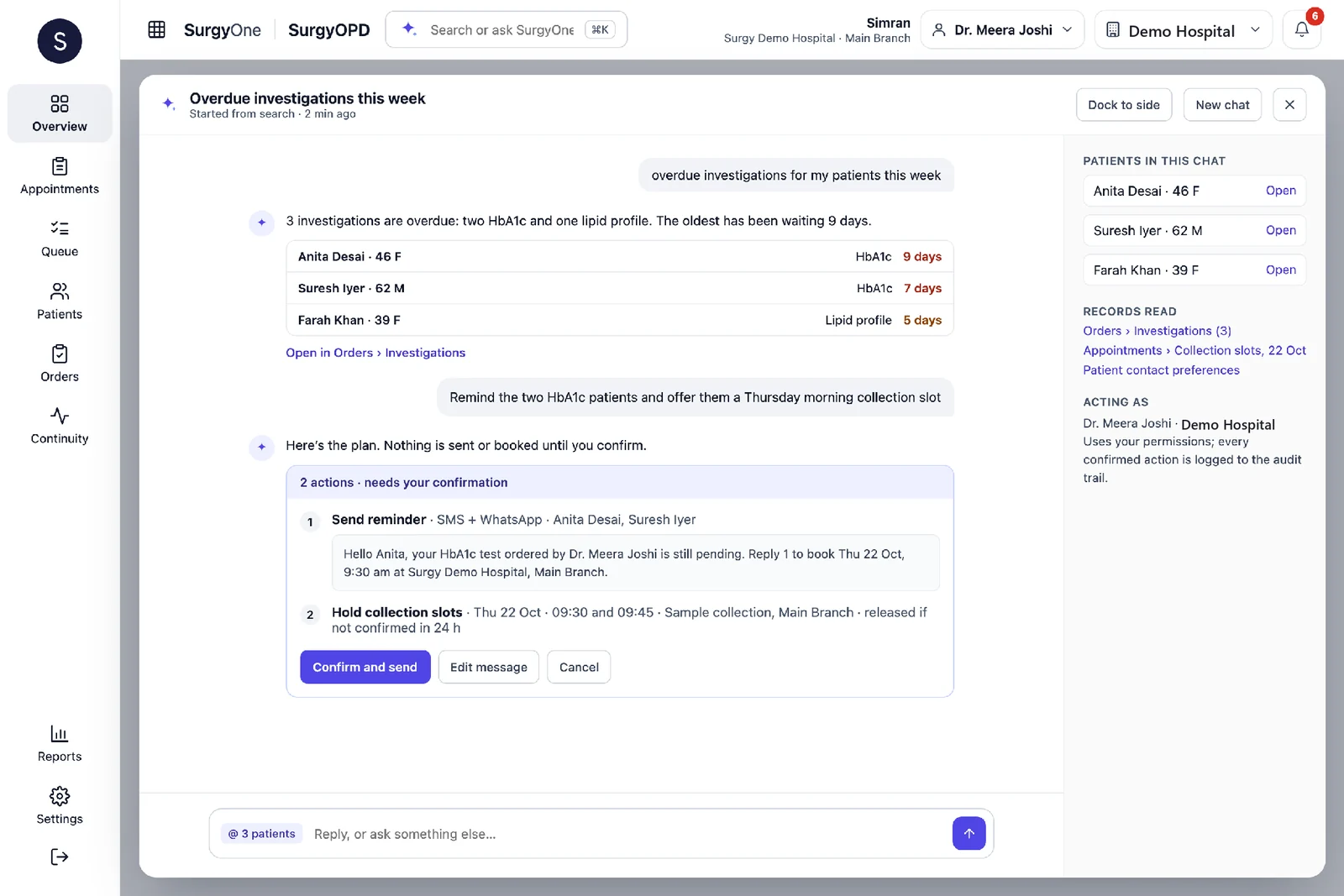
See the screens module by module on the SurgyOne hospital management software page.
Sources and method
Vendor information was read on each vendor's own website on 23 November 2026. Customer counts, certifications and AI claims are the vendors' own statements. Price ranges are indicative industry estimates.
- Healthray: HIMS and pricing pages
- KareXpert: Hospital Information Management System
- MocDoc: Hospital Management System
- DocPulse: Hospital Management Software
- Insta by Practo: Hospitals
- Plus91: MediXcel platform
- Lifetrenz: HMS
- Attune: Hospital Information System
- Medinous: HMS for large hospitals
- OneCity Technologies: Hospital management software cost in India
- Medical Dialogues: NMC orders medical colleges to integrate HMIS with ABDM
- NABH: Digital Health Standards for HIS and EMR systems
Changelog. 23 November 2026: first published; 10 systems checked; benchmark, capability matrix and cost ranges added.
Written by
Mohammed Jamil Nasir
Founder — Product & Tech, Surgy Innovation Labs Private Limited
14+ years in Product, Design & Tech · PGC AI/ML, IIT-Guwahati · Global MBA, SP Jain · BE-CSE
Mohammed Jamil Nasir leads product and technology at Surgy Innovation Labs Private Limited, building AI-first, seamless healthcare products for hospitals and healthcare networks across India and the GCC. He writes about healthcare AI, accreditation, and clinical operations.
Connect on LinkedInKeep reading
More on Healthcare AI
Hand-picked next reads that build on this article, so you can go deeper before you decide.
- Healthcare AI
Hospital AI Budget 2027: Where to Invest and How to Choose
For hospital leaders setting 2027 AI budgets in India and the GCC: where to invest first, what to budget for, a quarter-by-quarter plan, nine weighted criteria, 20 RFP questions and an honest look at where SurgyOne fits.
17 min readRead article - Healthcare AI
Building the AI-First Hospital: Inside Surgy Health's Vision for Healthcare in India and the GCC
Inside Surgy Health’s AI-first vision for connected clinical, patient, workforce, revenue and operational workflows across hospitals in India and the GCC.
13 min readRead article - Healthcare AI
Healthcare AI RFP Template and Vendor Scorecard (Free Excel Kit)
A free healthcare AI RFP template for hospitals: 25 vendor questions, a 9-criterion weighted scorecard with scoring rubric, a worked example and an Excel kit.
11 min readRead article