

HIS vs HMS vs EMR vs EHR: What Hospitals Actually Need
By Mohammed Jamil Nasir, Founder – Product & Technology at Surgy Health · Updated 23 November 2026
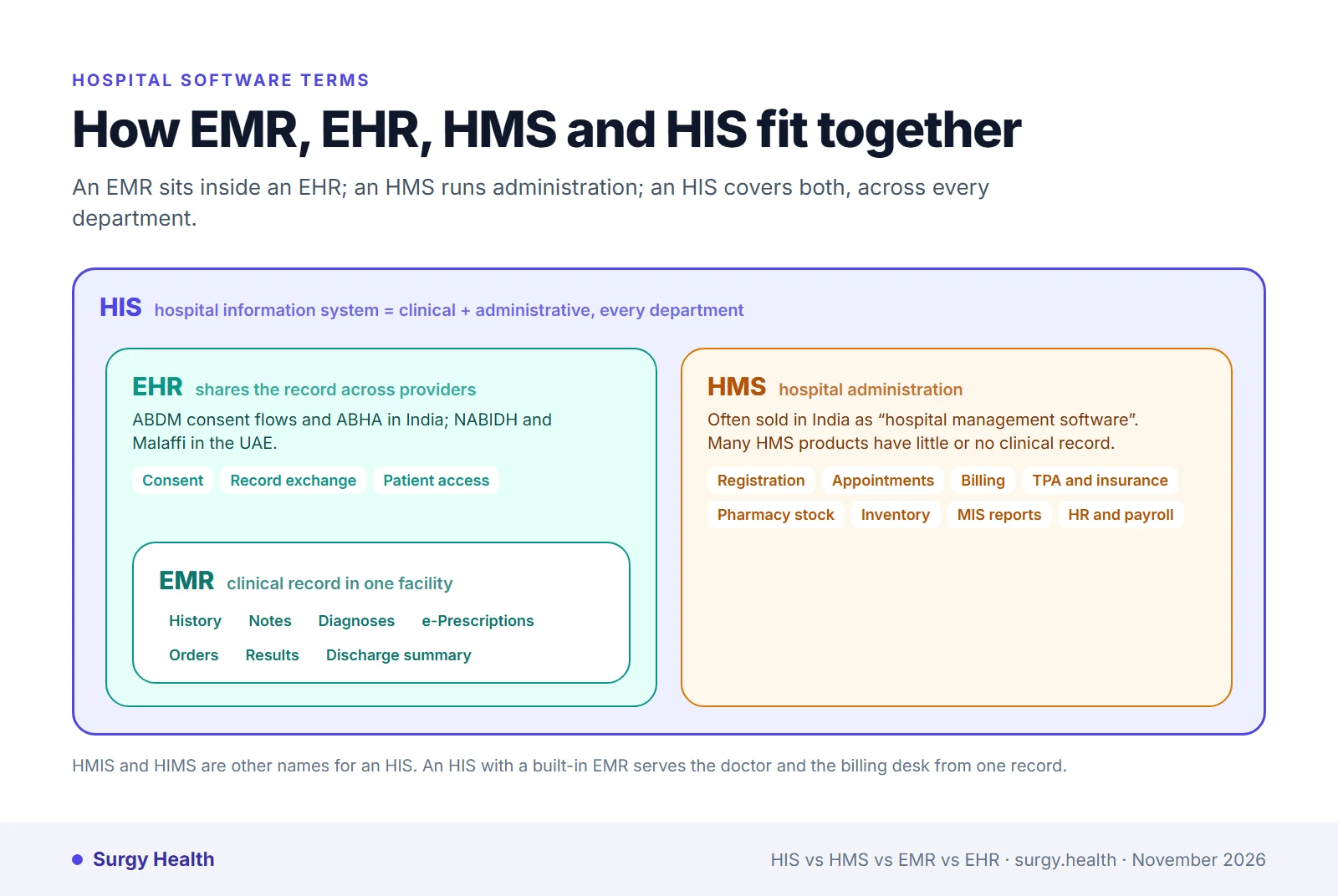
An EMR holds a patient's clinical record inside one facility, and an EHR shares that record across providers. A hospital management system (HMS) runs administration: registration, billing, pharmacy and inventory. A hospital information system (HIS) combines both, clinical and administrative, across every department. Most hospitals beyond a single clinic need an HIS.
The four terms in plain words
EMR (electronic medical record)
An EMR is the digital version of a patient's chart inside one facility: history, consultation notes, diagnoses, prescriptions, orders and results. It is built for clinicians and stays inside the hospital or clinic that created it.
EHR (electronic health record)
An EHR holds the same clinical record but is designed to be shared across providers, so a patient's history follows them from a clinic to a hospital to a lab. In India, ABDM consent flows and ABHA IDs are how records move between facilities; in the GCC, health information exchanges such as NABIDH and Malaffi play that role.
HMS (hospital management system)
A hospital management system, often sold in India as hospital management software, runs the administrative side of a hospital: registration, appointments, billing, insurance and TPA, pharmacy stock, inventory and MIS reports. Many products sold as an HMS have little or no clinical record.
HIS (hospital information system)
A hospital information system combines both: the clinical record (EMR/EHR) and the administrative system (HMS), across every department, from OPD and IPD to emergency, labs, pharmacy and billing. The terms HMIS and HIMS mean the same thing.
HIS vs HMS vs EMR vs EHR compared
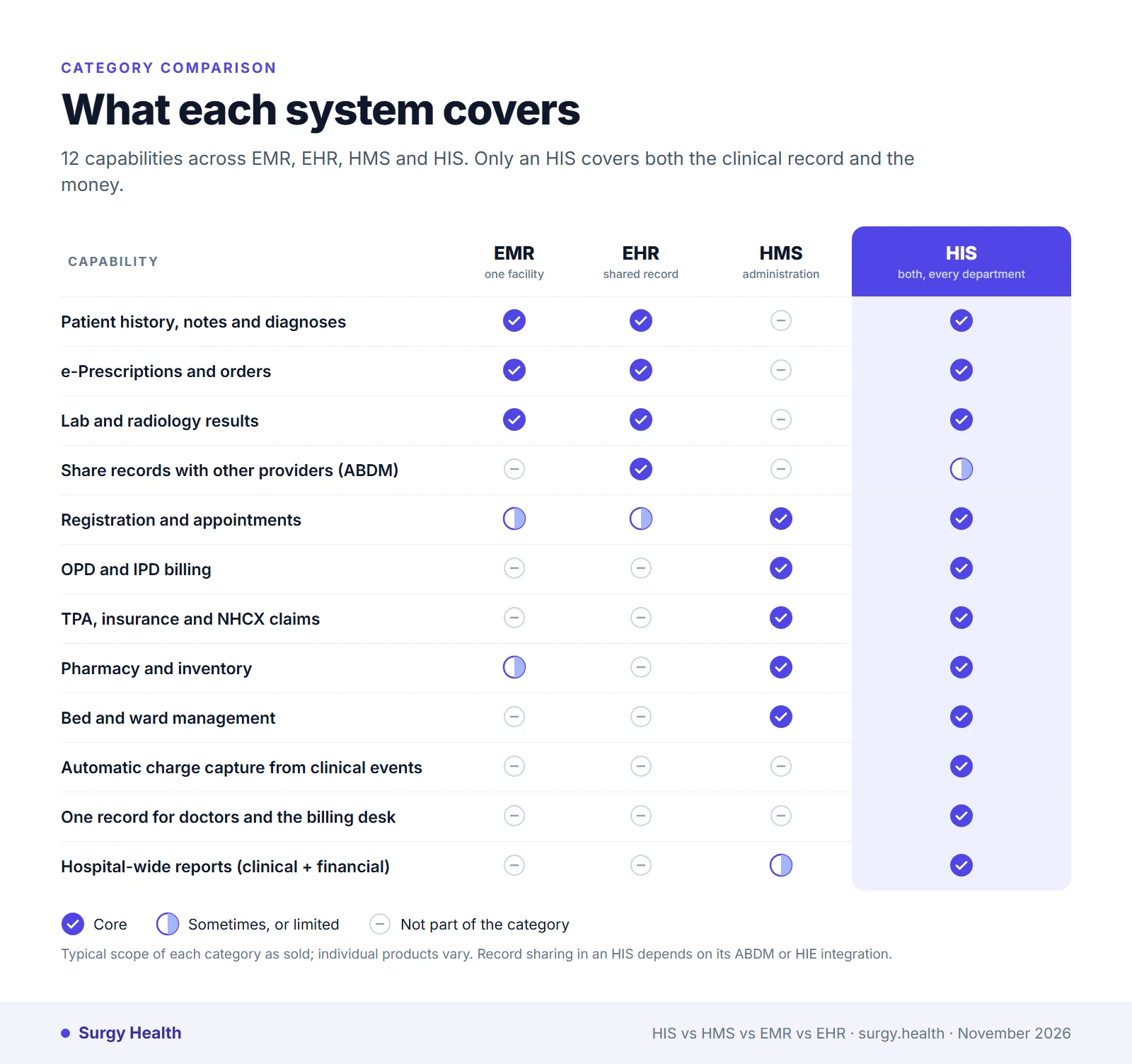
The four differ in scope: an EMR and an EHR are clinical, an HMS is administrative, and an HIS is both.
| Criterion | EMR | EHR | HMS | HIS |
|---|---|---|---|---|
| Scope | Clinical record, one facility | Clinical record, shared across providers | Administration and finance | Clinical + administrative, every department |
| Main users | Doctors, nurses | Doctors, nurses, other providers, patients | Front office, billing, stores, management | Everyone in the hospital |
| Typical modules | Notes, problem list, prescriptions, orders, results | EMR modules + consent and record exchange | Registration, appointments, billing, TPA, pharmacy stock, inventory, MIS | OPD, IPD, ER, OT, labs, radiology, pharmacy, billing, claims, reports |
| Answers the question | What happened to this patient here? | What happened to this patient anywhere? | What did we bill, stock and collect? | How is the whole hospital running, patient by patient? |
| Best fit | Clinics, single-specialty practices | Networks that share patients | Small hospitals focused on billing | Mid-size hospitals and hospital groups |
Related terms you will meet in tenders
HMIS (two meanings in India)
Vendors use HMIS or HIMS as another name for a hospital information system. India's Ministry of Health also runs a public-health HMIS portal, where government facilities report service data. When a tender says HMIS, check which one it means.
LIS (laboratory information system)
Runs the lab: sample tracking, analyzer interfaces, validation and reports. It is part of an HIS or connects to one.
RIS and PACS
A radiology information system schedules and reports imaging; PACS stores and displays the images (DICOM). Both connect to the HIS so the order and report sit on the patient's record.
PHR (personal health record)
The patient's own record, such as an ABHA-linked app, which can pull records from hospitals with the patient's consent.
Why the difference matters: one admission, two ways
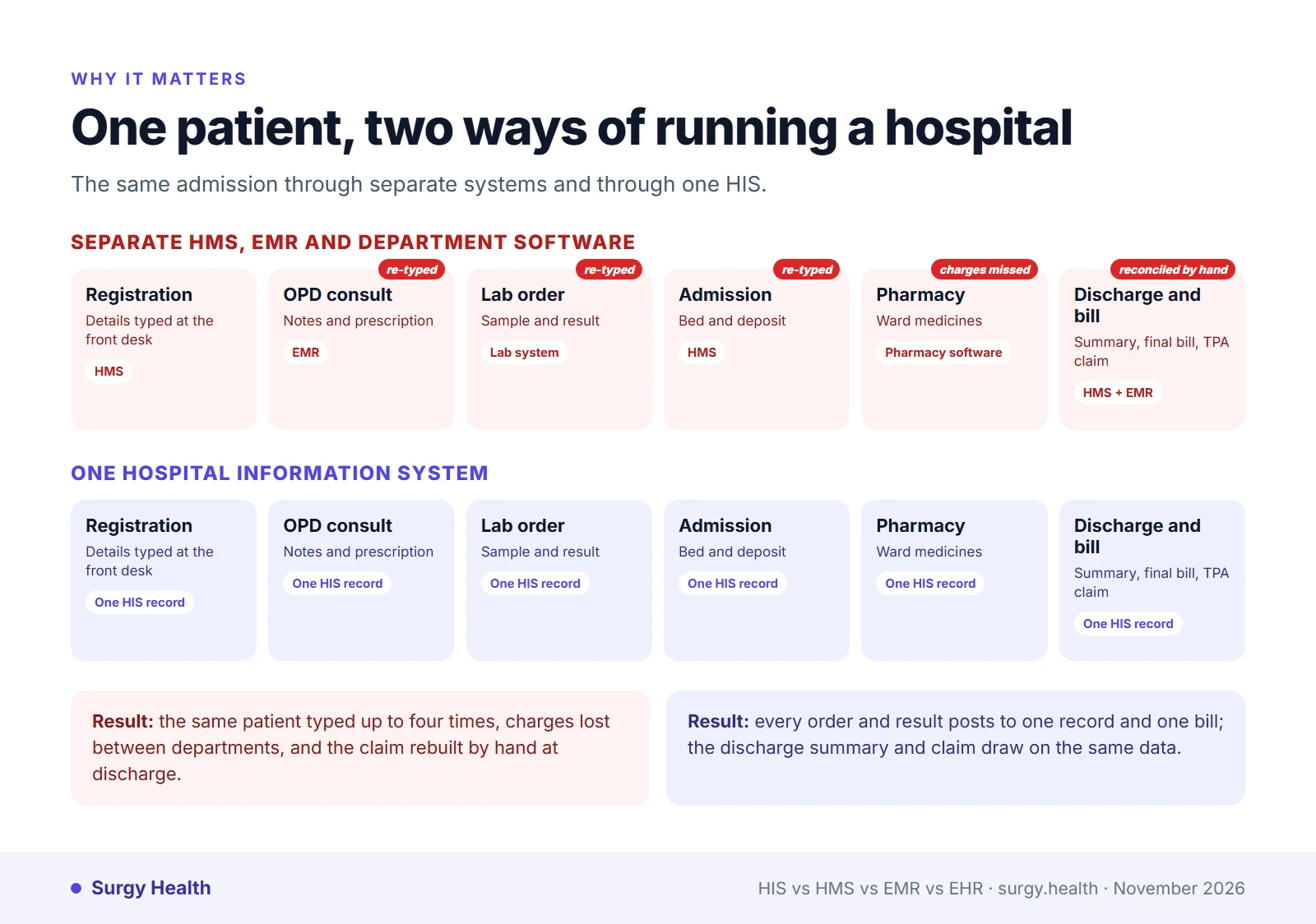
The cost of separate systems shows up in a single admission. With an HMS for the front desk and billing, an EMR for doctors and separate lab and pharmacy software, the same patient is typed several times and charges fall between systems. With one HIS, every order and result posts to one record and one bill.
Which one does your hospital need?
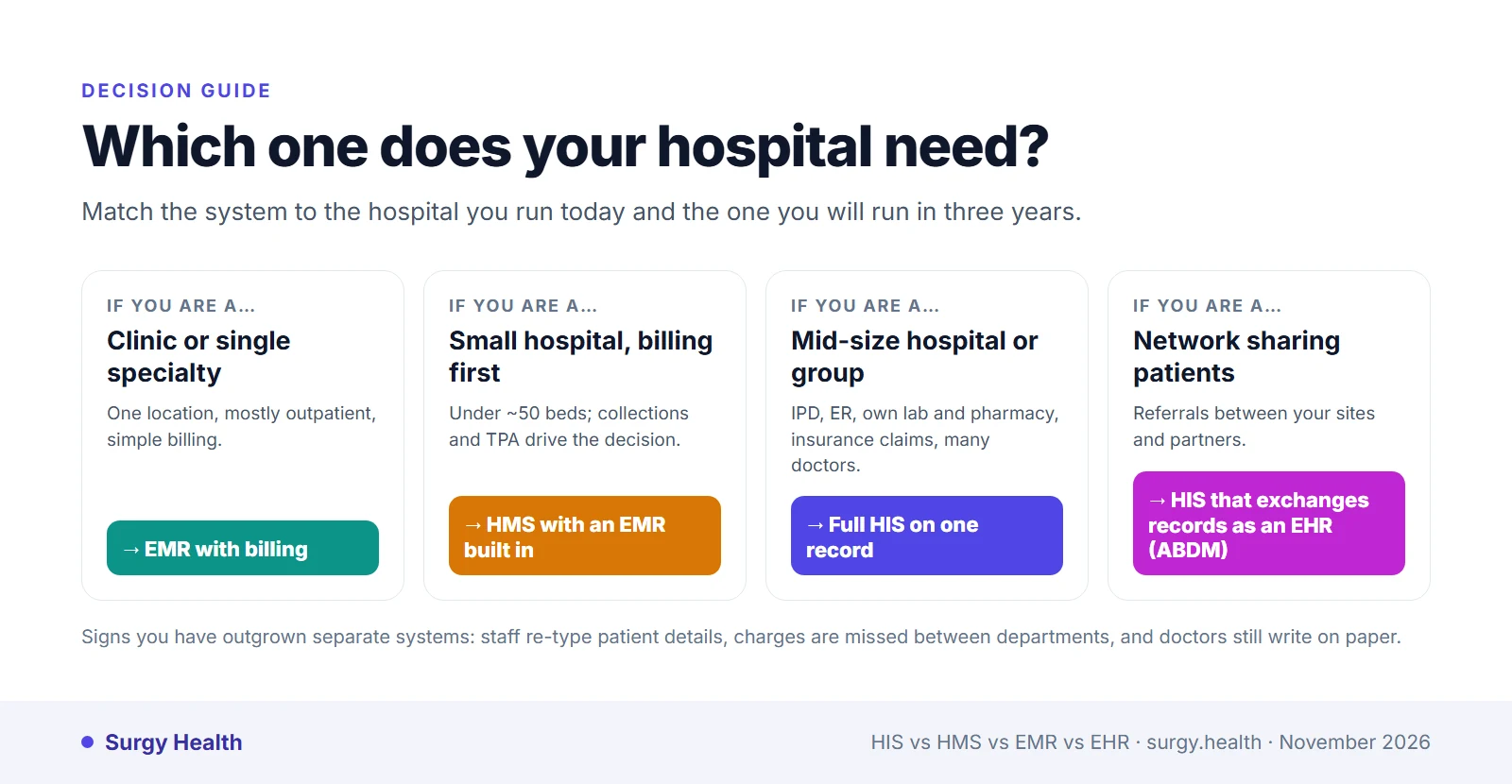
The right system depends on size and on who has to use it. A single clinic can run on an EMR with simple billing. A small nursing home focused on collections can start with an HMS. Once a hospital has inpatient beds, an emergency department, its own lab and pharmacy, and insurance or TPA claims, separate systems start to cost money: charges are missed between departments, staff re-type the same details, and doctors keep notes on paper because the system was built for the billing desk.
- Clinic or single specialty: EMR with billing.
- Small hospital, billing first: HMS, ideally with an EMR built in.
- Mid-size hospital or group: a full HIS on one patient record.
- Network sharing patients: an HIS that also exchanges records as an EHR (ABDM in India).
The Indian and GCC rules behind these terms
In India and the GCC, the choice between an EMR, an HMS and an HIS is shaped by national standards and exchanges as much as by features.
- EHR Standards for India (MoHFW, 2016)
- The Ministry of Health's recommended standards for electronic health records in India, including clinical terminologies and interoperability formats.
- ABDM
- Ayushman Bharat Digital Mission. A hospital acts as a health information provider (sharing records it creates) and a health information user (fetching records with consent). Software clears milestones M1 (ABHA), M2 and M3 with the National Health Authority.
- NABH Digital Health Standards
- NABH certifies HIS and EMR software at Basic or Advanced level, separately from accrediting the hospital itself.
- NMC direction (July 2026)
- Medical colleges were directed to integrate the HMIS of their attached hospitals with ABDM. For most private hospitals, ABDM remains voluntary.
- DPDP Act 2023
- The hospital is the data fiduciary for patient data; the software vendor is its processor. Most obligations under the Rules apply from May 2027.
- GCC equivalents
- Saudi Arabia's NPHIES for insurance and claims; the UAE's NABIDH (Dubai), Malaffi (Abu Dhabi) and Riayati (Northern Emirates) for record exchange.
Where an all-in-one AI-first HIS fits
An AI-first HIS is a hospital information system built so that doctors use it in every consult, with AI agents inside each module rather than AI bought as separate tools. Because the clinical record and the administrative system are one, an agent can prepare a pre-visit brief, flag a patient as ready for discharge or catch a missed charge, and staff approve before anything moves.
SurgyOne is Surgy Health's AI-first HIS with a built-in EHR/EMR: OPD, IPD, ER, labs, pharmacy and billing on one record, for mid-size hospitals and hospital groups in India and the GCC. Comparing products rather than categories? See the best hospital management software in India: 10 systems compared, or the hospital glossary for related terms.
See SurgyOne, AI-first hospital management software