Security and trust at Surgy Health

Founder – Product & Technology, Surgy Health · Last reviewed 25 November 2026
Security questions? Email nasir@surgyy.com
Short answer
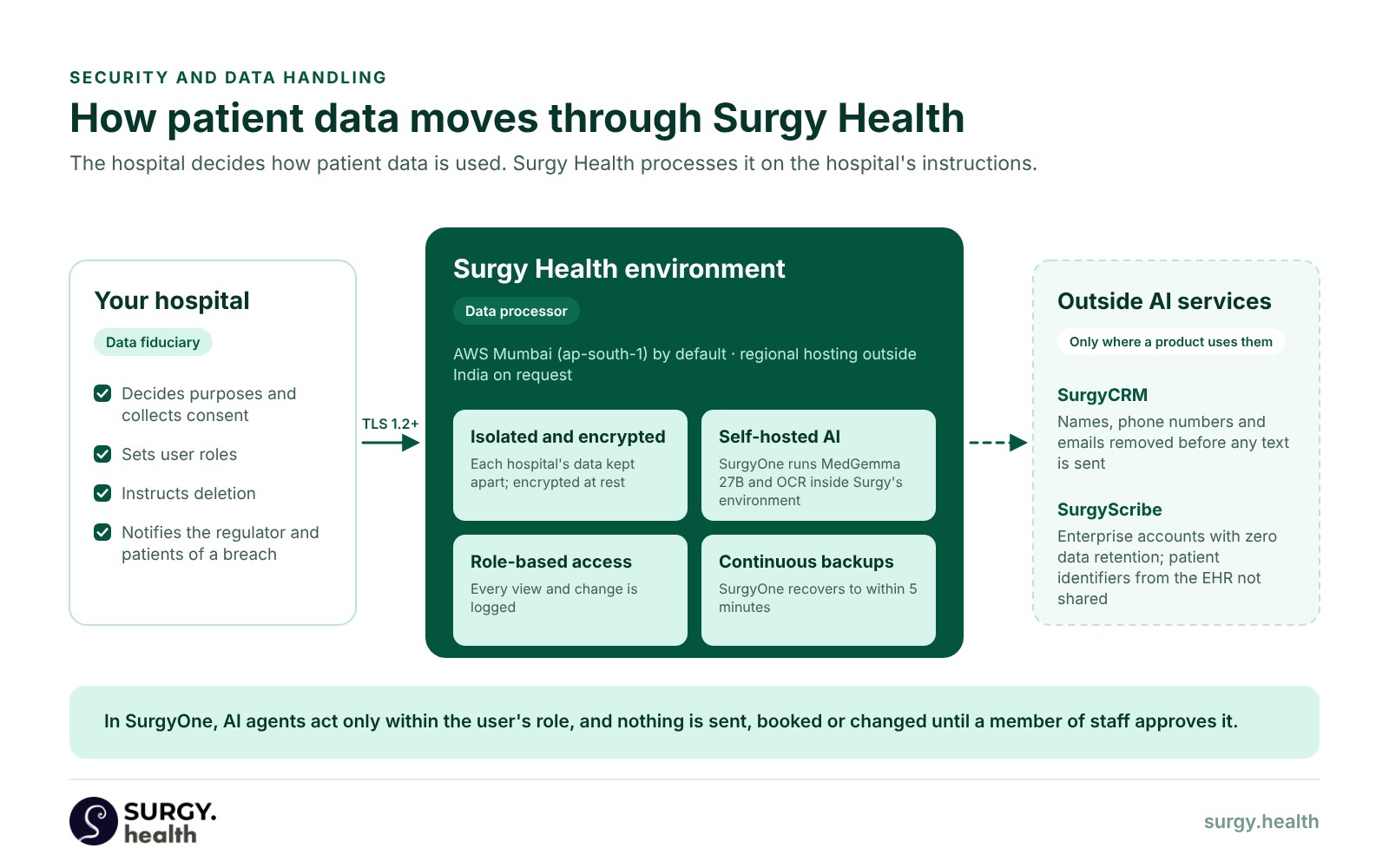
Surgy Health processes patient data on behalf of hospitals, which remain the data fiduciary. Data is hosted on AWS in Mumbai by default, with in-country or regional hosting outside India on request. SurgyOne runs its AI models inside Surgy's own environment, and identifiable patient data is not sent to outside AI services for documentation. Every product has a Privacy Center for your admins.
Key takeaways
- You own the data and decide its purposes. We process it only to run the products you use.
- Hosting stays in India by default. GCC hospitals can request in-country or regional AWS hosting.
- Self-hosted AI for SurgyOne. Enterprise AI accounts with zero data retention for SurgyScribe.
- Encryption in transit and at rest, role- and branch-scoped access, and a full audit trail.
- ISO 27001 certification and a SOC 2 Type 1 (Security) report are in progress.
- Data role
- Hospital = data fiduciary (controller). Surgy Health = data processor.
- Default hosting
- AWS Mumbai (ap-south-1), India
- Other hosting
- In-country or regional AWS hosting outside India on request; SurgyOne also runs on-premise
- Encryption
- TLS 1.2+ in transit; encryption at rest
- Backups (SurgyOne)
- Continuous; recovery point of 5 minutes or less
- Audit logs (SurgyOne)
- Kept for 400 days
- Access
- Role- and branch-scoped; data isolated per hospital
- AI
- Self-hosted MedGemma 27B and OCR (SurgyOne); own speech-to-text model and MedGemma (SurgyScribe)
- Standards
- ABDM-integrated; HL7 v2; FHIR R4; DPDP Act-ready workflows
- Certifications
- ISO 27001 and SOC 2 Type 1 (Security): in progress
- Security contact
- nasir@surgyy.com
Who is responsible for what
Under India's DPDP Act, the hospital decides why patient data is collected and stays accountable for it. We run the software that processes it. The split below is how that works day to day.
| Task | Hospital (data fiduciary) | Surgy Health (processor) |
|---|---|---|
| Decide purposes and collect consent | ||
| Answer patient access, correction and erasure requests | Supports through the Privacy Center | |
| Delete a patient's data | Instructs us | Deletes on the hospital's instruction (how deletion works) |
| Secure hosting, encryption, backups | ||
| Access control for hospital users | Sets roles | Enforces roles, logs every access |
| Breach response | Notifies the regulator and patients | Notifies the hospital and supports the investigation |
| Choose integrations (WhatsApp, telephony, HIS) | Connects only what the hospital approves |
There is no government-issued 'DPDP certificate' for software or hospitals. Compliance is a programme the hospital runs. Our job is to make the software side of it easy to evidence. Read our guide: The DPDP Act for hospitals.
Where your data lives
India by default
Production runs on AWS in Mumbai (ap-south-1).
GCC and other countries
In-country or regional AWS hosting outside India, on request and at extra cost.
On-premise option
SurgyOne can run as containers in your own data centre, with AI on your own GPU servers.
How AI handles patient data
| Product | AI used | What leaves Surgy's environment |
|---|---|---|
| SurgyOne | Self-hosted MedGemma 27B and OCR inside Surgy's environment | Nothing goes to an outside AI service |
| SurgyScribe | Surgy's own fine-tuned speech-to-text model and MedGemma; enterprise AI accounts where used | Patient identifiers received from the EHR are not shared with third-party AI services; enterprise accounts run with zero data retention |
| SurgyCRM | Google Cloud Vertex AI (India), with OpenAI (US) as backup, for AI-assisted features | Names, phone numbers and emails are removed before any text is sent |
| SurgyLearn | AI course creation from your SOPs | Identifiable staff or patient data is not passed to third-party content tools |
In SurgyOne, AI agents read, draft and act only within the user's role, and nothing is sent, booked or changed until a member of staff approves it.
Security controls
Encryption
TLS 1.2+ in transit and encryption at rest.
Tenant isolation
Each hospital's data is isolated from every other customer's.
Role-based access
Permissions scoped by role and branch, set by your admins.
Audit trail
Every view and change is logged; SurgyOne keeps logs for 400 days.
Backups
Continuous backups; SurgyOne recovers to within 5 minutes.
Monitored integrations
Failed interface messages are queued and surfaced, never silently dropped.
Staff training
Our own team completes security and privacy training on SurgyLearn, with logs kept as evidence.
Privacy Center
A Privacy Center in every product for your admins.
Vendor agreements
Business associate agreements in place with AWS and Google Cloud.
Compliance map
| Framework | Market | Where Surgy Health stands |
|---|---|---|
| DPDP Act 2023 and DPDP Rules 2025 | India | Processor role; Privacy Center; deletion on hospital instruction. Most obligations apply from 13 May 2027. |
| ABDM | India | Integrated (ABHA, health information exchange) |
| NABH | India | Role-based access and full audit trail support NABH documentation; SurgyOne NABH HIS/EMR certification in progress |
| UAE health data law (Federal Law No. 2 of 2019) | UAE | In-country hosting available on request |
| PDPL | Saudi Arabia, Bahrain | Regional hosting on request; processor role |
| HIPAA | United States | Controls aligned; BAAs with AWS and Google Cloud in place |
| ISO 27001 | Global | Certification audit in progress |
| SOC 2 Type 1 (Security) | Global | Report in progress |
Sub-processors
We use a small set of providers to run the products. The full, current list is in our Privacy Policy.
| Provider | Purpose | Location |
|---|---|---|
| Amazon Web Services | Hosting, database, files, backups | Mumbai, India (default) |
| Google Cloud Vertex AI | AI-assisted features in SurgyCRM, with identifiers removed | India |
| OpenAI | Backup for SurgyCRM AI features, with identifiers removed | United States |
| WhatsApp Business and cloud-calling providers | Messaging and calls, only when the hospital connects them | As chosen by the hospital |
Report a security issue
If you think you have found a vulnerability, email nasir@surgyy.com with the details and steps to reproduce. Please do not test against live hospital data. We acknowledge reports within two business days.