
One training standard for every dialysis centre
DCDC Kidney Care and Apex Kidney Care keep hundreds of centres to one training standard on SurgyLearn.
Short answer
Dialysis networks need the same standard of care at every centre and on every shift, and proof that each technician and nurse was trained. SurgyLearn syncs staff from your HR system, assigns courses by role automatically, runs live and self-paced training on phones in several languages, and keeps a training record per employee that assessors can check.
- 2,819
- staff at DCDC Kidney Care
- 270+
- DCDC locations
- 250+
- Apex Kidney Care centres
- 98.1%
- DCDC course assignments made by rules
Customer data as of 23–24 November 2026.
Why dialysis training is hard to scale
Centres far from headquarters
Metros, district hospitals and small towns; bringing staff to a central classroom does not scale.
Shift work
Day-shift training leaves night-shift staff behind in the same centre.
Constant joiners
New technicians and nurses every month need the right courses from day one.
Evidence for audits
Paper sign-in sheets can't be consolidated across hundreds of centres.
India's public dialysis programme alone runs 1,704 centres in 751 districts (June 2025), alongside private networks, so the training gap is national. Source: Lok Sabha reply, 1 Aug 2025 (IANS)
How SurgyLearn trains a network
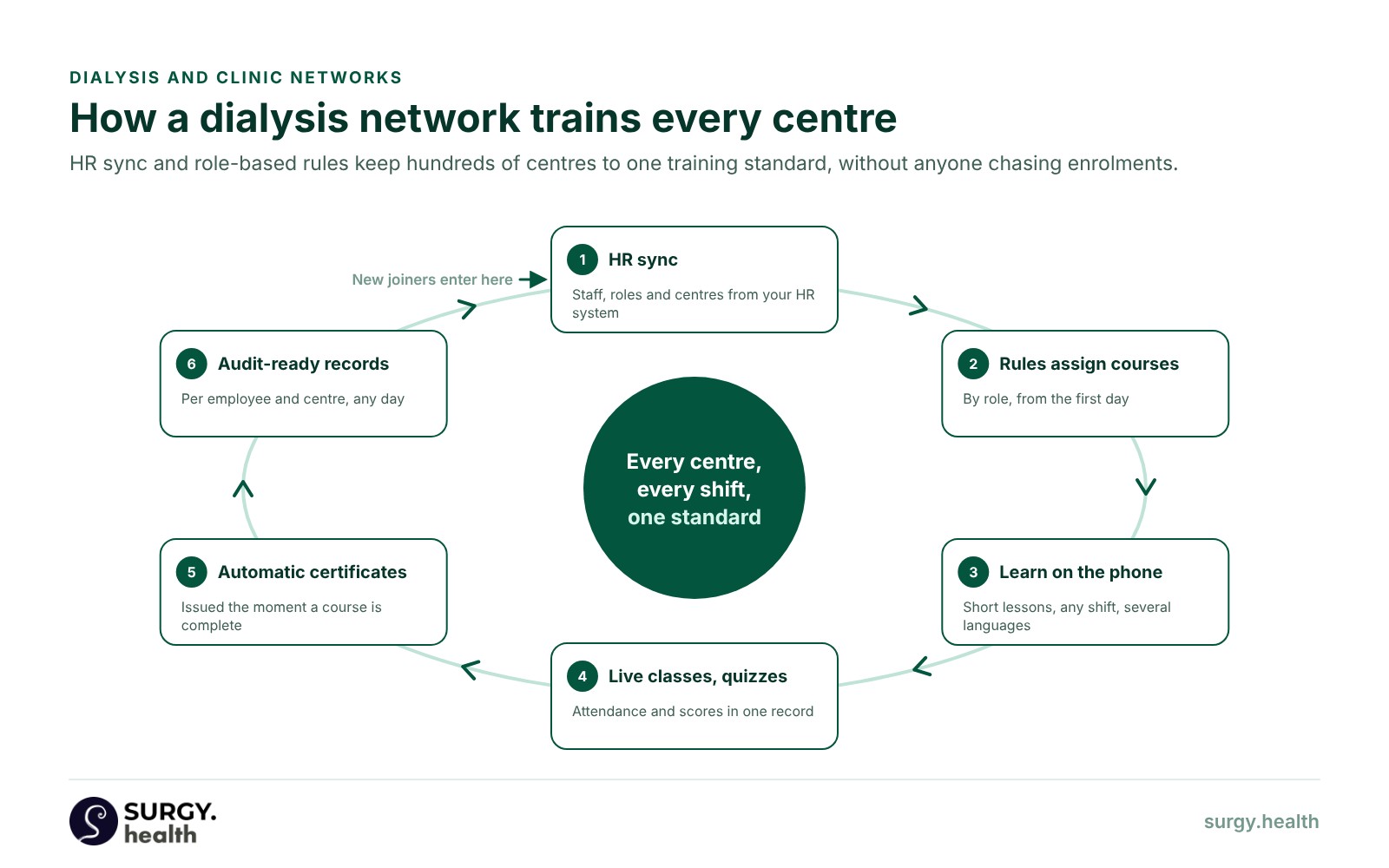
HR sync
Staff, roles and centres arrive from your HR system; at DCDC, 99.3% of profiles sync automatically.
Rules, not lists
A rule like 'all junior technicians take cannulation technique' applies to everyone who joins the role later.
Your teams' languages
Apex Kidney Care trains in four languages.
On the phone, between sessions
Short, mobile-first lessons for technicians on any shift.
Live classes in one record
Virtual or in-person classes with attendance, alongside self-paced courses.
Certificates on completion
Issued automatically the moment every lecture and quiz is done.
Example course catalogue from a dialysis network
| Category | Example courses (DCDC Kidney Care) |
|---|---|
| Clinical | BLS and ACLS, cannulation technique, intradialytic complications, needle-stick injury, water treatment |
| HR | HR induction, POSH/ICC, grooming, effective communication |
| Quality | NABH, fire safety, emergency colour codes, IPSG, mock drill |
| Operations | Quality score and internal audits, HMIS registration and process |
Start faster with 24 ready-made hospital courses, or turn your own SOPs into courses with AI.
How networks roll out
- Step 1
Pilot with a small group
DCDC started with 20 users to settle courses and rules.
- Step 2
Connect HR
Import staff, roles and centres from the HR system in one go.
- Step 3
Switch on rules
Role-based assignment for every course.
- Step 4
Add live classes
Trainers schedule classes and mark attendance on the platform.
- Step 5
Review by centre
Completion and certificates by centre and role, every month.
Dialysis network training: questions
What is the best way to train dialysis technicians across many centres?
Use a learning platform that syncs staff from HR, assigns courses by role automatically, delivers short mobile lessons for shift workers and records completion per employee. That keeps every centre on one standard without manual enrolment.
Which dialysis networks use SurgyLearn?
DCDC Kidney Care (2,819 staff across 270+ locations) and Apex Kidney Care (250+ centres in 15 states and union territories), as of November 2026.
Can training run in regional languages?
Yes. Apex Kidney Care runs its training in four languages on SurgyLearn.
Does it help with NABH assessments?
Yes. Course completions, quiz results, live-class attendance and certificates sit in one record per employee, so assessors can see who was trained on what and when.
Keep reading
Related reading
 DCDC Kidney Care case studyHow DCDC Kidney Care trains 2,819 staff across 270+ dialysis centres on SurgyLearn: HR sync, rule-based assignment, live classes and NABH evidence.Read
 Apex Kidney Care case studyApex Kidney Care trains staff at 250+ dialysis centres in four languages on SurgyLearn: 2,019 certificates in 30 days, 87% of staff active.Read
 NABH training software comparedSix ways hospitals run NABH training in 2027, from a hospital LMS to spreadsheets: evidence for assessors, automation, languages and cost.Read