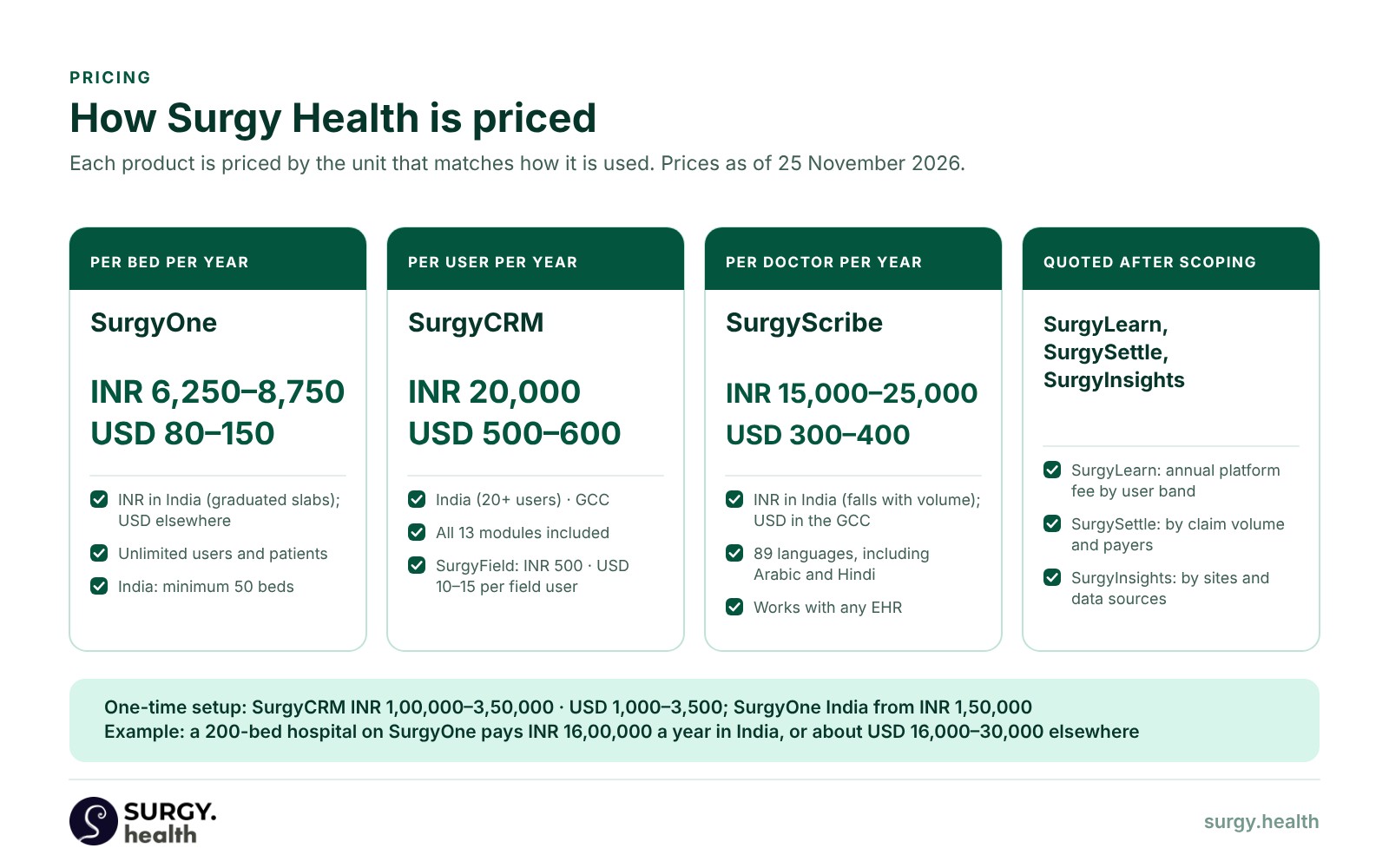
In India, SurgyOne costs INR 6,250–8,750 per bed per year in graduated slabs (minimum 50 beds); elsewhere it costs USD 80–150 per bed per year. SurgyCRM costs INR 20,000 per user per year in India (20+ users) or USD 500–600 in the GCC, with every module included. SurgyScribe costs INR 15,000–25,000 per doctor per year in India, falling with volume, or USD 300–400 in the GCC. SurgyLearn costs INR 500–800 per employee per year in India or USD 20–30 in the GCC, depending on the number of employees. SurgySettle and SurgyInsights are quoted after a short scoping call.
Key takeaways
Per bed for SurgyOne, so users and patients are unlimited. In India the rate falls as you add beds: a 200-bed hospital pays INR 16,00,000 a year.
Per user for SurgyCRM, with all 13 modules in one price. No module add-ons.
One-time setup applies to SurgyCRM (by integration and setup scope) and SurgyOne (in India, per bed in slabs, minimum INR 1,50,000).
Buy one product or several. Each works on its own and shares one patient record with the others.
How each Surgy Health product is priced, as of 25 November 2026.
Price list
Prices by product
SurgyOne
AI-first HIS and EHR
INR 6,250–8,750USD 80–150
per bed per year (India, graduated slabs · GCC and other markets)
India: minimum 50 beds; one-time implementation from INR 1,50,000
Unlimited users and patients
OPD, IPD, ER, labs, pharmacy and billing on one record
Cloud by default, on-premise as an option
Example: a 200-bed hospital pays INR 16,00,000 a year in India, or about USD 16,000–30,000 elsewhere
INR 6,250–8,750 in graduated slabs (minimum 50 beds)
USD 80–150
India: INR 1,500–2,500 per bed in slabs, minimum INR 1,50,000 · elsewhere: scoped with data migration
Demos and pilots; first go-live Dec 2026–Jan 2027
SurgyCRM
Per user per year
INR 20,000 (20+ users)
USD 500–600
INR 1,00,000–3,50,000 · USD 1,000–3,500
Live
SurgyField
Per field user per year
INR 500
USD 10–15
Included in SurgyCRM setup
Live
SurgyScribe
Per doctor per year
INR 15,000–25,000 by volume (INR 25,000 below 10 doctors; INR 15,000 at 100+)
USD 300–400
Per EHR integration
Live
SurgyLearn
Per employee per year
INR 500–800 by number of employees
USD 20–30
Scoped
Live
SurgySettle
Quoted
Quoted
Quoted
Scoped
Live
SurgyInsights
Quoted
Quoted
Quoted
Scoped
Live
SurgyFrontdesk
Quoted
Quoted
Quoted
Scoped
Available
Surgy Health list prices as of 25 November 2026. Annual subscriptions; GST or VAT extra.
SurgyOne · India
SurgyOne in India: per-bed slabs
In India, SurgyOne is billed per licensed bed per year in graduated slabs. Each slab's rate applies only to the beds inside it, like income-tax slabs, so adding beds never raises the price of beds you already license. Prices in INR; GST extra.
Subscription rate for beds in this slab (INR per bed per year)
One-time implementation (INR per bed)
1–100
8,750
2,500
101–300
7,250
2,500
301–500
6,750
2,000
501–1,000
6,250
1,500
Above 1,000
Enterprise agreement, quoted on request
Quoted on request
SurgyOne India price slabs, as of 25 November 2026. Minimum billing 50 beds; minimum implementation fee INR 1,50,000; GST extra.
Hospital size
Effective rate (INR per bed per year)
Annual subscription, Years 1–2 (INR)
One-time implementation (INR)
Year-one total (INR)
50 beds
8,750
4,37,500
1,50,000
5,87,500
100 beds
8,750
8,75,000
2,50,000
11,25,000
200 beds
8,000
16,00,000
5,00,000
21,00,000
300 beds
7,750
23,25,000
7,50,000
30,75,000
500 beds
7,350
36,75,000
11,50,000
48,25,000
700 beds
7,036
49,25,000
14,50,000
63,75,000
1,000 beds
6,800
68,00,000
19,00,000
87,00,000
SurgyOne in India by hospital size: core subscription and implementation before add-ons and GST. Example: 250 beds = 100 × INR 8,750 + 150 × INR 7,250 = INR 19,62,500 a year.
Included in the subscription
OPD, IPD, ER, pharmacy, lab and billing modules on one record
SurgyOne AI across modules, including AI radiology analysis on a self-hosted MedGemma 27B model
Standard BI dashboards
AWS Mumbai hosting with 2 GB of storage per licensed bed
All updates and upgrades, no separate AMC
Connectors for payment gateway, POS, SMS, WhatsApp, email, Tally, ABDM and HL7/FHIR
L1 and L2 support in business hours
Unlimited users and patients
Included in implementation
Project management
Masters, tariffs, print and EMR templates
Connector setup
Data migration of patient demographics, active IPD admissions and store stock (up to 2 runs)
A UAT environment through go-live
2 weeks of onsite training
2 weeks of onsite and 2 weeks of remote hypercare
Onsite travel and stay at actuals
Add-on
INR per year
Cath lab module
15,000
Equipment maintenance module
15,000
Document management module
15,000
Patient feedback module
15,000 (included for SurgyCRM customers)
Staff duty roster module
30,000
Lab analyser integration, uni-directional
5,000 per analyser
Lab analyser integration, bi-directional
6,000 per analyser
PACS / RIS integration
40,000
Extra storage
50,000 per 100 GB
24×7 priority support
10% of the annual subscription
SurgyScribe (AI medical scribe)
15,000–25,000 per doctor, by volume
SurgyOne add-ons in India, billed annually with the subscription and on the same price lock.
Terms in brief
Beds are counted across all of a hospital group's locations on one contract; minimum billing is 50 beds.
3-year minimum term, then annual renewal. Rates are fixed for Years 1 and 2, then rise 5% a year from Year 3.
Implementation is paid 50% at signing and 50% at go-live. The subscription is billed quarterly in advance from go-live, or 120 days after the purchase order if sooner.
You own your data and stay the data fiduciary; full export in FHIR or CSV at any time, including at exit.
Fees for SMS, WhatsApp and payment gateways are paid by the hospital directly to those vendors. GST extra.
What you would pay in year one
Six worked examples using the list prices above. Replace the numbers with your own users, beds and doctors.
Example
Products
Year-one cost
Every year after
A 3-site hospital group in India with 25 CRM users and 5 field reps
Worked examples at list price, before tax. Setup depends on integrations and data migration.
How our pricing compares
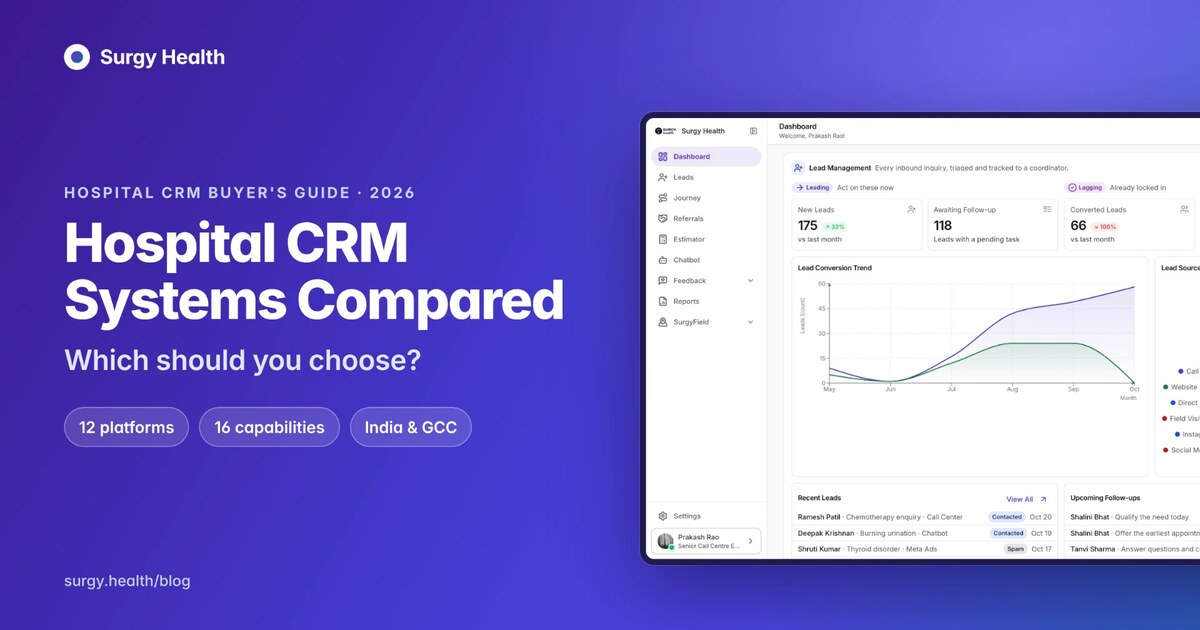
Hospital CRM is the one category with enough public prices to compare. On a 25-user hospital over three years, list licences alone range from under USD 50,000 to over USD 300,000.
Hospital information systems are harder to compare. Most HIS vendors quote by edition, beds and modules, and few publish a number. That is why we publish SurgyOne's per-bed slabs.
What changes the price
Product
What moves the price
SurgyOne
Beds across all sites (graduated slabs in India) · add-on modules and integrations · cloud or on-premise · data migration from the current HIS
SurgyCRM
Number of users · HIS integration depth · telephony and WhatsApp provider setup · number of locations
SurgyScribe
Number of doctors (the per-doctor rate falls with volume) · EHR integration (API or Chrome extension) · specialties and templates
SurgyLearn
Number of staff · HRMS integration · custom course creation · white-label apps
SurgySettle
Claim volume · number of payers and TPAs · integration with billing
SurgyInsights
Number of sites · data sources and refresh frequency
Price drivers by product.
Included in every subscription
Hosting and backups
AWS Mumbai by default; in-country or regional AWS hosting outside India on request.
Updates
New features and fixes shipped module by module through our release pipeline.
Privacy Center
Every product has a Privacy Center for your admins. You stay the data fiduciary.
Role-based access
Access scoped by role and branch, with an audit trail.
Phased rollout
Start with one product or module and add more on the same patient record.
Product-team support
Direct access to the people who build the product.
How to buy
Step 1
Scoping call
30 minutes on your sites, departments and the one number you want to move.
Step 2
Written quote
Scope, price, setup and go-live plan in one document.
Step 3
Demo on your own data
Send a week of anonymised data; we run the demo on it.
Step 4
Phased go-live
Start with one product or module, then add more on the same record.
FAQ
Pricing questions, answered
Are Surgy Health prices monthly or yearly?
Yearly. Every product is an annual subscription. GST in India and VAT in the GCC are extra.
Does SurgyOne charge per user?
No. SurgyOne is priced per bed per year, so users and patients are unlimited. In India it costs INR 6,250–8,750 per bed in graduated slabs, with a 50-bed minimum; outside India it costs USD 80–150 per bed.
How much does SurgyOne cost for a 100-bed hospital in India?
INR 8,75,000 a year (100 beds × INR 8,750), plus a one-time implementation fee of INR 2,50,000, so INR 11,25,000 in year one before GST. Rates are fixed for two years.
How much does SurgyCRM cost in India?
INR 20,000 per user per year for 20 or more users, with all modules included. SurgyField app users cost INR 500 per user per year. One-time setup is INR 1,00,000–3,50,000, depending on integrations and setup scope.
How much does SurgyCRM cost in the UAE, Saudi Arabia or Kuwait?
USD 500–600 per user per year, plus USD 10–15 per SurgyField user and a one-time setup of USD 1,000–3,500, depending on integrations and setup scope.
How much does an AI medical scribe cost?
SurgyScribe costs INR 15,000–25,000 per doctor per year in India (INR 25,000 below 10 doctors, falling to INR 15,000 at 100 or more) and USD 300–400 per doctor per year in the GCC. It supports 89 languages, captures medicines, tests and admission advice as structured orders, and works with any EHR through its Chrome extension.
Do we have to buy every Surgy Health product?
No. Each product works on its own. Hospitals usually start with one, often SurgyCRM or SurgyScribe, and add others on the same patient record later.
What does the setup fee cover?
For SurgyCRM: configuration, data import, integration with your HIS, telephony and WhatsApp providers, and training; the range depends on how many systems we connect. For SurgyOne in India: project management, masters and templates, connector setup, data migration (up to 2 runs), a UAT environment, 2 weeks of onsite training and 4 weeks of hypercare.
Can we try it before we buy?
Yes. Send us a week of anonymised data and we will run the demo on your own records, so you see results on your workflows, not a sample dataset.