Patient engagement platform vs hospital CRM: which does your hospital need?

Founder – Product & Technology, Surgy Health · Last reviewed 25 November 2026
Short answer
Choose a patient engagement platform if you want messaging, reminders and AI agents on top of your HIS without changing how teams track patients. Choose a sales-style CRM if a large call centre runs lead conversion and you have budget to configure it. Choose a hospital CRM connected to the doctor's note if you need to prove which enquiries, orders and care journeys turned into revenue.
Key takeaways
- Three different products are sold as 'patient engagement': integration-first engagement platforms, sales CRMs with a healthcare template, and hospital CRMs on one record with the clinical note.
- The deciding question is who captures the doctor's orders. Follow-ups are only as good as the list of what was advised.
- Engagement platforms are quick to add on top of an HIS; sales CRMs are flexible but need configuration; one-record hospital CRMs trade some flexibility for revenue you can prove.
- Compare three-year cost, not licence price: configuration, partner fees and WhatsApp message charges change the total.
The three models, defined
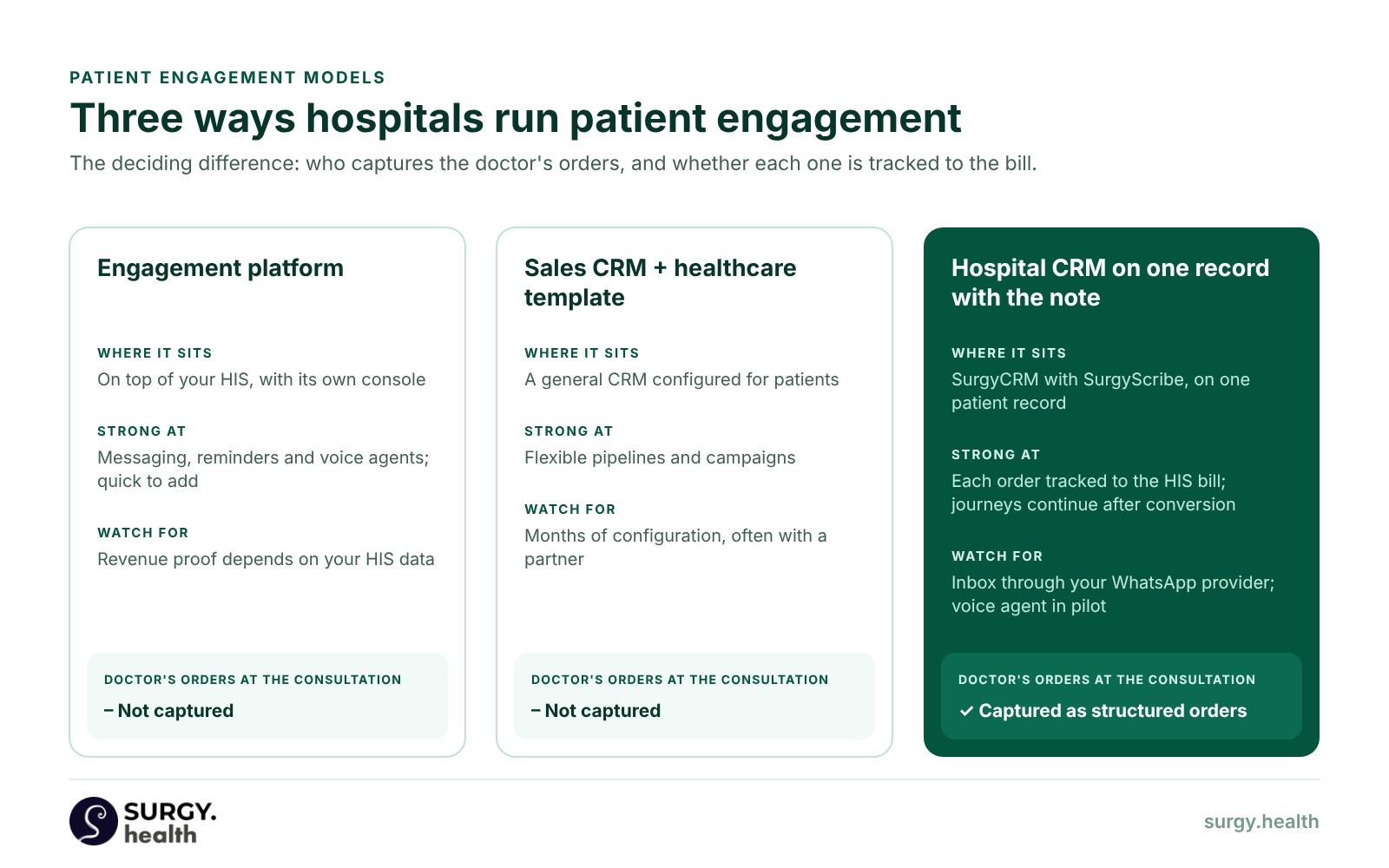
Integration-first engagement platform
Sits on top of your HIS and runs messaging, reminders, voice agents and journeys from its own console. Examples: Prodoc AI, Zavis, DocEngage.
Sales CRM with a healthcare template
A general CRM configured for patients: leads, pipelines, campaigns. Examples: LeadSquared Healthcare CRM, Salesforce Health Cloud, Zoho for Healthcare.
Hospital CRM on one record with the note
A CRM built for hospitals that receives the doctor's orders from the consultation and tracks each one to completion. Example: SurgyCRM with SurgyScribe.
What each model covers
| Capability | Engagement platform | Sales CRM + template | Hospital CRM + scribe (SurgyCRM) |
|---|---|---|---|
| Lead capture from calls, WhatsApp and ads | |||
| Built-in omnichannel inbox | Varies | Via your WhatsApp provider (WATI, Interakt) | |
| Voice AI agent for calls | ✓ (most) | Add-on | ✓ (SurgyFrontdesk) |
| Doctor's orders captured at the consultation | |||
| Care journeys that continue after conversion | Varies | Build yourself | |
| Referral partner and field visit tracking | Varies | Configure | ✓ (SurgyField) |
| Revenue verified against the HIS bill | Depends on HIS data | Configure | |
| DPDP consent and rights module | Some vendors | Privacy Center for admins | |
| Time to go live | Weeks | Months with a partner | 4–6 weeks |
Options compared
| Option | Model | Markets | Scale (vendor-stated) | Published price | Source |
|---|---|---|---|---|---|
| Prodoc AI | Engagement platform ("Patient Journey OS", 16 modules) | India | 200+ hospitals; 1M+ patient engagements a month; 50+ integrations | No public price found | prodoc.ai |
| Zavis | AI receptionist, omnichannel inbox and patient CRM | UAE | 150+ clinics and hospitals | Quoted per clinic setup | zavis.ai |
| DocEngage | Healthcare CRM and practice suite | India and other markets | Not stated | Healthcare CRM ₹1,499–2,499 per user per month, billed annually | docengage.in/pricing |
| LeadSquared Healthcare CRM | Sales CRM with healthcare vertical | India, UAE | Not stated | USD 60–100 per user per month | Hospital CRM Systems Compared |
| Salesforce Health Cloud | Enterprise CRM | Global | Not stated | USD 350–725 per user per month, billed annually | Hospital CRM Systems Compared |
| Zoho CRM / Zoho for Healthcare | Configurable CRM | India and global | Not stated | ₹800–2,600 per user per month, billed annually | Hospital CRM Systems Compared |
| SurgyCRM + SurgyScribe | Hospital CRM on one record with the note | India, GCC | Mediversal Hospitals: 600+ calls a day across 3 hospitals | INR 20,000 per user per year (India, 20+ users); USD 500–600 (GCC) | /pricing |
The question that decides it: who captures the doctor's orders?
Every follow-up a hospital makes depends on knowing what the doctor advised: which medicines, which tests, whether to admit. If that list lives on a handwritten prescription or a free-text note, no CRM can chase it reliably.
Published studies show how often advice goes unfinished. In a US cohort of 4,133 orders, only 58.4% of tests and referrals ordered at in-person visits were completed. In a cohort of 186,306 patients with diabetes, 1 in 7 did not complete ordered lab tests within six months. Forgetting was the main reason patients gave.
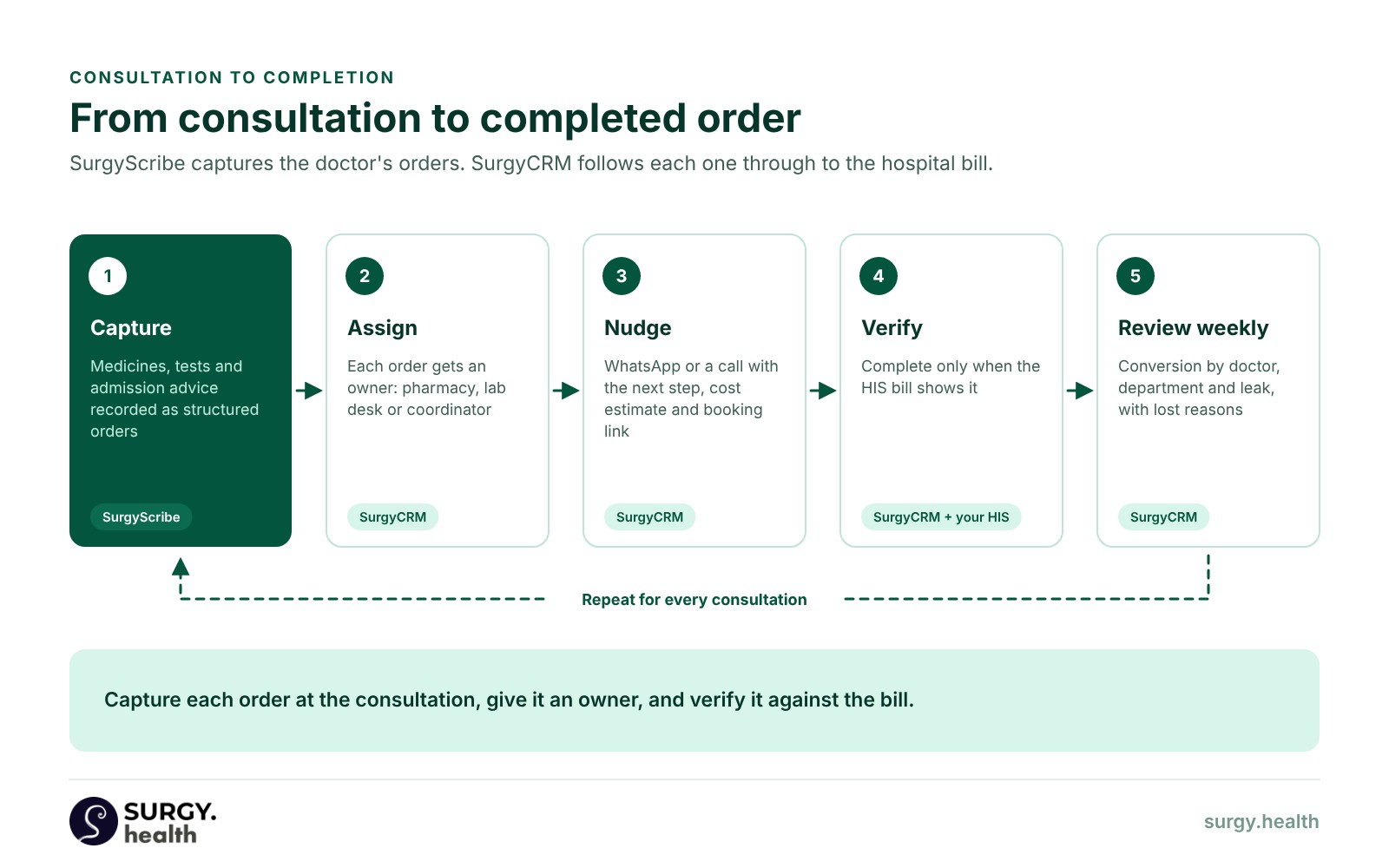
In the one-record model, SurgyScribe turns the consultation into a structured note, and each prescribed medicine, ordered test and 'admission recommended' flag becomes a task or lead in SurgyCRM. The team then follows each item to completion, and the HIS bill confirms whether it happened.
When each model is the better choice
| Choose | When |
|---|---|
| An engagement platform | You want AI agents, reminders and messaging on top of your HIS quickly, and you are not trying to track doctors' orders to revenue. Some platforms also bundle DPDP consent workflows. |
| A sales CRM with a healthcare template | You run a large call centre, already use the vendor elsewhere, and have a partner and budget to configure journeys. |
| A hospital CRM on one record with the note | You need care journeys that continue after conversion (maternity, paediatric, chronic care), referral and field tracking, bedside feedback, and revenue you can verify against the HIS bill. |
Questions to ask every vendor
- Who captures the doctor's orders that your follow-ups depend on?
- What happens to the patient after the booking is made?
- How do you prove a conversion: by a status in your tool, or by the HIS bill?
- What happens when our HIS vendor changes its API?
- How much configuration and partner cost sits in year one?
- Where is patient data hosted, and which AI services see it?
- Which WhatsApp provider do we need, and who pays message fees?
Where Surgy Health fits (and where it doesn't)
SurgyCRM fits hospitals that want the consultation, the follow-up and the revenue on one record. It is a weaker fit today if you need a built-in WhatsApp inbox that replaces your provider (SurgyCRM connects to WATI or Interakt rather than replacing them).