Arabic AI medical scribes compared: a GCC hospital guide

Founder – Product & Technology, Surgy Health · Last reviewed 25 November 2026
Short answer
An Arabic AI scribe for a GCC hospital must understand dialectal Arabic and consultations that switch between Arabic and English, write the note in clinical English, connect to your EHR, and keep data in-country where the law requires it. Shortlist two or three, run each on your own recorded consultations for two weeks, and choose on edit rate and critical errors, not the demo.
Key takeaways
- Most GCC consultations happen in Arabic, while notes are written in English. The scribe has to bridge both.
- Dialect matters: Gulf, Levantine and Egyptian Arabic all appear in GCC clinics, often in the same day.
- UAE law keeps health data in the country by default. Ask where audio and notes are processed.
- Look for published evidence on Arabic accuracy, and then test on your own audio anyway.
Why Arabic is harder for AI scribes
Arabic is a lower-resource language for medical speech AI, and GCC consultations rarely stay in one language: a doctor may speak Gulf Arabic with the patient, switch to English for drug names and write the note in English. A peer-reviewed 2026 study of a bilingual scribe in Riyadh described exactly this pattern: physicians converse mainly in Arabic and document in English.
Dialects
Gulf, Levantine, Egyptian and South Asian accents in one clinic.
Code-switching
Arabic conversation, English drug names, English note.
Clinical English output
The EHR expects structured English notes and codes.
Options compared
| Option | What it is | Arabic support (as stated) | Evidence or footprint | Hosting | Source |
|---|---|---|---|---|---|
| Sahl AI | Bilingual Arabic–English ambient scribe, Riyadh | Arabic and English | Peer-reviewed evaluation: mean modified PDQI-9 of 42.4/45 (Arabic) and 37.8/40 (English) | Not stated in study | JMIR Med Inform 2026 (PubMed) |
| Heidi | Ambient AI scribe; Dubai HQ for the GCC | Arabic and dialectal Arabic across GCC regions | ~80,000 UAE consultations in five months before formal launch | Patient data hosted in-country in the UAE | Zawya press release |
| Augnito Omni AI Scribe | Medical voice AI and ambient scribe | Multilingual, including Arabic dialects | Enterprise deal with Almoosa Health (750 beds, Saudi Arabia), Jan 2025; integrates with EMR and HIS | Not stated | PR Newswire, 31 Jan 2025 |
| EHR-native AI (Epic AI Charting, Oracle Clinical AI Agent) | Ambient documentation built into the EHR | Check language support with the vendor | Released Feb 2026 (Epic); expanded Aug 2026 (Oracle, US) | With the EHR | Becker's, Oracle |
| Provider-built tools | Scribes built by large GCC providers for their own facilities (for example PureHealth's Nada in Abu Dhabi) | Arabic and local dialects (as reported) | In use inside the provider's own hospitals | Provider's environment | Arabian Business |
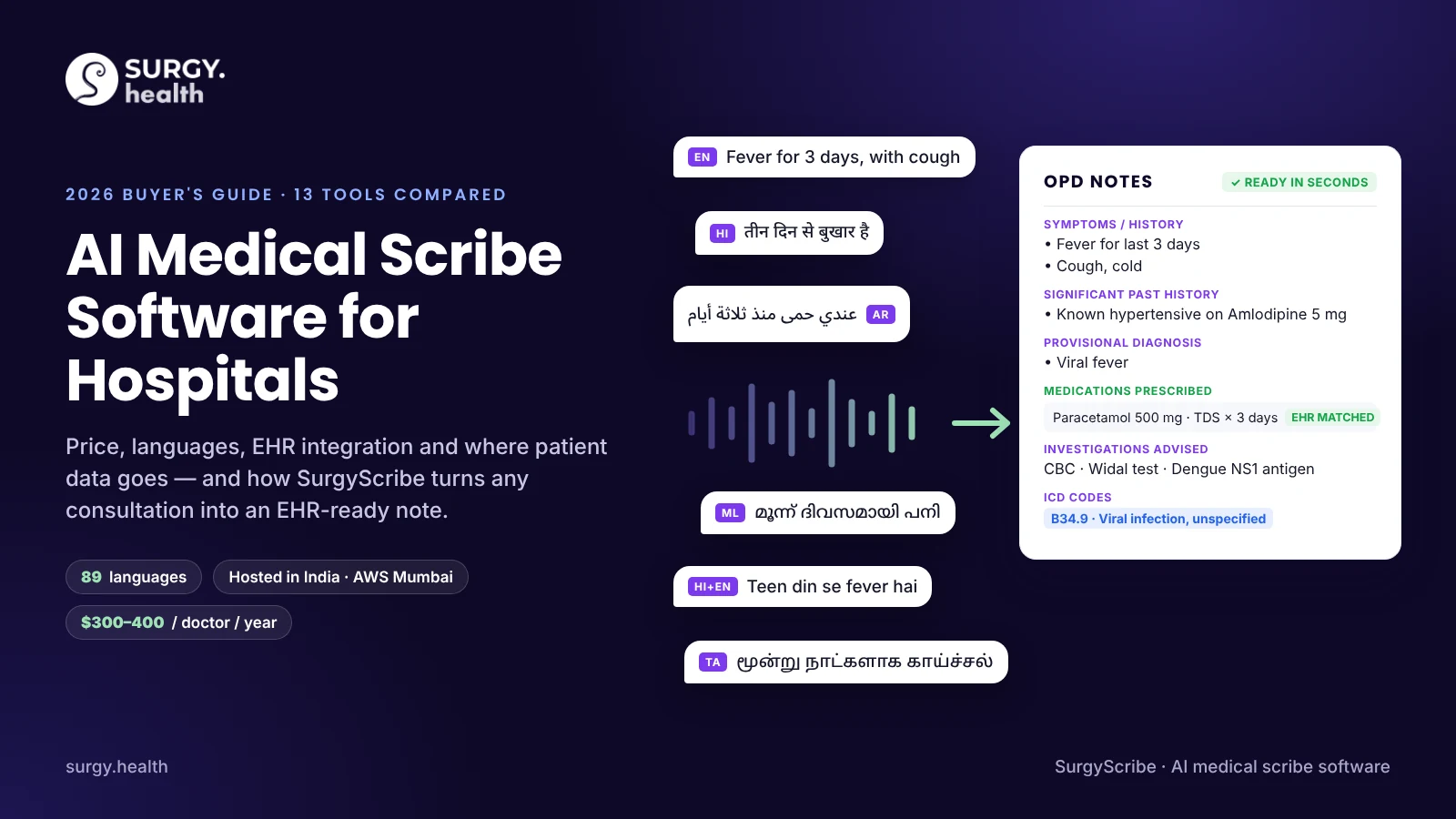
| SurgyScribe (Surgy Health) | Ambient AI scribe that also turns orders into follow-up tasks | 89 languages including Arabic; notes in clinical English | Live at Apollo Clinic Kuwait | AWS Mumbai by default; in-region hosting on request | /products/surgy-scribe |
Eight criteria to score every option
| Criterion | What good looks like | How to test |
|---|---|---|
| Dialect coverage | Handles the dialects your patients speak | Record consultations from each main patient group |
| Code-switching | Keeps English drug names and Arabic speech in one note | Include mixed-language consultations in the test |
| Output | Structured clinical English note, by specialty template | Ask doctors to rate notes against their usual format |
| Edit rate | Doctors change little before signing | Measure share of each note edited |
| Critical errors | Zero wrong drugs, doses or laterality | Clinical reviewer checks every test note |
| Orders and coding | Medicines, tests and admission advice captured as structured items; ICD-10 suggestions | Check what reaches the EHR or follow-up list |
| EHR integration | Writes into your EHR, not a separate window | Test with your EHR in the pilot |
| Hosting and consent | In-country processing where required; patient consent wording | Get it in writing before the pilot |
A two-week test you can run
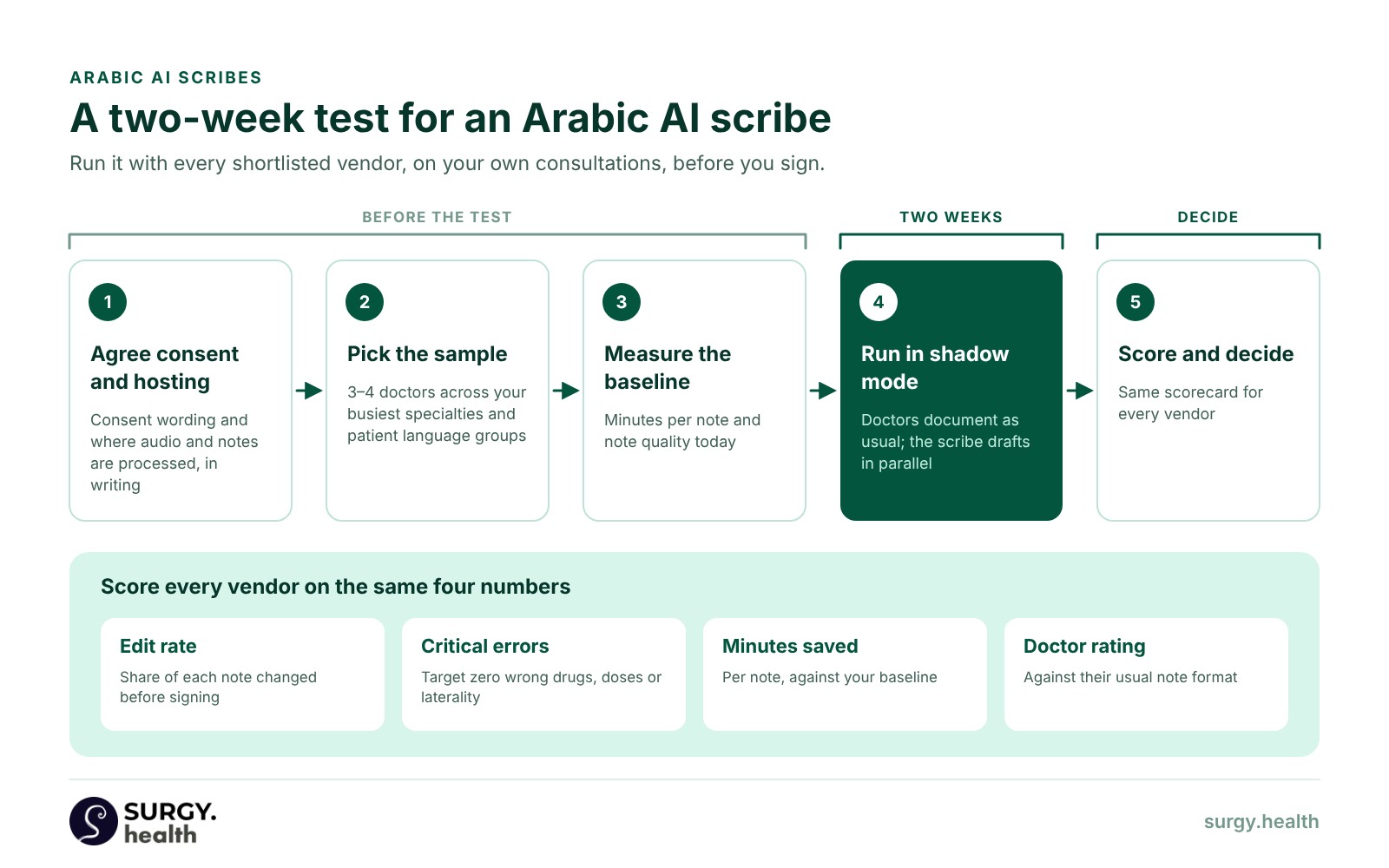
- Step 1
Agree consent and hosting
Patient consent wording and where audio and notes are processed, in writing.
- Step 2
Pick the sample
Three or four doctors across your busiest specialties and your main patient language groups.
- Step 3
Measure the baseline
Minutes per note and note quality today, before the scribe.
- Step 4
Run in shadow mode
Doctors document as usual; the scribe drafts in parallel for comparison.
- Step 5
Score and decide
Edit rate, critical errors, minutes saved and doctor ratings, per vendor.
Rules that shape the choice in the GCC
| Country | Rule that matters for a scribe | What to ask |
|---|---|---|
| UAE | Health data stored and processed in-country by default (Federal Law No. 2 of 2019); DoH and DHA AI policies | Is audio and note processing in the UAE? |
| Saudi Arabia | PDPL limits transfers abroad; SFDA regulates AI that is a medical device | Is any feature classed as a medical device? Where is data processed? |
| Kuwait | No single national data protection law; contract and Ministry of Health requirements apply | What does the contract say about hosting and deletion? |
| Bahrain | PDPL (Law No. 30 of 2018) treats health data as sensitive | How is sensitive data processed and transferred? |
Where Surgy Health fits (and where it doesn't)
SurgyScribe fits GCC hospitals that want more than a note: medicines, tests and admission advice become structured items that SurgyCRM can follow up, and the scribe is already live at Apollo Clinic Kuwait. It works in 89 languages including Arabic and writes notes in clinical English. We have not yet published a peer-reviewed Arabic accuracy study; run the two-week test above on your own audio and judge the results.
“SurgyScribe AI is handling our medical records at Apollo Clinic Kuwait. Time saving, automated documentation, voice to text immediately, easy access.”