Replace your HIS or integrate with it? A decision guide for hospitals

Founder – Product & Technology, Surgy Health · Last reviewed 25 November 2026
Short answer
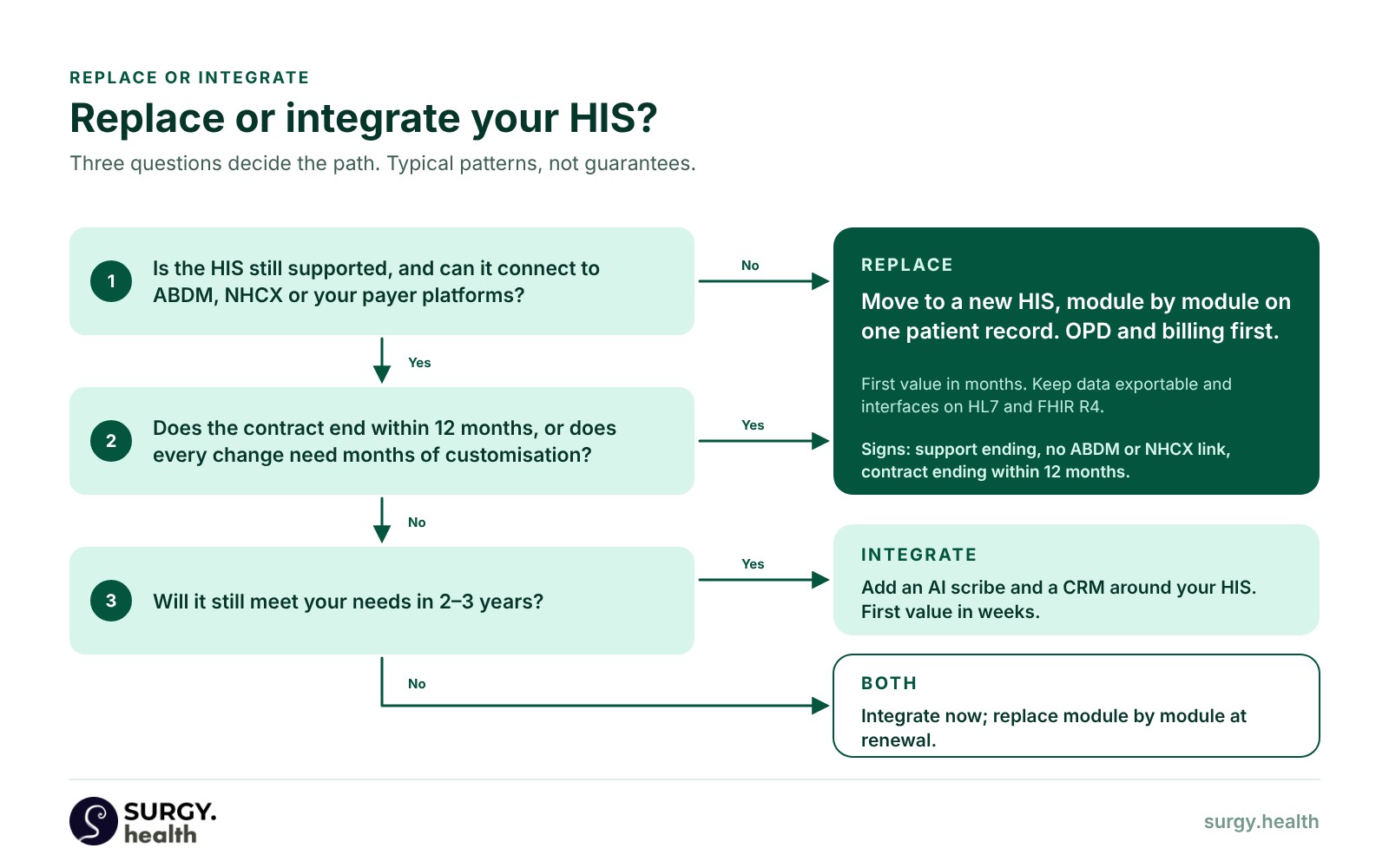
Integrate first if your HIS is stable, billing works and your real problem is doctors not documenting or patients leaking after the consultation. Replace when the HIS is near the end of its contract, cannot meet ABDM, NHCX or NABH needs, or blocks every change you ask for. Many hospitals do both: add an AI scribe and a CRM now, then replace the HIS module by module at renewal.
Key takeaways
- Integration delivers value in weeks; a hospital-wide HIS replacement typically takes months. One published rollout at a 1,500+ bed hospital took eight months.
- Most HIS pain is a doctor-adoption problem, not a database problem. Fix documentation first and measure again.
- Replace when the system itself blocks you: unsupported, end of contract, missing national integrations, or no vendor roadmap.
- If you replace, go module by module on one patient record, with OPD and billing first.
- Whatever you choose, keep your data exportable and your integrations on open standards (HL7, FHIR R4).
Why this question comes up now
Three things changed in 2025–2026. AI scribes became good enough to write the note while the doctor talks. National platforms (ABDM and NHCX in India, NPHIES in Saudi Arabia, Malaffi and NABIDH in the UAE) raised the bar for what an HIS must connect to. And the largest EHR vendors began building AI into the core: Epic released native AI Charting in February 2026, and Oracle launched an AI-driven EHR in August 2025.
In our work with mid-sized hospitals, the most common pattern is an HIS used by billing and administration but barely touched by doctors, because its screens are old and cluttered. That is a documentation and adoption problem first.
The three paths compared
| Integrate: add AI around your HIS | Replace: move to a new HIS | Both: integrate now, replace at renewal | |
|---|---|---|---|
| First value | Weeks | Months | Weeks |
| Disruption to staff | Low; new tools beside the HIS | High; every department changes system | Low now, managed later |
| Data migration | None | Full migration of patients, tariffs and history | Later, module by module |
| Doctor adoption | AI scribe writes the note; no new HIS screens | Depends on the new system's design | Doctors adopt the scribe first |
| National integrations (ABDM, NHCX) | Stay with the current HIS | Must be rebuilt and re-certified | Move when the module moves |
| Risk | Interfaces depend on your HIS vendor | Go-live risk across the hospital | Spread across smaller steps |
| Best when | HIS is stable; problem is documentation or leakage | HIS is unsupported, near end of contract, or blocks change | HIS works today but will not meet your needs in 2–3 years |
Signs integration is enough
- Billing, pharmacy and lab run on the HIS without daily workarounds.
- Your HIS vendor offers an API, HL7/FHIR interfaces or scheduled exports.
- The biggest complaint is that doctors don't use the system.
- Revenue leaks after the consultation: prescriptions filled outside, tests not done, admissions not converted.
- Your HIS contract has more than two years left.
Signs it is time to replace
- The vendor no longer updates the product, or support tickets go unanswered.
- The system cannot connect to ABDM, NHCX or your payer platforms.
- Every workflow change needs a paid customisation and months of waiting.
- You run several systems that don't share one patient record.
- The contract ends within 12 months, so you will be choosing anyway.
What a replacement really takes
A hospital-wide replacement touches every department. Published examples set expectations: KareXpert reports an 8-month rollout across 55+ specialties at Artemis Hospitals, a 1,500+ bed hospital in Gurugram (KareXpert case study, Aug 2026). Smaller hospitals move faster, but the work is the same: master data, tariffs, interfaces, training and a go-live plan per department.
- Step 1
Discover
Workflow walkthroughs per department; master data, tariffs and packages; interface specs.
- Step 2
Configure
Departments, forms and roles; data migration; national registry set-up.
- Step 3
Day-1 core
OPD and billing first, then pharmacy and labs.
- Step 4
Expand
IPD and ER, imaging and analyzer interfaces.
- Step 5
Optimise
Claims, analytics and the second wave of workflows.
A module-by-module replacement plan, as used for SurgyOne.
Common HIS platforms in India and the GCC
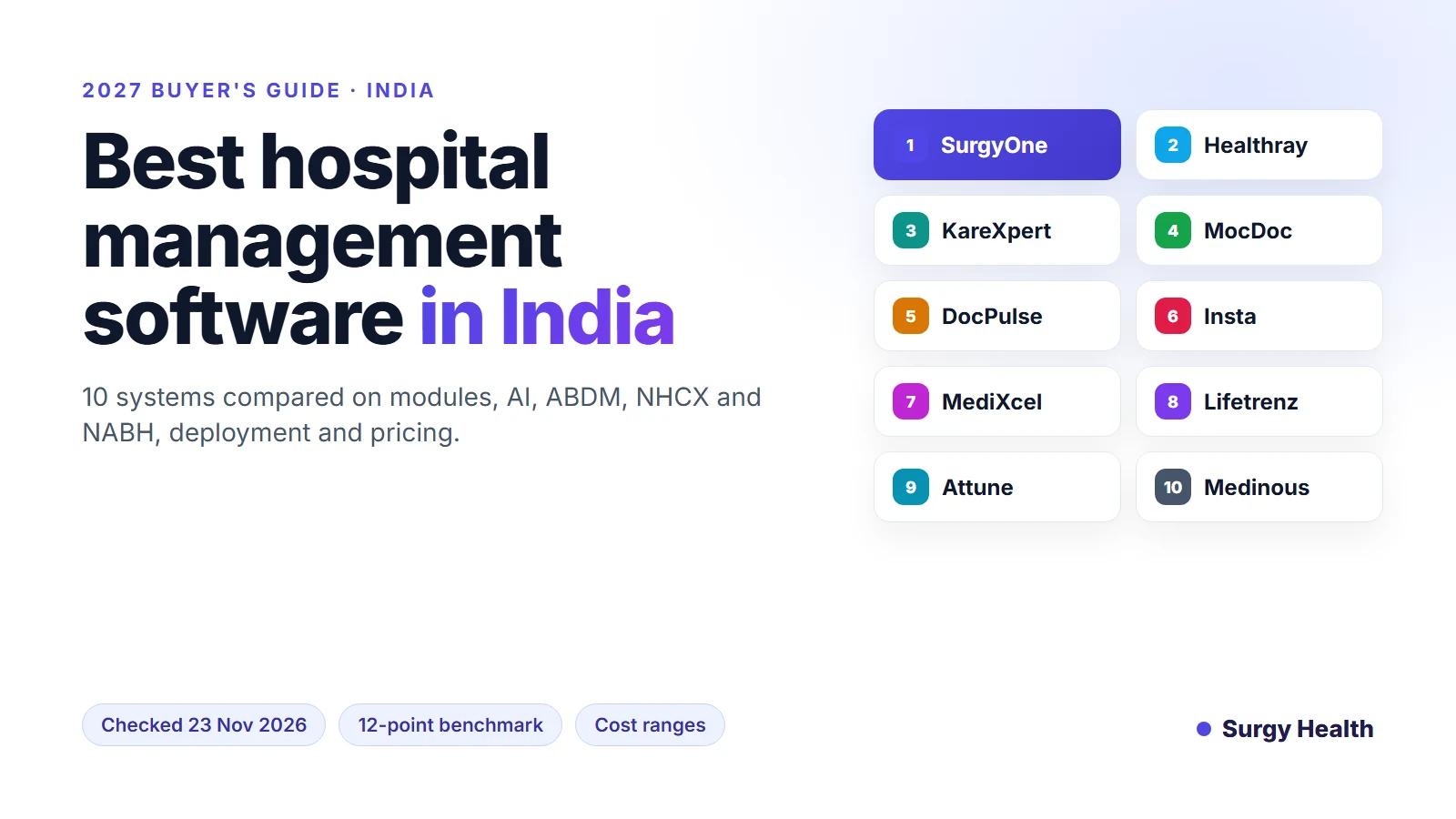
If you are weighing a replacement, these are the systems mid-sized hospitals most often compare. Figures are vendor-stated.
| Platform | What it is | Footprint (vendor-stated) | Source |
|---|---|---|---|
| KareXpert | Cloud HIS platform with 60+ modules, backed by Reliance Jio | "Trusted by 500+ hospitals organizations" | karexpert.com |
| Insta by Practo | Web-based clinic and hospital management system, founded 2008 | 1,250+ centres in 22+ countries; implemented at ARGAN Riaya Specialized Hospital, Kuwait | Insta by Practo on LinkedIn |
| MocDoc | Hospital, lab, pharmacy and clinic software; NABH Advanced certified EMR and HMS | 1,500+ customers in 10+ countries | mocdoc.com |
| Healthray | AI-branded cloud hospital management software | Hospitals in India and the USA | healthray.com |
| Oracle Health | Global EHR; AI-driven next-generation EHR launched Aug 2025 | Large health systems worldwide | Oracle, 13 Aug 2025 |
| Epic | Global EHR; native AI Charting released Feb 2026 | Large health systems worldwide | Becker's |
| SurgyOne (Surgy Health) | AI-first HIS and EHR with approval-based AI agents | Demos and pilots; first go-live Dec 2026–Jan 2027 | /products/surgy-one |
What each path costs
| Path | What you pay for | Example list price |
|---|---|---|
| Integrate | AI scribe per doctor; CRM per user; one-time setup | SurgyScribe INR 15,000–25,000 per doctor per year in India (USD 300–400 in the GCC); SurgyCRM INR 20,000 per user per year (India) |
| Replace | HIS subscription or licence; migration; training; parallel running | SurgyOne INR 6,250–8,750 per bed per year in India (graduated slabs) or USD 80–150 elsewhere; most HIS vendors quote by edition, beds and modules |
| Both | Integrate now; HIS subscription from renewal | Sum of the two, spread over time |
10 questions to ask before you decide
- What share of our doctors write notes in the current HIS today?
- Where do we lose revenue after the consultation: pharmacy, lab, admission or follow-up?
- When does our HIS contract end, and what does exit cost?
- Does our vendor offer an API, HL7 or FHIR interfaces, or scheduled exports?
- Which national platforms must we connect to in the next two years?
- How long did our last module rollout take?
- Can we export all our data in a usable format today?
- Who in each department will own go-live?
- What would we stop paying for if one system replaced three?
- What does success look like in 90 days, in one number?
Where Surgy Health fits (and where it doesn't)
For the integrate path, SurgyScribe and SurgyCRM are live today and work beside your current HIS. For the replace path, SurgyOne is in demos and pilots, with its first hospital go-live scheduled for December 2026 to January 2027 and NABH certification in progress. If you need a certified HIS with many live references this quarter, an established HIS is the lower-risk choice today; you can still add SurgyScribe and SurgyCRM to it.