What is AI-first hospital software?

Founder – Product & Technology, Surgy Health · Last reviewed 25 November 2026
Short answer
AI-first hospital software is built around what AI can do from the first design decision: capturing clinical information by voice, turning it into structured orders, and letting AI agents find, draft and act on work, with staff approval and a full audit trail. AI-added software keeps a 10- to 20-year-old design and bolts AI features onto it. The test is not whether a product has AI, but whether its workflows would make sense without it.
Key takeaways
- AI-first means structured data captured at the source, not typed in later.
- AI agents should read, draft and act within each user's role, and only act after a person approves.
- One patient record across modules matters more than any single AI feature.
- Judge vendors on measured outcomes (minutes per note, conversion, edit rate), not on an AI label.
- Large EHR vendors are adding AI to their core products, so 'AI-first' alone will not differentiate for long.
AI-first vs AI added on
| AI added on | AI-first | |
|---|---|---|
| Where data comes from | Typed into forms by staff | Captured by voice and documents, structured automatically |
| Role of AI | A feature in one module | Present in every module, on one record |
| What AI can do | Summarise or suggest | Find, draft and act, with approval and audit |
| Doctor's experience | Same screens as before, plus a tool | Fewer screens; the note writes itself for review |
| Time to value | Depends on the core system | Often starts from exports and CSV files |
| Data handling | Often sent to an outside AI service | Self-hosted or zero-retention models by design |
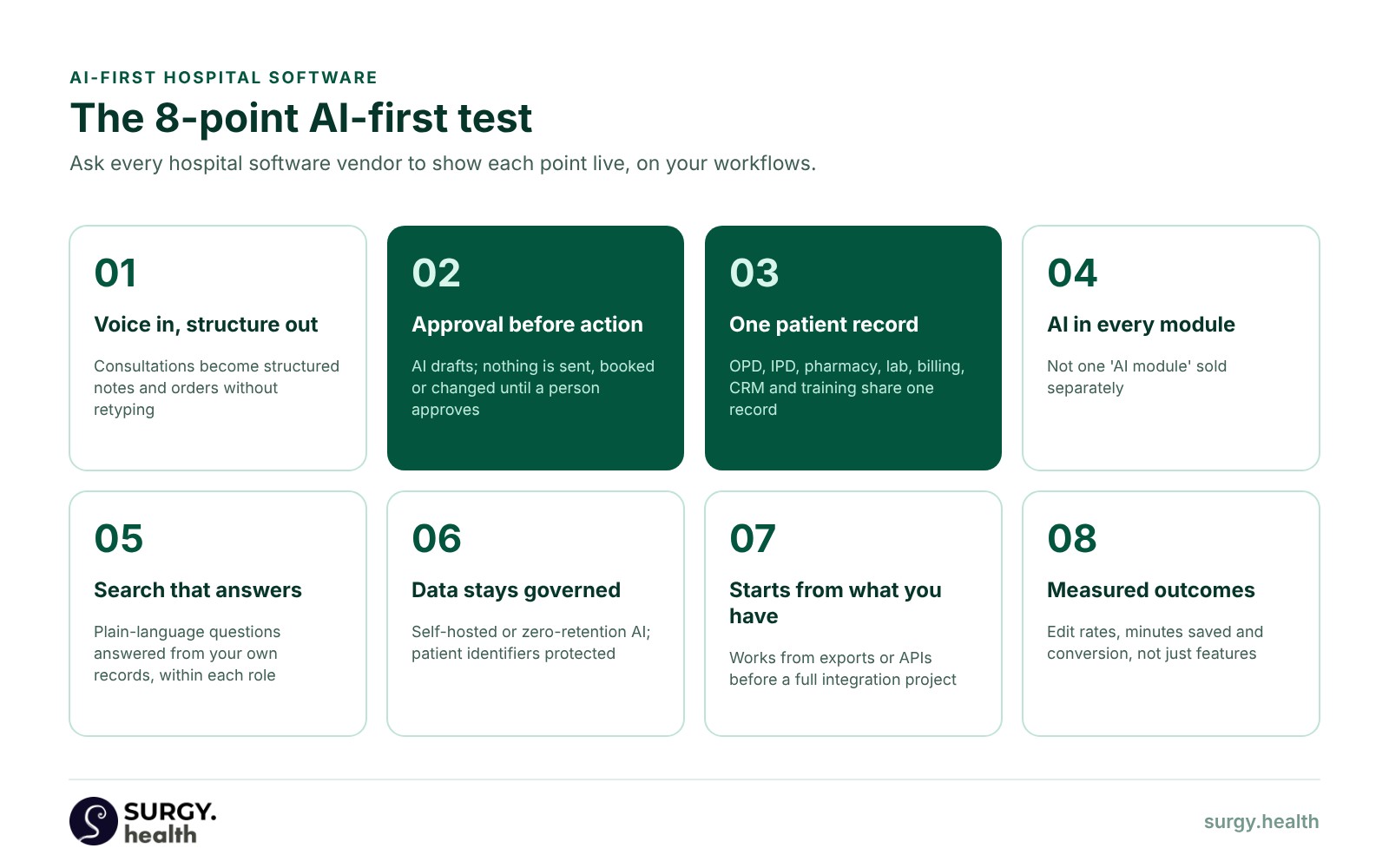
The 8-point AI-first test
- Voice in, structure out. Consultations become structured notes and orders without retyping.
- Approval before action. AI drafts and proposes; nothing is sent, booked or changed until a person approves.
- One patient record. OPD, IPD, pharmacy, lab, billing, CRM and training share one record.
- AI in every module. Not one 'AI module' sold separately.
- Search that answers. Staff ask questions in plain language and get answers from their own records, within their role.
- Data stays governed. Self-hosted models or zero-retention enterprise AI; patient identifiers protected.
- Starts from what you have. Works from exports or APIs before a full integration project.
- Measured outcomes. The vendor reports edit rates, minutes saved and conversion, not just features.
Where the market stands in 2026
The largest EHR vendors are building AI into their core products. Oracle launched an AI-driven, next-generation EHR for US ambulatory providers in August 2025, and Epic released native AI Charting in February 2026. Indian HIS vendors are adding AI modules to existing platforms; KareXpert, for example, lists an AI-ready healthcare platform among its products. A smaller group of vendors, including Surgy Health, are building hospital software around AI from the start.
| Approach | Examples | What to check |
|---|---|---|
| Global EHR with native AI | Epic AI Charting; Oracle's AI-driven EHR and Clinical AI Agent | Availability and price outside the US; language support |
| Established HIS adding AI modules | KareXpert's AI-ready platform | Which workflows use AI today; whether doctors use the system |
| AI-first suites | SurgyOne (Surgy Health) | Live references; certification status |
| AI point tools beside your HIS | AI scribes, CRMs, voice agents | Integration depth; one record or many |
Why it matters for mid-sized hospitals in India and the GCC
Doctors who don't use the HIS
When the note writes itself, doctors stop working around the system.
Revenue that leaks after the OPD
Orders captured at source can be followed to the pharmacy, lab and ward.
OPD revenue leakageThin teams
AI that drafts routine work lets small teams cover more patients.
Questions to ask any vendor that says "AI-first"
- Which workflows use AI today, in production, at a named customer?
- What does the AI do without a person approving it?
- Where are models hosted, and which outside AI services see patient data?
- Is there one patient record across your modules?
- What is the measured edit rate on AI-drafted notes?
- How do we start before a full integration?
- What is certified (NABH, ABDM, NPHIES), and what is in progress?
- What does it cost per bed, user or doctor, in writing?
Where Surgy Health fits (and where it doesn't)
Surgy Health builds AI-first software for hospitals. SurgyScribe, SurgyCRM and SurgyLearn are live with 4,000+ users across 500+ centres. SurgyOne, our AI-first HIS and EHR, is in demos and pilots, with its first hospital go-live scheduled for December 2026 to January 2027 and NABH certification in progress. If you need an AI-first HIS with many live hospital references today, that list is still short across the market, including ours.