Case study: DCDC Kidney Care automated training for 2,800+ staff across 270+ locations
How DCDC Kidney Care auto-assigns 98% of training, syncs 99% of staff from its HR system and runs 267 live classes on SurgyLearn.

Founder – Product & Technology, Surgy Health · Last reviewed 25 November 2026

Key takeaways
- DCDC Kidney Care is the largest SurgyLearn deployment: 2,819 staff across 270+ locations, as of November 2026.
- 99.3% of staff profiles sync automatically from DCDC's HR system (ZingHR), so the training directory maintains itself.
- 98% of 51,181 course assignments were generated by role-based rules. In 16 months, only 13 were ever made by hand.
- 267 live classes have run on the platform, led by 24 trainers, with 984 attendance marks recorded.
- 1,082 certificates issued, and 56% of courses that learners start are completed.
- For distributed clinical networks, the lesson is that automated assignment and HR sync, not content volume, keep training in step with a growing network.
- 2,819
- staff on the platform
- 98.1%
- of 51,181 assignments made by rules
- 267
- live classes by 24 trainers
- 1,082
- certificates issued
Live production data as of 24 November 2026.
Running more than 240 dialysis centres in India is not a logistics problem. It is a clinical quality problem. Every centre must deliver the same standard of care to every patient, on every shift.
That standard depends on the people running the machines, managing patients and responding to complications at 2am in a district hospital far from headquarters. DCDC Kidney Care has faced one question throughout its growth: how do you guarantee that training in a Bengaluru centre matches training in Ghazipur or Warangal, and how do you prove it?
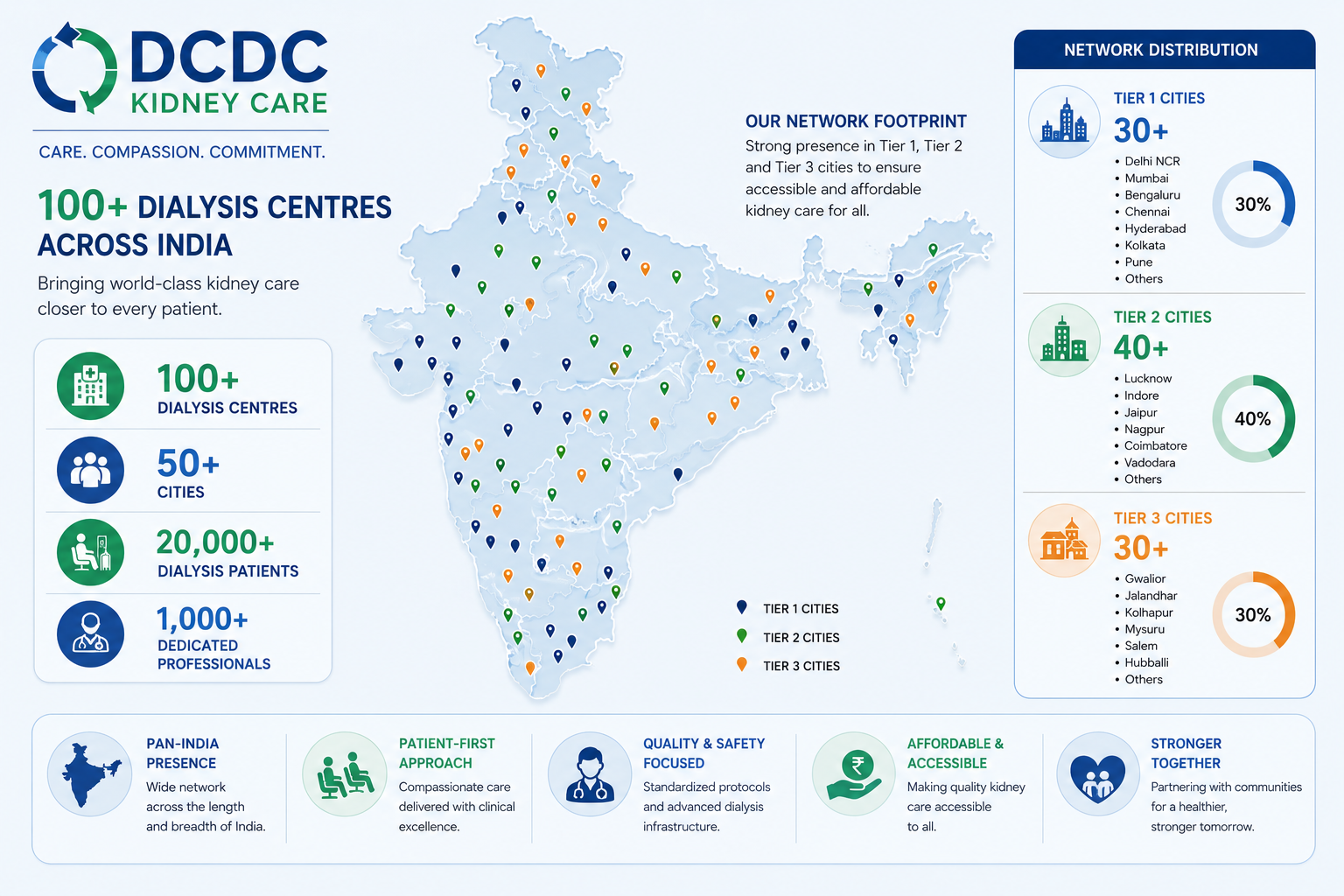
DCDC's answer, deployed with Surgy Health's SurgyLearn, now covers 2,819 staff across 270+ locations in more than 15 states. This case study shows how it was set up and what the live data says in November 2026.
About DCDC Kidney Care
DCDC Kidney Care (Deep Chand Dialysis Centre) was founded in 2009 in New Delhi by brothers Aseem Garg and Akshat Garg. It set out to prove that high-quality, affordable dialysis could be delivered at scale as a sustainable business.
- 240+
- Dialysis centres
- 1,000+
- Dialysis machines
- 10,000+
- Patients served
- 10M+
- Cumulative dialysis sessions
Source: DCDC Kidney Care, 2026.
The company has raised over $61.4 million from investors including the Asian Development Bank, Impact Fund Denmark (IFU) and ABC Impact (backed by Temasek Trust). Its Series C closed in March 2025.
In April 2026, DCDC launched the DCDC Academy of Healthcare, a Diploma in Dialysis programme affiliated with the IMA and AHPI. The Academy trains new entrants; SurgyLearn trains, assesses and documents everyone already working in the network.
“To cater to the increasing need for dialysis and renal services, it is essential to build a strong pool of skilled healthcare professionals.”
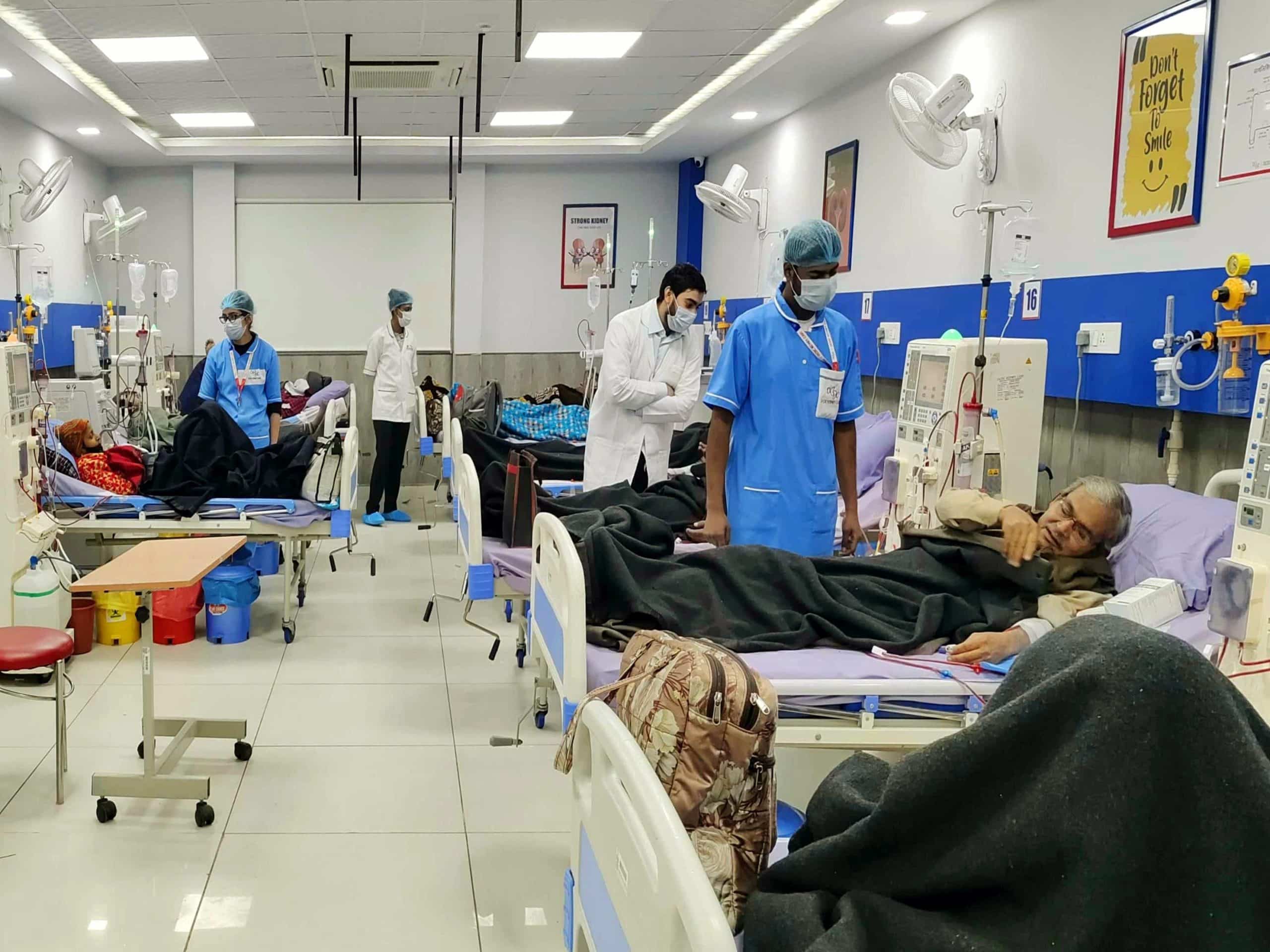
The challenge: training at scale across a distributed clinical network
As DCDC grew, its training problem shifted from what to teach to how to deliver, track and verify training across a workforce spread over hundreds of sites and running 24/7.
- Geographic dispersion. Centres span metros, Tier 2 and Tier 3 towns and district hospitals. Bringing staff to Delhi for every protocol update was not viable.
- Shift-based workforce. Training events held on day shifts left night-shift staff behind, creating uneven competency within the same centre.
- A constantly changing roster. New technicians, nurses and managers join every month. Enrolling each one by hand in the right courses depends on someone remembering to do it.
- Documentation gaps. Quality audits and NABH assessments need evidence that specific staff completed specific training. Paper sign-in sheets and Excel trackers could not be consolidated across hundreds of locations.
- Inconsistent quality. Without one system, training depth varied by centre, by senior technician and by how current the printed manual was.
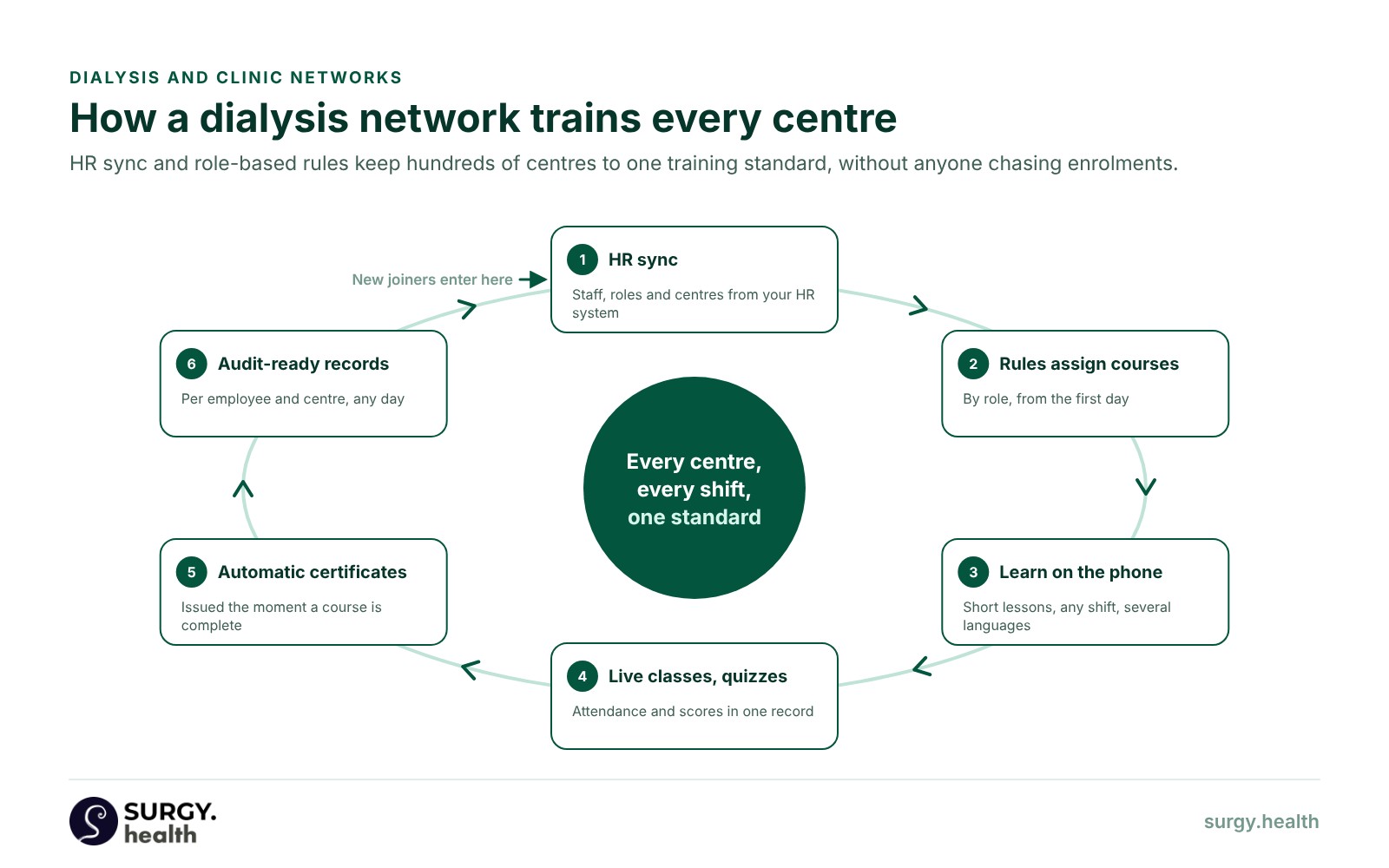
The solution: what DCDC runs on SurgyLearn
DCDC uses SurgyLearn as the single training platform for its whole network. Five capabilities carry the deployment.
1. HR system integration
SurgyLearn is connected to ZingHR, DCDC's HR system. 2,799 of 2,819 staff profiles (99.3%) arrive by sync, and 99.4% carry an employee ID. When someone joins, moves role or changes centre, their training record follows. It is the deepest HR integration of any SurgyLearn deployment.
2. Rule-based auto-assignment
Every one of DCDC's 68 courses has auto-assignment switched on, and 62 use role-based rules. A rule such as "all junior technicians take Cannulation Technique" applies to everyone in that role today and to everyone who joins it later. No coordinator builds enrolment lists.
3. A structured compliance catalogue
DCDC publishes 68 courses in four categories:
| Category | Courses | Examples |
|---|---|---|
| Clinical | 41 | BLS & ACLS, Cannulation Technique, Intradialytic Complications, Needle Stick Injury, Water Treatment |
| HR | 12 | HR Induction, POSH/ICC, Grooming, Effective Communication |
| Quality | 11 | NABH, Fire Safety, Emergency Color Codes, IPSG, Mock Drill |
| Operations | 4 | Quality Score and Internal Audits, HMIS Registration & Process |
Most courses are short, 30 to 60 minutes, built for a technician's break between sessions. The longest, NABH Essentials, runs 10 hours 15 minutes across 34 lectures and 8 quizzes. A course counts as complete only when every lecture and every quiz is finished.
4. Live classes, virtual and in-person
Trainers schedule classes on SurgyLearn and record attendance there. Of 267 classes, 139 were virtual (Google Meet, Microsoft Teams, Zoom) and 128 in-person at centres. Classroom training and self-paced courses now sit in one record per employee.
5. Automatic certification and mobile access
A certificate is issued the moment a course is completed: 1,082 so far. Staff can learn on their own phones, so a technician on a night shift has the same access as a colleague on days.
DCDC on SurgyLearn by the numbers
Live production data as of 24 November 2026, 16 months after the first pilot learners signed up in July 2025.
- 2,819
- Staff on the platform, across 270+ locations
- 98.1%
- Course assignments generated by rules (50,212 of 51,181)
- 267
- Live classes delivered by 24 trainers
- 1,082
- Certificates issued
| Metric | Value |
|---|---|
| Staff on the platform | 2,819 |
| Locations | 270+ |
| Staff profiles synced from ZingHR | 99.3% |
| Courses published | 68 |
| Course assignments made | 51,181 |
| Assignments generated automatically by rules | 98.1% (50,212) |
| Assignments ever made by hand by an admin | 13 |
| Live classes delivered | 267 |
| Trainers running live classes | 24 |
| Live-class attendance marks recorded | 984 |
| Lessons completed | 3,238 |
| Quiz attempts | 2,678 |
| Completion rate of courses started | 56% |
| Certificates issued | 1,082 |
The roster is still growing: 162 staff were added in October 2026 alone.
What this looks like in practice
Three workflows from DCDC's live deployment show how the platform behaves at network scale.
Workflow 1: From a 20-person pilot to the whole network
DCDC piloted SurgyLearn with 20 users from June to September 2025. In October 2025, 1,591 staff profiles were brought in from ZingHR in a single month. In December 2025, the role-based rules assigned DCDC's mandatory library to the workforce: 45,353 assignments generated automatically in one month. No coordinator built a list, sent a spreadsheet or chased a centre manager.
Workflow 2: New-joiner intakes, handled by rule
The network keeps hiring. After 275 staff joined in February 2026, the rules generated 2,568 assignments in March. After 152 joined in May, they generated 1,713 more. Each new technician, nurse or centre manager received the courses for their role without anyone enrolling them, and their record stays linked to their employee ID.
Workflow 3: A live-class programme that grew 8×
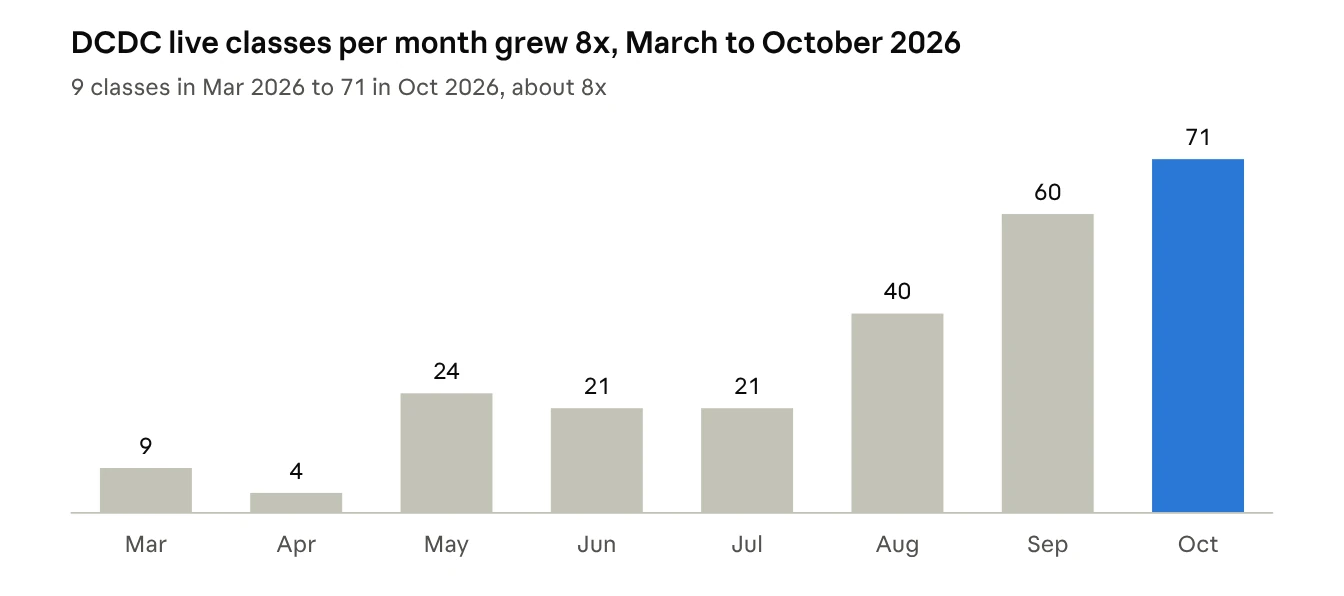
DCDC's trainers use SurgyLearn to run virtual and in-person classes and to record who attended. Monthly classes rose from 9 in March 2026 to 71 in October 2026. Over the same period, the share of classes with attendance recorded rose from 22% to 55%, giving the quality team evidence it can show an auditor.
The broader context: SurgyLearn and the DCDC Academy
The DCDC Academy builds the pipeline; SurgyLearn keeps everyone already in the network trained and credentialed.
Launched in April 2026, the Academy offers a Diploma in Dialysis affiliated with the IMA and AHPI. It targets 40 students per cohort each year and is open to 12th-pass students from all streams and to practising staff nurses.
SurgyLearn serves the 2,819 technicians, nurses, doctors, centre managers and support staff already working across DCDC. Together, the two cover a dialysis professional's whole career at DCDC, from diploma to daily practice.
Impact and outcomes
- Enrolment admin removed. 50,212 course allocations were made by rules, work no training coordinator had to do by hand. Only 13 assignments in the platform's history were made manually.
- One curriculum, every location. The same 68 courses are assigned by role across 270+ locations, whatever the centre's size or distance from Delhi.
- A self-maintaining staff directory. With 99.3% of profiles synced from ZingHR, the training roster tracks hiring and role changes without manual upkeep.
- Audit-ready records. Course completions, quiz attempts, 1,082 certificates and attendance for 134 live sessions sit in one exportable system, ready for internal audits and NABH assessments.
- Classroom and digital in one place. 267 live classes and self-paced courses are tracked against the same employee record.
Lessons for multi-site healthcare operators
- The documentation problem is the training problem. In audits and accreditation, undocumented training counts as no training. An LMS that produces audit-ready records is a clinical quality tool, not an admin tool.
- Connect the LMS to HR first. DCDC's 99.3% HR sync is what lets everything else run unattended. Without it, every hire and transfer becomes a manual task.
- Write rules, not enrolment lists. Role-based rules let DCDC assign 50,000+ courses with 13 manual interventions. Rules scale with the network; lists do not.
- Pace what you assign. Rules make it easy to assign a whole library at once. Sequencing a few courses at a time, with due dates, gives staff a clear next step.
- Blend live and self-paced learning. DCDC's live-class programme grew 8× in seven months. Trainer-led sessions and short digital courses work best tracked side by side.
- Reach staff where they are. Frontline teams rarely check email. Mobile access, and channels such as WhatsApp reminders, decide whether an assignment gets opened.
Run a clinical network? See SurgyLearn in action.
SurgyLearn is built for multi-site healthcare operators: HR sync, rule-based assignment, live classes, certification, and courses in English, Hindi, Marathi and Telugu. Talk to our team about your deployment.
References
- SurgyLearn production data, DCDC Kidney Care tenant, as of 24 November 2026 — Surgy Health
- DCDC Kidney Care: 240+ Centres, 10M+ Sessions — dcdc.co.in
- DCDC Academy of Healthcare — dcdc.co.in
- DCDC Kidney Care launches Academy — BioSpectrum India, April 2026
- DCDC Kidney Care launches Academy — Indian Pharma Post, April 2026
- DCDC Kidney Care: Following the Bloodline — London Business School
- SurgyLearn — Healthcare Staff Training Platform — surgy.health