

NABH 6th Edition Standards: All 10 Chapters, 639 Objective Elements and What Changed
All 10 NABH 6th Edition chapters (AAC to IMS), 100 standards and 639 objective elements, what changed, official fees and the 2026–27 rule changes.


Key takeaways
- NABH 6th Edition has 10 chapters, 100 standards and 639 objective elements: 105 Core, 457 Commitment, 60 Achievement and 17 Excellence.
- It has applied to all new and renewal applications since 1 January 2025. No 5th Edition surveillance assessments have been held since 31 March 2025.
- Infection control is now IPC (Infection Prevention and Control). New requirements cover sustainability, preventive care, digital prescriptions, antimicrobial stewardship, staff well-being and patient-reported outcomes.
- In 2026, Entry-Level Certification moved to a 2nd Edition and a new portal (nabh.qcin.org). Hospitals above 300 beds are no longer eligible for it.
- Plan about 12 months for first-time accreditation. NABH requires the standards to be implemented for at least 3 months before you apply.
- Most obligations under India's DPDP Rules apply to hospitals from 13 May 2027. Align your patient-rights (PRE) and information-management (IMS) evidence now.
Last reviewed 8 November 2026 · Checked against official NABH standards, programme pages and notifications.
The 10 Chapters of NABH 6th Edition
Chapters 1–5 are patient-centred; chapters 6–10 are organisation-centred.
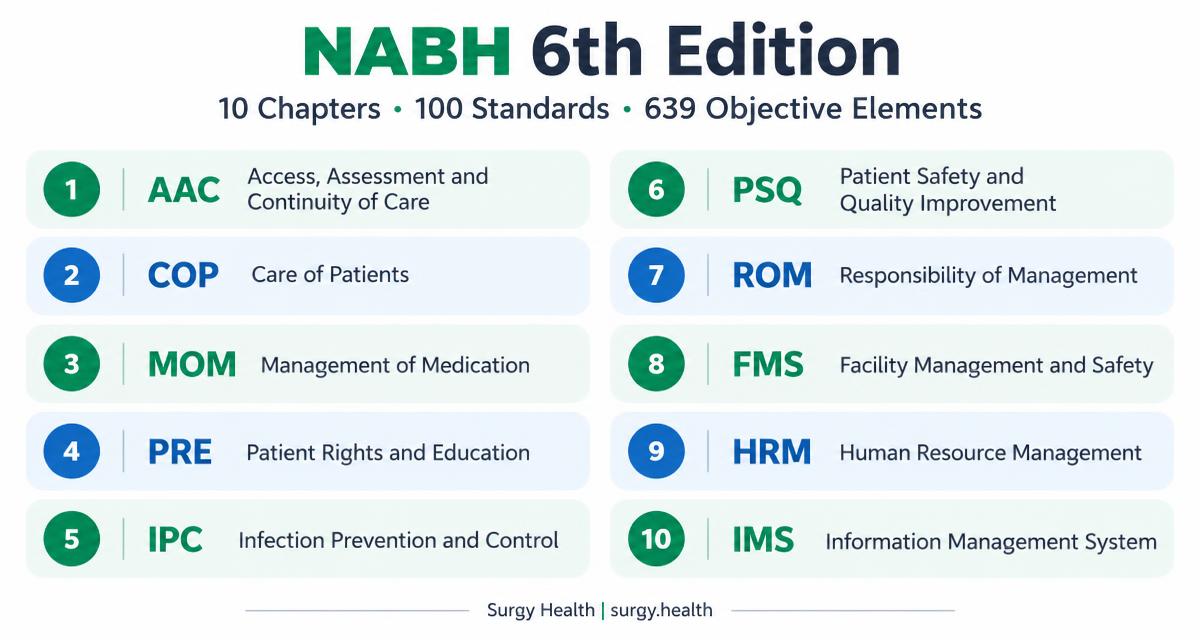
| # | Code | Chapter | Standards | Objective elements |
|---|---|---|---|---|
| 1 | AAC | Access, Assessment and Continuity of Care | 13 | 87 |
| 2 | COP | Care of Patients | 20 | 135* |
| 3 | MOM | Management of Medication | 11 | 68 |
| 4 | PRE | Patient Rights and Education | 8 | 52 |
| 5 | IPC | Infection Prevention and Control | 8 | 49 |
| 6 | PSQ | Patient Safety and Quality Improvement | 7 | 46 |
| 7 | ROM | Responsibility of Management | 6 | 37 |
| 8 | FMS | Facility Management and Safety | 7 | 43 |
| 9 | HRM | Human Resource Management | 13 | 76 |
| 10 | IMS | Information Management System | 7 | 45 |
| Total | 100 | 639 | ||
*NABH’s summary table lists COP as 135 objective elements. Its level breakdown totals 136, and the COP chapter itself states 136. The published overall total is 639; the summary column totals 638 because of this one-element discrepancy.
Core, Commitment, Achievement and Excellence
Every objective element is graded at one of four levels. Hospitals are assessed on more of them as they move through the accreditation cycle.
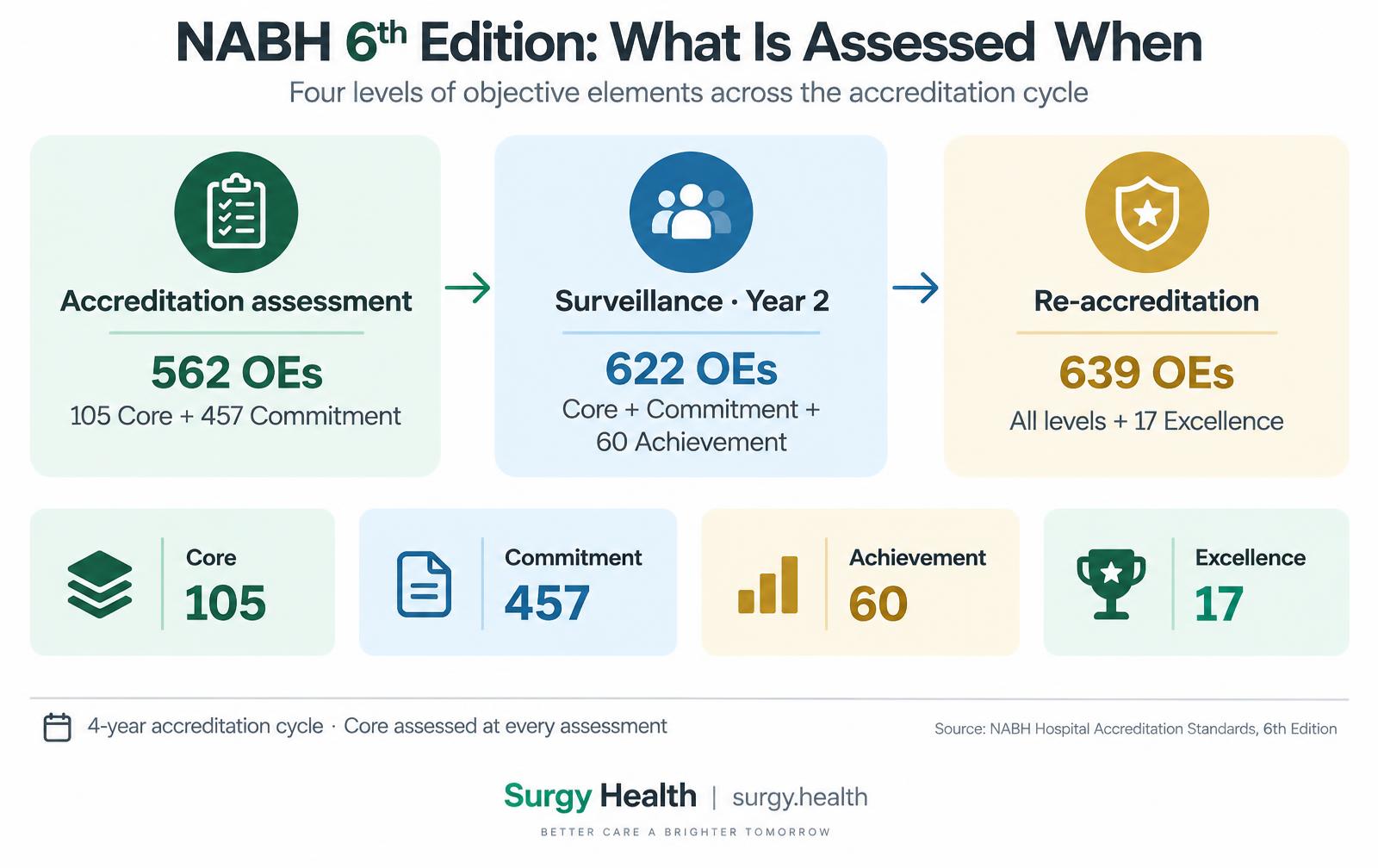
| Level | Objective elements | When it is assessed |
|---|---|---|
| Core | 105 | Every assessment |
| Commitment | 457 | Every assessment (Core + Commitment = 562 at the accreditation assessment) |
| Achievement | 60 | Added at the surveillance assessment (622 cumulative) |
| Excellence | 17 | Added at re-accreditation (all 639) |
Key Dates: 5th to 6th Edition Transition
| Date | What happened |
|---|---|
| 10 Sep 2024 | NABH issues the 6th Edition implementation plan (NABH/Gen/2024/6413) |
| 17 Sep 2024 | 6th Edition launched at the NABH Patient Safety Conference, New Delhi |
| 31 Dec 2024 | Last date for fresh or renewal applications under the 5th Edition |
| 1 Jan 2025 | 6th Edition takes effect; all new applications assessed under it |
| 31 Mar 2025 | Last surveillance assessments under the 5th Edition |
| 16 Feb 2026 | Entry-Level 2nd Edition applications move to nabh.qcin.org |
| 1 Mar 2026 | Entry-Level 2nd Edition applies (fee paid on or after this date) |
| 13 Nov 2026 | DPDP Rules: consent-manager provisions apply |
| 13 May 2027 | DPDP Rules: data fiduciary obligations apply |
What Changed from the 5th Edition
The 6th Edition keeps the 10-chapter structure, reduces objective elements from 651 to 639, renames the infection-control chapter, and adds requirements in the areas below.
| Area | What changed | Where |
|---|---|---|
| Infection control | Chapter renamed from HIC (Hospital Infection Control) to IPC (Infection Prevention and Control) | IPC |
| Sustainability | New ESG-linked sustainability programme: energy and water saving, sustainable procurement, staff use of public transport, financial sustainability | ROM.3 |
| Preventive care | New standard on preventive and promotive health services; domiciliary care added | AAC.11 |
| Digital prescriptions | Interpretation now includes digital prescriptions to reduce medication errors | MOM.4.b |
| Digital records | Digital health technology and electronically signed records addressed | IMS |
| Antimicrobial stewardship | Emphasis on antimicrobial policy and a stewardship programme | HRM.5.f |
| Staff well-being | Written guidance on staff physical and mental health | HRM.9 |
| Patient-reported measures | Patient-reported outcome and experience measures (PROMs and PREMs) emphasised, with annexures | PRE, PSQ |
| Clinical governance | New objective element on a clinical governance framework | ROM |
| Clinical services | Birth companion during labour; assisted reproductive technology (ART) services | COP |
The hospital standards do not mandate a fixed share of digital records. Digital maturity is assessed separately under NABH’s Digital Health Standards.
Why NABH Accreditation Matters
NABH was established in 2006 as a constituent board of the Quality Council of India (QCI). Since then, it has evolved into the gold standard for healthcare quality in India, with its standards recognised and accredited by the International Society for Quality in Health Care (ISQua) — placing it at par with top global accreditation bodies.
Accreditation gives hospitals a structured framework for patient safety, reliable care and continuous improvement. Insurer and government-scheme eligibility and payment incentives depend on the applicable current rules; confirm those with the payer rather than budgeting against a general percentage.
Which NABH Programme Fits Your Hospital?
| Programme | Who it is for | Standards | Validity | Apply at |
|---|---|---|---|---|
| Hospital Accreditation (HCO), 6th Edition | Hospitals with more than 50 sanctioned beds | 10 chapters, 100 standards, 639 OEs | 4 years, surveillance in year 2 | hcoaccreditation.nabh.co |
| SHCO Accreditation, 3rd Edition | Hospitals and day-care centres with 50 or fewer sanctioned beds | SHCO 3rd Edition | 4 years, surveillance in year 2 | hcoaccreditation.nabh.co |
| Entry-Level Certification, 2nd Edition | Allopathic hospitals up to 300 beds, functional for at least 6 months | 10 chapters, 45 standards, 167 OEs | 2 years | nabh.qcin.org |
| Digital Health Standards, 2nd Edition | Hospitals seeking recognition for digital maturity (Entry-Level-certified hospitals can apply for Silver) | 8 chapters, 38 standards, 182 OEs | Accreditation 4 years; certification 2 years | NABH |
Full accreditation is relevant for medical-tourism empanelment and major corporate hospital networks. Programme eligibility and applicable requirements should be checked with NABH before applying.
Official fees — Hospital Accreditation (HCO)
Fees below are listed on NABH’s current programme pages, checked 8 November 2026, excluding 18% GST. The HCO page labels its schedule as revised from 1 April 2024. NABH may revise fees.
| Beds | Application fee (₹) | Annual fee (₹) |
|---|---|---|
| Up to 100 | 40,000 | 2,00,000 |
| 101–300 | 75,000 | 3,00,000 |
| 301–500 | 1,00,000 | 4,00,000 |
| 501+ | 1,50,000 | 5,00,000 |
SHCO (up to 50 beds): application ₹25,000; annual ₹1,50,000.
Entry-Level Certification, 2nd Edition — two-year fee
| Beds | Fee (₹) |
|---|---|
| Up to 5 | 21,000 |
| 6–20 | 40,000 |
| 21–50 | 80,000 |
| 51–100 | 1,60,000 |
| 101–300 | 2,00,000 |
| Above 300 | Not eligible |
Other fees include a virtual assessment fee (₹3,000–₹15,000 for hospitals), a focus assessment fee (₹15,000) and a certificate re-issue fee (₹6,000). See the linked official programme pages for the current schedule.
The 12-Month NABH Roadmap
Whether you are a 200-bed district hospital or a 10-bed clinic, a structured timeline prevents last-minute scrambles. Here is a proven 12-month plan:
Month 1–2 — Gap Assessment: Conduct an internal audit against all 10 chapters. Identify critical non-conformities. Appoint a NABH Coordinator and department-level Champions. Download the official 6th Edition standards (free on nabh.co) and assess each of the 639 objective elements, chapter by chapter.
Month 3–4 — Policy & Documentation Sprint: Draft and approve all mandatory policies. Build your Document Control System. Ensure 200+ documents are organised and accessible digitally.
Month 5–6 — Staff Training: Conduct all-staff orientation on NABH standards — particularly infection control, patient rights, medication safety, and emergency protocols.
Month 7–8 — Mock Assessment: Simulate the actual NABH audit. Walk the floors as an assessor would. Identify and close remaining gaps. Log corrections with evidence.
Month 9–10: Apply Online. Once the standards have been running in all departments for at least 3 months, apply on NABH’s accreditation portal (hcoaccreditation.nabh.co) with the required documents, and pay the application fee. Entry-Level applicants apply on nabh.qcin.org.
Month 11–12: Desktop and On-site Assessment. NABH reviews your documents (desktop assessment) and then schedules the on-site assessment. Close any non-conformities within the stipulated timeline. Under Entry-Level 2nd Edition, you receive one consolidated set of desktop observations and get a single cycle to close non-conformities.
The Role of Staff Training in NABH Success
HRM Chapter 9 of NABH mandates not just that staff are trained, but that training is documented, tracked, and linked to competency outcomes. This is where most hospitals quietly struggle.
Manual training — printed handouts, classroom sessions, sign-in sheets — creates documentation nightmares. A healthcare LMS solves this by automating the entire training lifecycle: course assignment, progress tracking, assessment, certification, and audit-ready reporting.
- Auto-generate quizzes embedded in training videos
- Proctored assessments for high-stakes compliance modules
- Department-wise completion dashboards for the NABH assessor
- Integration with HR systems so training records stay linked to employee profiles
Our deeper guide on why every NABH-aspiring hospital needs an LMS in 2026 covers the feature checklist in detail.
Training and competency evidence is assessed under the HRM chapter (76 objective elements).
Common Reasons NABH Assessments Are Deferred
- Incomplete documentation — especially medication policies and consent forms
- Hand hygiene compliance below NABH-specified thresholds
- Absence of a functioning quality committee with documented meeting minutes
- Staff unable to articulate patient rights during the walkthrough
- Missing calibration records for biomedical equipment
- No evidence of root cause analysis for sentinel events
Each of these is preventable with systematic preparation. Keep a record of each non-conformity, its owner and the evidence of closure.
NABH and India’s Digital Health Ecosystem
NABH’s 6th Edition sits alongside three digital frameworks that hospitals will be held to in 2027.
1. NABH Digital Health Standards, 2nd Edition (September 2025)
The separate digital-health framework covers 8 chapters, 38 standards and 182 objective elements, with Silver, Gold and Platinum levels. Its chapters cover AAC, COP, MOM, Digital Infrastructure, Digital Operations Management, Finance and Procurement Management, HRM and IMS.
- Create ABHA IDs at registration.
- Link laboratory and radiology reports to ABHA.
- Connect external appointment platforms to the hospital’s HIS/EMR through UHI.
2. Ayushman Bharat Digital Mission (ABDM)
By September 2026, ABDM had linked nearly 120 crore health records to 97.6 crore ABHA IDs and onboarded about 4.1 lakh healthcare facilities. See the PIB update and our AI in healthcare statistics for 2027.
3. DPDP Act and Rules
Hospitals are data fiduciaries. From 13 May 2027, they must meet the Rules’ obligations on notice and consent, patient rights, security safeguards and breach reporting. These map directly to PRE and IMS, so build the evidence once for both. Our DPDP Act for hospitals guide covers the department-wise checklist.
What Changes in 2027
- 13 May 2027: DPDP obligations apply. Consent records, patient-rights requests and breach procedures need to be in place and auditable.
- Large hospitals (more than 300 beds) can no longer use Entry Level as a stepping stone. Plan directly for full accreditation.
- HOPE-era Entry-Level certificates are moving to the 2nd Edition. Hospitals certified under HOPE (validity on or after 1 August 2025) can renew on nabh.qcin.org within six months of expiry. After that, the application is treated as fresh.
- Digital maturity is now assessed. Expect insurers and partners to ask for Digital Health Standards levels alongside accreditation.
How Digital Systems Produce NABH Evidence
Assessors look for evidence that a process runs every day, not just a policy file. Digital systems help because they create that evidence as a by-product of routine work.
| Chapter | Evidence assessors look for | How Surgy Health helps |
|---|---|---|
| MOM | Complete, legible prescriptions; digital prescriptions (MOM.4.b) | SurgyScribe captures medicines, investigations and admission/surgery advice at the point of care |
| PRE, PSQ | Patient feedback, PROMs/PREMs, grievance closure, follow-up | SurgyCRM runs follow-ups and care journeys and records patient feedback |
| HRM | Per-employee training and competency records | SurgyLearn tracks training, assessments and competency for each employee |
Frequently asked questions
How many chapters are there in NABH 6th Edition?
NABH 6th Edition has 10 chapters, 100 standards and 639 objective elements.
What are the 10 chapters of NABH 6th Edition?
Access, Assessment and Continuity of Care (AAC); Care of Patients (COP); Management of Medication (MOM); Patient Rights and Education (PRE); Infection Prevention and Control (IPC); Patient Safety and Quality Improvement (PSQ); Responsibility of Management (ROM); Facility Management and Safety (FMS); Human Resource Management (HRM); and Information Management System (IMS).
When did NABH 6th Edition become effective?
On 1 January 2025. It was launched on 17 September 2024. All new applications from 1 January 2025 are assessed under it, and no 5th Edition surveillance assessments have been held since 31 March 2025.
How many objective elements are in NABH 6th Edition?
639: 105 Core, 457 Commitment, 60 Achievement and 17 Excellence.
How long is NABH accreditation valid?
Four years, with a surveillance assessment in year 2. Entry-Level certification is valid for two years.
How much does NABH accreditation cost?
Hospitals: NABH lists an application fee of ₹40,000–₹1,50,000 and an annual fee of ₹2,00,000–₹5,00,000, depending on bed count, plus 18% GST. Entry-Level certification: ₹21,000–₹2,00,000 for two years.
Can hospitals with more than 300 beds apply for NABH Entry Level?
No. NABH has excluded bed categories above 300 from Entry-Level certification (Notification NABH/Gen/2025/3798). These hospitals need full accreditation.
Is EMR mandatory under NABH 6th Edition?
The hospital standards do not mandate a fixed share of digital records, but they add digital expectations such as digital prescriptions. Digital maturity is assessed separately under NABH's Digital Health Standards.
How long does NABH accreditation take?
Plan about 12 months for a first-time hospital. NABH requires the standards to be implemented across all departments for at least 3 months before you apply.
References
- NABH Hospital Accreditation Standards, 6th Edition (January 2025)
- NABH 6th Edition implementation plan — 10 September 2024
- NABH Hospital Accreditation Programme — eligibility, portal and current fees
- NABH SHCO Accreditation Programme — current fees
- NABH Entry-Level Certification Programme, 2nd Edition — current fees and bed limit
- NABH Entry-Level implementation and migration notification — 13 February 2026
- NABH Digital Health Standards for Hospitals, 2nd Edition (September 2025)
- MeitY — Digital Personal Data Protection Rules, 2025
- Press Information Bureau — ABDM update, September 2026
Update log: 8 Nov 2026: corrected chapter names and OE counts to the official 6th Edition; added the Entry-Level 2nd Edition, the 300-bed rule, Digital Health Standards 2nd Edition and DPDP 2027 timelines.
Written by
Mohammed Jamil Nasir
Founder – Product & Technology, Surgy Health
14+ years in Product, Design & Tech · PGC AI/ML, IIT-Guwahati · Global MBA, SP Jain · BE-CSE
Mohammed Jamil Nasir leads product and technology at Surgy Health, building AI-first, seamless healthcare products for hospitals and healthcare networks across India and the GCC. He writes about healthcare AI, accreditation, and clinical operations.
Connect on LinkedInKeep reading
More on NABH Accreditation
Hand-picked next reads that build on this article, so you can go deeper before you decide.
- Healthcare AI
Healthcare AI RFP Template and Vendor Scorecard (Free Excel Kit)
A free healthcare AI RFP template for hospitals: 25 vendor questions, a 9-criterion weighted scorecard with scoring rubric, a worked example and an Excel kit.
11 min readRead article - Healthcare Compliance
Is Your AI Software a Medical Device? A CDSCO Guide for Hospitals (2026)
When AI software is a medical device in India: CDSCO's July 2026 software guidance, Class A–D matrix, licensing, AI/ML rules and a hospital buyer checklist.
9 min readRead article - Healthcare Compliance
AI in Healthcare in the UAE and Saudi Arabia: Rules for Hospitals (2026)
How AI in healthcare is regulated in the UAE and Saudi Arabia: data localisation, DoH and DHA policies, SFDA approval, PDPL transfers and a buyer checklist.
10 min readRead article