
Never miss a due vaccine dose
Parents get a reminder before every due date, and a same-day follow-up if a dose is missed.
Short answer
A paediatric vaccination journey reminds parents of every vaccine their child is due, on the schedule your paediatricians set, and follows up when a dose is missed. India's Universal Immunisation Programme schedules vaccines at birth, 6, 10 and 14 weeks, 9–12 months, 16–24 months and 5–6 years. SurgyCRM turns that schedule into WhatsApp reminders, owners and recorded doses for each child.
Key takeaways
- The national schedule has seven visits in the first six years; each is a chance for a family to drop out or go elsewhere.
- Reminders work best before the due date, with a booking link, and a same-day call when a dose is missed.
- Start the journey at birth: enrol newborns from the maternity journey on the day of discharge.
- Your paediatricians decide the schedule, including optional vaccines; SurgyCRM runs it.
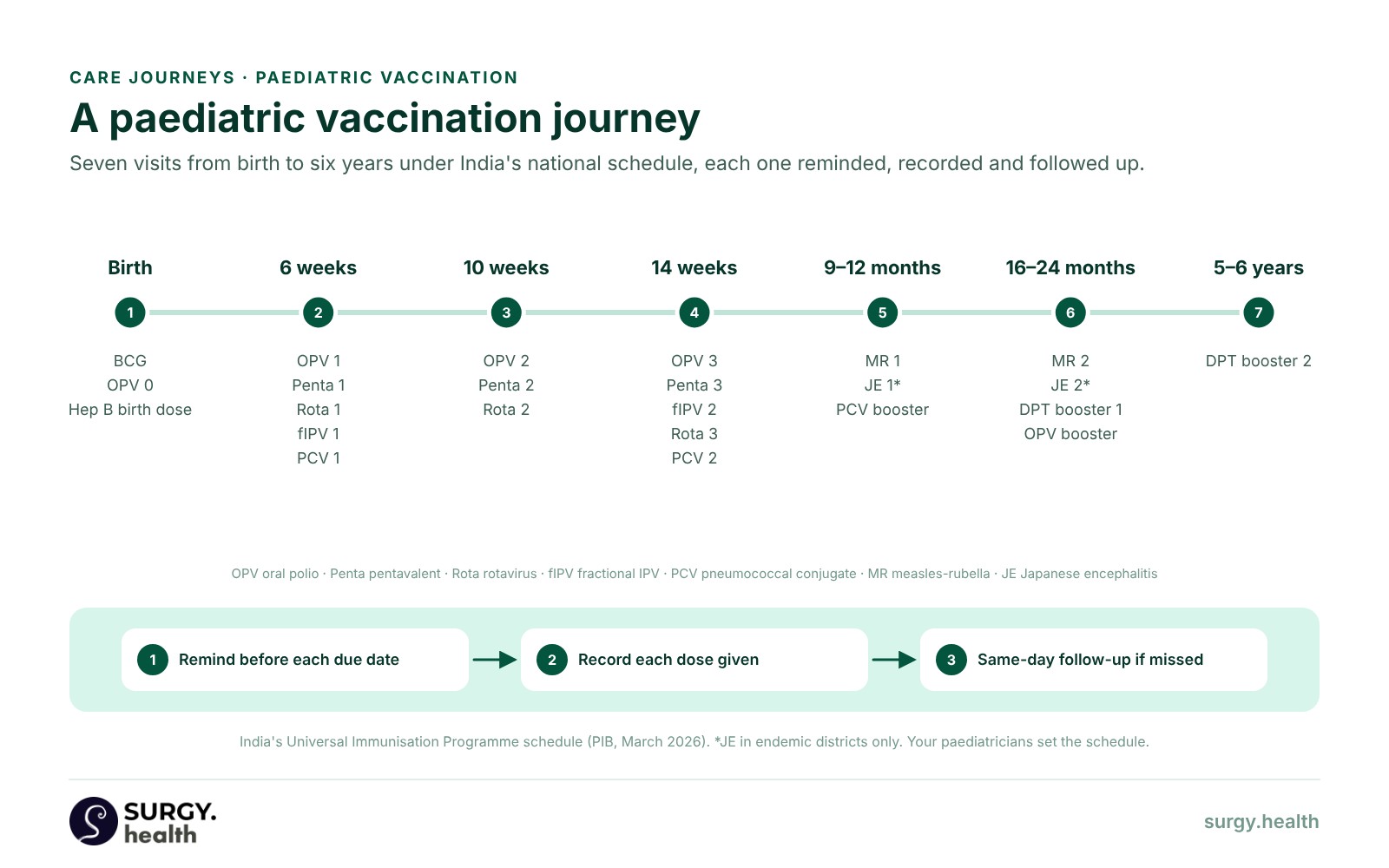
India's national immunisation schedule
| Age | Vaccines (Universal Immunisation Programme) |
|---|---|
| Birth | BCG, oral polio dose 0, hepatitis B birth dose |
| 6 weeks | Oral polio 1, pentavalent 1, rotavirus 1, fractional IPV 1, pneumococcal conjugate 1 |
| 10 weeks | Oral polio 2, pentavalent 2, rotavirus 2 |
| 14 weeks | Oral polio 3, pentavalent 3, fractional IPV 2, rotavirus 3, pneumococcal conjugate 2 |
| 9–12 months | Measles-rubella 1, Japanese encephalitis 1 (endemic districts only), pneumococcal conjugate booster |
| 16–24 months | Measles-rubella 2, Japanese encephalitis 2 (endemic districts only), DPT booster 1, oral polio booster |
| 5–6 years | DPT booster 2 |
Source: PIB, "Celebrating the Power of Vaccines", 17 March 2026
This schedule is shown for reference. Your hospital's paediatricians set the schedule SurgyCRM follows, including any additional vaccines. SurgyCRM sends reminders; it does not give medical advice.
How the journey runs in SurgyCRM
- Step 1
Enrol at birth
Newborns join from the maternity journey or are added at the first visit.
- Step 2
Schedule every dose
Due dates calculated from the date of birth using your hospital's schedule.
- Step 3
Remind before each due date
WhatsApp to parents with a booking link.
- Step 4
Record each dose
Marked done when given, ideally confirmed against the HIS bill.
- Step 5
Follow up missed doses
A coordinator task the same day a dose is overdue.
Measure what matters
| Metric | Definition |
|---|---|
| On-time dose rate | Doses given within the due window ÷ doses due |
| Missed-dose recovery | Overdue doses later given ÷ overdue doses |
| Journey retention | Children still in the journey at 24 months ÷ children enrolled at birth |
Vaccination journey questions, answered
What is India's national immunisation schedule for children?
Under the Universal Immunisation Programme, vaccines are given at birth, 6 weeks, 10 weeks, 14 weeks, 9–12 months, 16–24 months and 5–6 years, with Td at 10 and 16 years.
How do hospitals reduce missed vaccinations?
By booking the next dose before the family leaves, sending a reminder before the due date with a booking link, and calling the same day a dose is missed.
Can we add vaccines that are not in the national schedule?
Yes. Your paediatricians define the schedule, including optional vaccines, and SurgyCRM follows it.
Does it work for GCC hospitals?
Yes. GCC hospitals load their own national schedule, and WhatsApp reminders use the message templates and language the hospital sets up.
Keep reading
Related reading
 Maternity care journeysKeep expectant mothers on track from first antenatal visit to postnatal care: visit schedules, scan reminders, delivery planning and newborn handover.Read
 Care journeysRun care journeys that continue after the visit: maternity, paediatric vaccination and diabetes, with reminders, owners and milestones on one record.Read
 SurgyCRMHospital CRM software for India & the GCC. Capture Meta ad, call and WhatsApp leads, track every surgery and follow-up, and prove revenue. Book a demo.Read