Care journeys · Maternity

Maternity care journeys that continue after delivery

From the first antenatal visit to the baby's first vaccines, on the schedule your obstetricians set.

Short answer

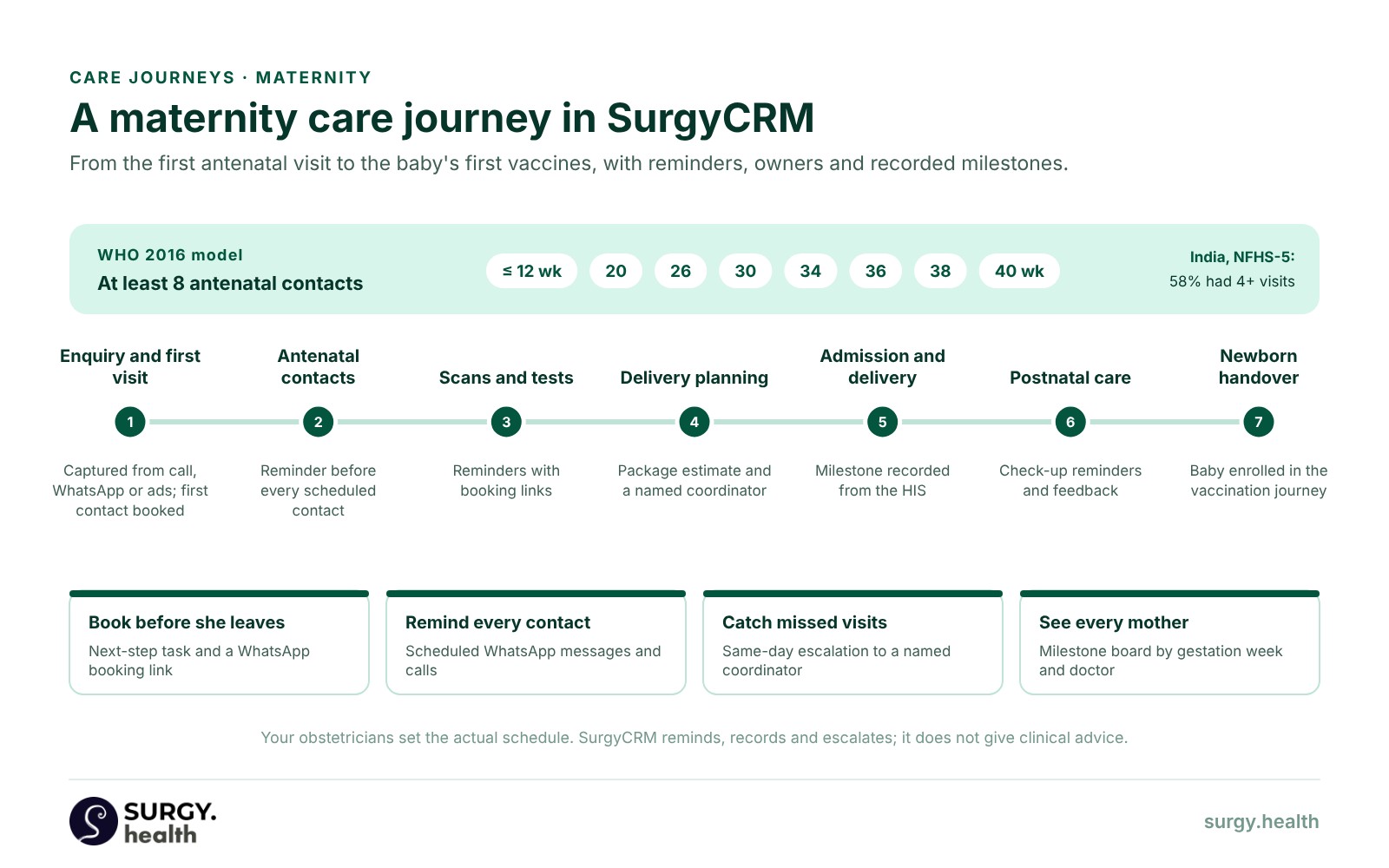
A maternity care journey is the schedule of antenatal contacts, scans, tests, delivery planning and postnatal care that a hospital follows for each expectant mother. WHO's 2016 model recommends at least eight antenatal contacts, at up to 12 weeks and then at 20, 26, 30, 34, 36, 38 and 40 weeks. SurgyCRM turns your hospital's version of that schedule into reminders, owners and recorded milestones, so fewer mothers drop out between visits.

Key takeaways

  • Only 58% of mothers in India had at least four antenatal visits in NFHS-5 (2019–21), half of WHO's recommended eight contacts.
  • Most drop-off happens between visits, when the next appointment is not booked.
  • A maternity journey is also a revenue journey: scans, tests, the delivery package and the newborn's care.
  • Hand the newborn into a vaccination journey on the day of discharge.
Seven-stage maternity journey in SurgyCRM from enquiry to newborn handover, with WHO's 2016 schedule of at least eight antenatal contacts (up to 12 weeks, then 20, 26, 30, 34, 36, 38 and 40 weeks).
A maternity care journey in SurgyCRM. Contact schedule from WHO's 2016 antenatal care model; your obstetricians set the actual schedule.

The maternity journey, stage by stage

  1. Stage 1

    Enquiry and first visit

    Enquiry captured from call, WhatsApp or ads; first antenatal contact booked (WHO: up to 12 weeks).

  2. Stage 2

    Antenatal contacts

    Reminders before each contact your obstetricians schedule; WHO's model sets contacts at 20, 26, 30, 34, 36, 38 and 40 weeks.

  3. Stage 3

    Scans and tests

    Reminders for the scans and tests your team orders, with booking links.

  4. Stage 4

    Delivery planning

    Delivery package estimate, admission planning and a named coordinator.

  5. Stage 5

    Admission and delivery

    Milestone recorded from the HIS admission.

  6. Stage 6

    Postnatal care

    Postnatal check reminders and feedback after discharge.

  7. Stage 7

    Newborn handover

    The baby is enrolled in the paediatric vaccination journey.

Schedules shown are examples from WHO's 2016 antenatal care model. Your hospital's obstetricians define the actual journey; SurgyCRM does not give clinical advice.

What SurgyCRM does at each step

NeedSurgyCRM feature
Book the next contact before the mother leavesNext-step task for the coordinator, booking link on WhatsApp
Remind before every due contact or scanScheduled WhatsApp messages and calls
Catch missed contactsSame-day escalation to a named coordinator
Give a clear delivery costSurgery and package cost estimator by payer and room category
Know where every mother isMilestone board by gestation week, doctor and location
Hear what mothers thinkNPS on WhatsApp after key milestones
SurgyCRM features used in a maternity journey.

Measure what matters

MetricDefinition
Antenatal contact adherenceContacts completed on time ÷ contacts scheduled
Scan and test completion (in-house)Scans and tests done at your hospital ÷ ordered
Delivery package conversionMothers who deliver at your hospital ÷ mothers in the journey
Newborn handover rateNewborns enrolled in the vaccination journey ÷ deliveries
Maternity journey metrics to review monthly.

In use at Mediversal Hospitals

SurgyCRM · Maatri maternity journey

Mediversal Hospitals, Patna

Mediversal Hospitals in Patna runs its maternity journey, Maatri, on SurgyCRM. Across three hospital locations, its teams record 200+ journey milestones a week (November 2026).

200+
journey milestones a week
3
hospital locations
Read the Mediversal story
FAQ

Maternity journey questions, answered

How many antenatal visits does WHO recommend?

WHO's 2016 guidelines recommend at least eight antenatal contacts: the first in the first 12 weeks, then at 20, 26, 30, 34, 36, 38 and 40 weeks.

How many mothers in India complete four antenatal visits?

58% of mothers had at least four antenatal visits in NFHS-5 (2019–21), up from 51% in NFHS-4.

How does software help mothers keep antenatal appointments?

By booking the next contact before the mother leaves, reminding her on WhatsApp before it is due, and escalating to a coordinator the same day if she misses it.

Does SurgyCRM decide the clinical schedule?

No. Your obstetricians set the schedule and protocols. SurgyCRM handles reminders, ownership and tracking.

What happens after delivery?

Postnatal check reminders and feedback continue, and the newborn is enrolled in the paediatric vaccination journey.

Sources

  1. WHO news release, 7 November 2016: new antenatal care model
  2. Lok Sabha reply on NFHS-5 key findings (MoHFW)
  3. Girotra et al., BMC Pregnancy and Childbirth, 2023