
Net Promoter Score (NPS) in hospitals

Mohammed Jamil Nasir
Founder – Product & Technology, Surgy Health · Last reviewed 25 November 2026
Definition
Net Promoter Score (NPS) measures how likely patients are to recommend a hospital, on a 0–10 scale. It equals the percentage of promoters (scores of 9 or 10) minus the percentage of detractors (scores of 0 to 6), giving a number from −100 to +100. Passives (7 or 8) count in the total but not in the score.
Formula
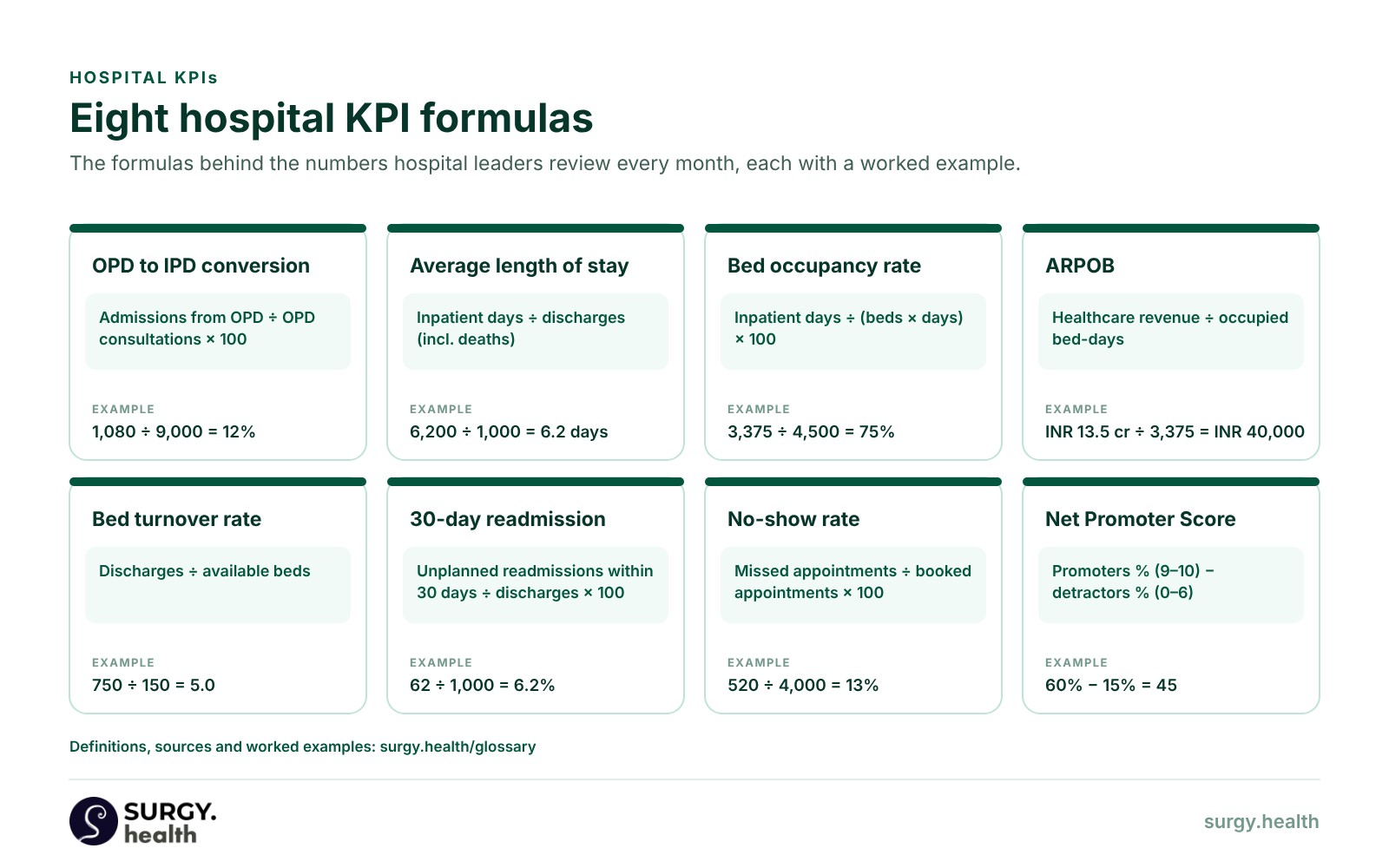
NPS = % promoters (9–10) − % detractors (0–6)
Worked example
| Responses | Count | Share |
|---|---|---|
| Promoters (9–10) | 240 | 60% |
| Passives (7–8) | 100 | 25% |
| Detractors (0–6) | 60 | 15% |
| NPS | 60 − 15 = 45 |
How hospitals run NPS
- Ask one question after discharge or a key milestone: ‘How likely are you to recommend [hospital] to a friend or family member?’
- Send it on WhatsApp within a day, while the visit is fresh.
- Add one open question: ‘What is the main reason for your score?’
- Call every detractor and log the issue as a ticket with an owner.
- Report NPS by department and doctor, monthly.