
30-day readmission rate

Mohammed Jamil Nasir
Founder – Product & Technology, Surgy Health · Last reviewed 25 November 2026
Definition
The 30-day readmission rate is the percentage of discharged patients who are readmitted to hospital, unplanned, within 30 days of discharge. The US Medicare programme counts unplanned readmissions for any cause within 30 days and excludes planned ones, such as a scheduled second-stage surgery.
Formula
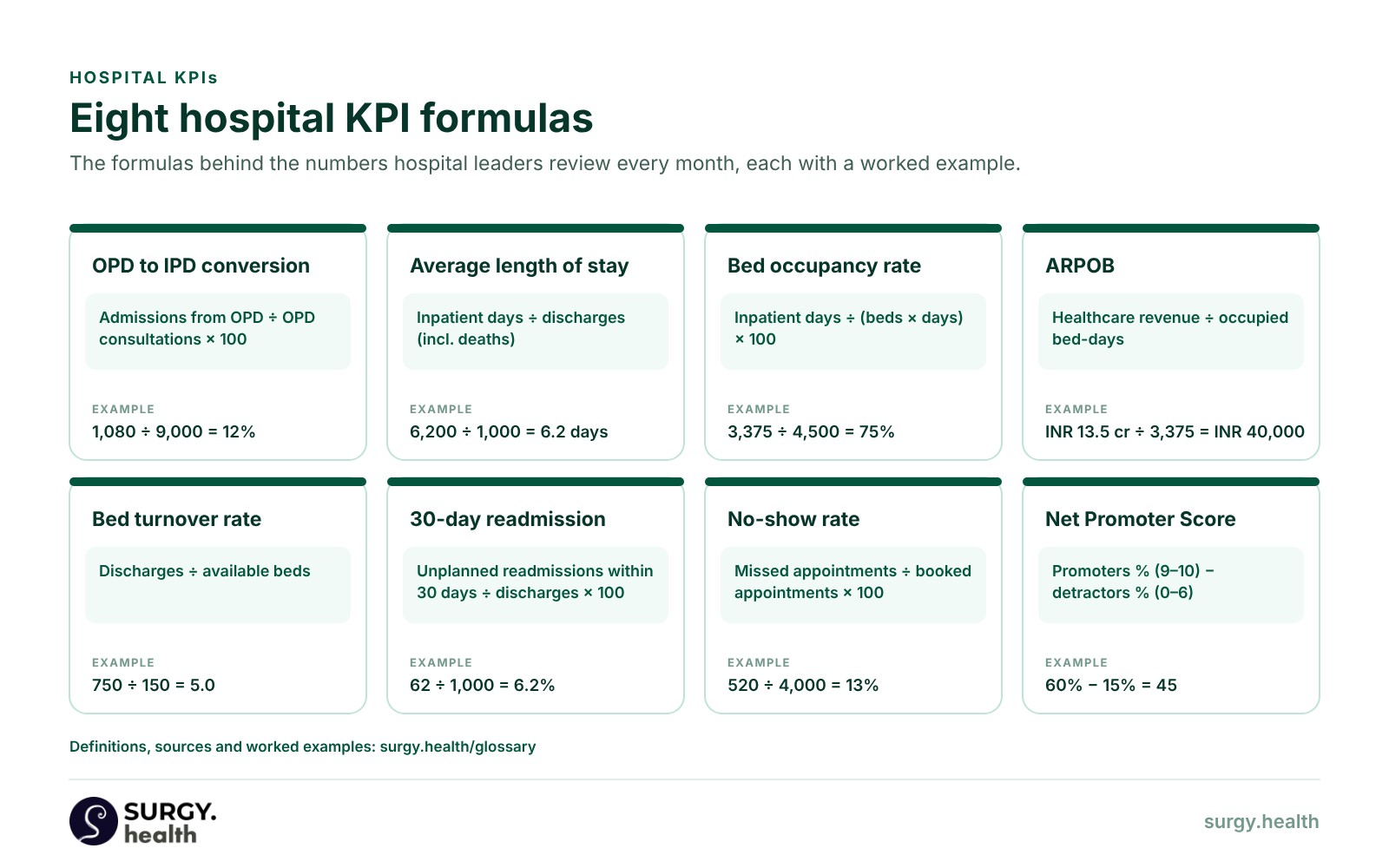
30-day readmission rate = (unplanned readmissions within 30 days) ÷ (discharges) × 100
Worked example
| Input (one quarter) | Value |
|---|---|
| Discharges | 1,000 |
| Unplanned readmissions within 30 days | 62 |
| Readmission rate | 62 ÷ 1,000 × 100 = 6.2% |
What reduces readmissions
- A clear discharge summary and medicine list the patient understands.
- Medication reconciliation at discharge.
- A follow-up call within a few days and a booked review visit.
- Care journeys for chronic conditions such as diabetes and heart failure.