
Bed turnover rate

Mohammed Jamil Nasir
Founder – Product & Technology, Surgy Health · Last reviewed 25 November 2026
Definition
Bed turnover rate (BTR) is the number of patients who used each bed in a period. It equals discharges, including deaths, divided by available beds. Its companion, the turnover interval, is the average number of days a bed stays empty between patients.
Formula
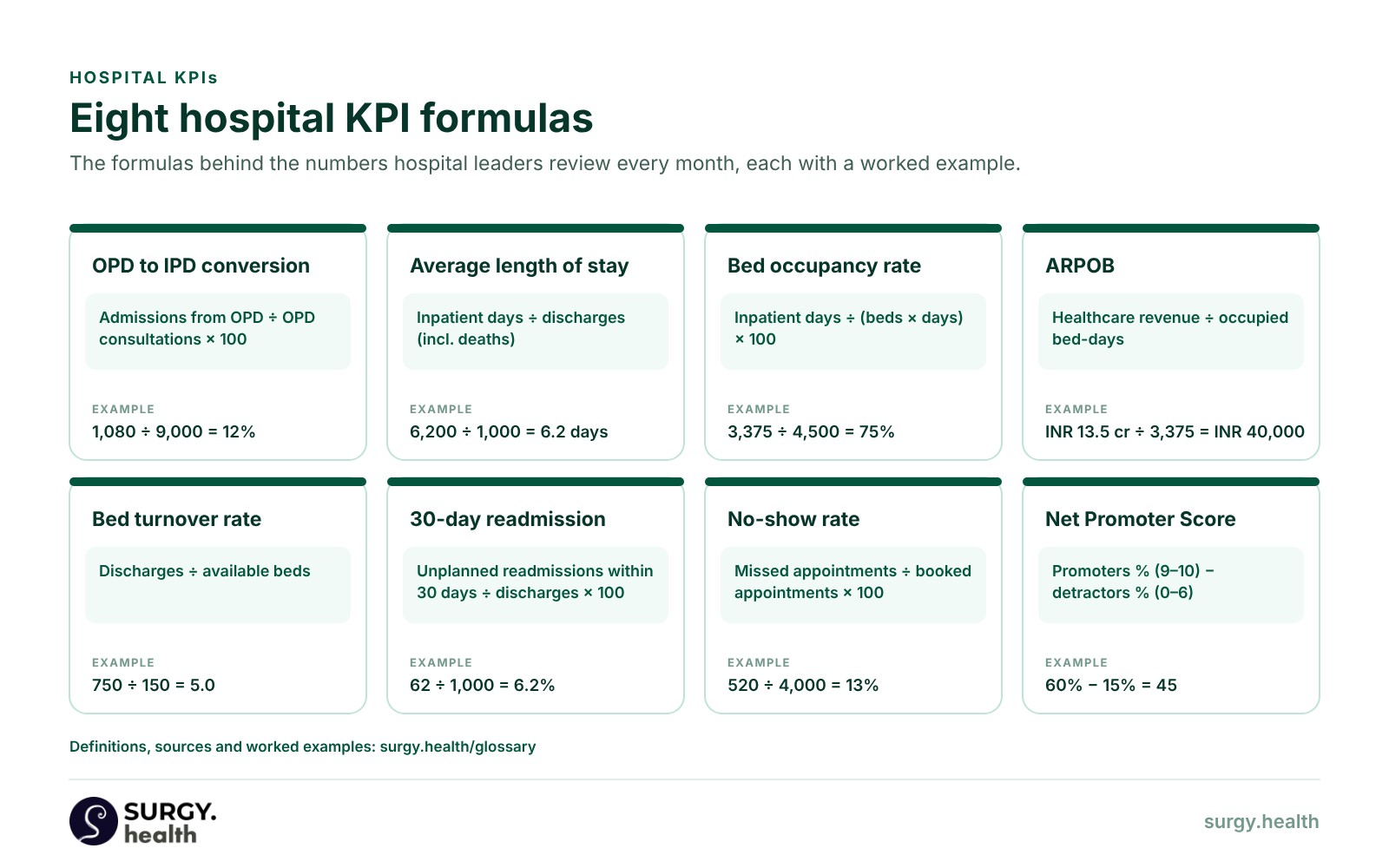
BTR = (discharges (including deaths)) ÷ (available beds)
Turnover interval (days) = (available bed-days − inpatient days) ÷ (discharges)
Worked example
| Input (30 days) | Value |
|---|---|
| Available beds | 150 |
| Discharges including deaths | 750 |
| BTR | 750 ÷ 150 = 5.0 patients per bed |
| Available bed-days − inpatient days | 4,500 − 3,375 = 1,125 |
| Turnover interval | 1,125 ÷ 750 = 1.5 days |
How to read it
High turnover with high occupancy means beds are used well. High turnover with low occupancy means short stays and empty gaps. A long turnover interval points to slow discharge, cleaning or admission processes.